Li Hui, Meng Hua, Yang Yan-Yu, Huang Jia-Xi, Chen Yong-Jie, Yang Fei, Yan Jia-Zhi
Department of Orthopedic Surgery, Beijing Tiantan Hospital, Capital Medical University, Beijing, China.
Institute of Chemistry, Chinese Academy of Science, Beijing; Zhengzhou University, Zhengzhou, Henan Province, China.
Neural Regen Res. 2020 Sep;15(9):1724-1731. doi: 10.4103/1673-5374.276361.
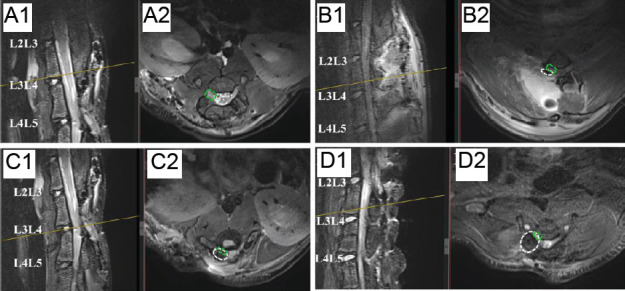
Current animal models of nerve root compression due to lumbar disc herniation only assess the mechanical compression of nerve roots and the inflammatory response. Moreover, the pressure applied in these models is static, meaning that the nerve root cannot be dynamically compressed. This is very different from the pathogenesis of lumbar disc herniation. In this study, a chitosan/polyacrylamide double-network hydrogel was prepared by a simple two-step method. The swelling ratio of the double-network hydrogel increased with prolonged time, reaching 140. The compressive strength and compressive modulus of the hydrogel reached 53.6 and 0.34 MPa, respectively. Scanning electron microscopy revealed the hydrogel's crosslinked structure with many interconnecting pores. An MTT assay demonstrated that the number of viable cells in contact with the hydrogel extracts did not significantly change relative to the control surface. Thus, the hydrogel had good biocompatibility. Finally, the double-network hydrogel was used to compress the L4 nerve root of male sand rats to simulate lumbar disc herniation nerve root compression. The hydrogel remained in its original position after compression, and swelled with increasing time. Edema appeared around the nerve root and disappeared 3 weeks after operation. This chitosan/polyacrylamide double-network hydrogel has potential as a new implant material for animal models of lumbar nerve root compression. All animal experiments were approved by the Animal Ethics Committee of Neurosurgical Institute of Beijing, Capital Medical University, China (approval No. 201601006) on July 29, 2016.
目前,腰椎间盘突出症导致神经根受压的动物模型仅评估神经根的机械压迫和炎症反应。此外,这些模型中施加的压力是静态的,这意味着神经根无法受到动态压迫。这与腰椎间盘突出症的发病机制有很大不同。在本研究中,通过简单的两步法制备了壳聚糖/聚丙烯酰胺双网络水凝胶。双网络水凝胶的溶胀率随时间延长而增加,达到140。水凝胶的抗压强度和压缩模量分别达到53.6和0.34MPa。扫描电子显微镜揭示了水凝胶具有许多相互连通孔隙的交联结构。MTT分析表明,与水凝胶提取物接触的活细胞数量相对于对照表面没有显著变化。因此,该水凝胶具有良好的生物相容性。最后,使用双网络水凝胶对雄性沙鼠的L4神经根进行压迫,以模拟腰椎间盘突出症神经根受压。压迫后水凝胶保持在其原始位置,并随时间增加而肿胀。神经根周围出现水肿,并在术后3周消失。这种壳聚糖/聚丙烯酰胺双网络水凝胶有潜力作为腰椎神经根受压动物模型的新型植入材料。所有动物实验于2016年7月29日获得中国首都医科大学附属北京天坛医院神经外科研究所动物伦理委员会批准(批准号:201601006)。