Department of Oncological Endocrinology, Medical University of Lodz, 90-752 Lodz, Poland.
Polish Mother's Memorial Hospital-Research Institute, 93-338 Lodz, Poland.
Int J Environ Res Public Health. 2020 Mar 23;17(6):2122. doi: 10.3390/ijerph17062122.
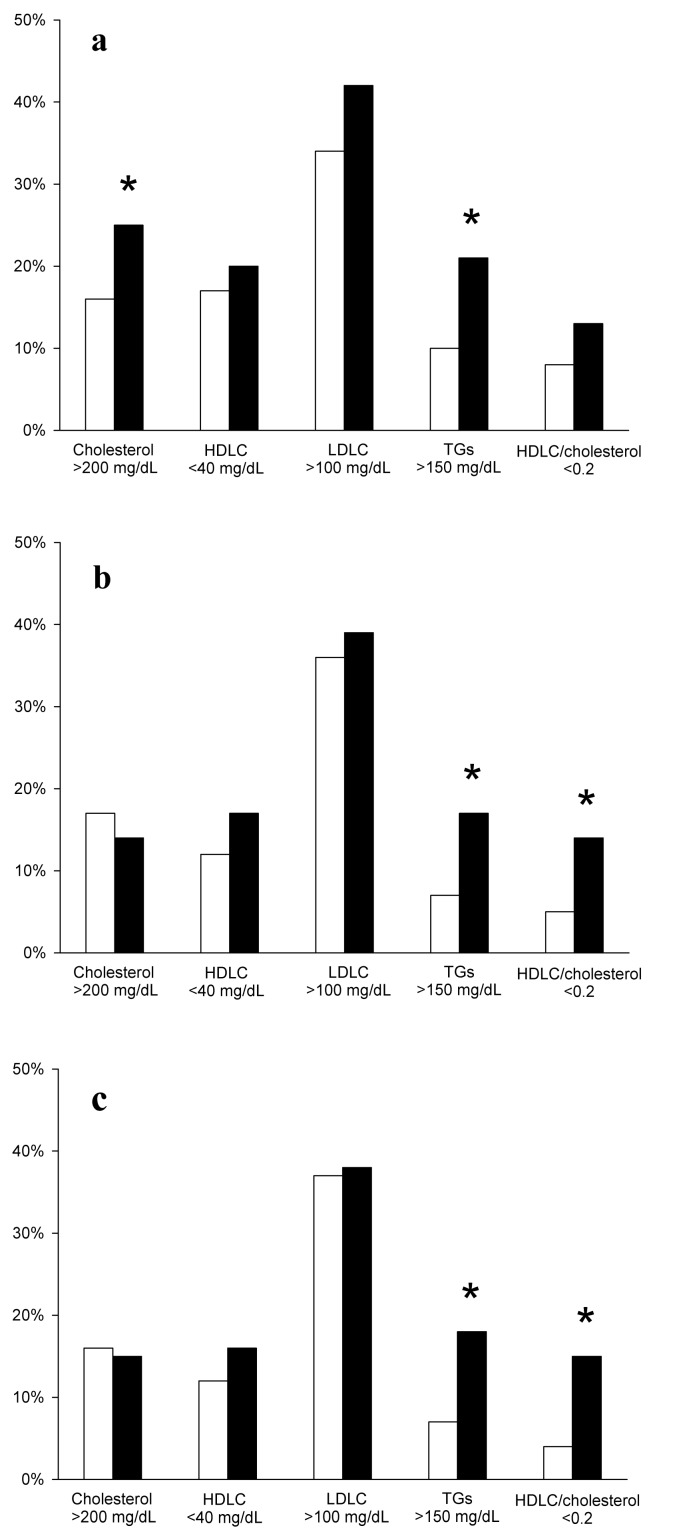
High-normal TSH can be associated with metabolic abnormalities and infertility. Aims of this study are to analyze retrospectively if routinely measured blood laboratory and anthropometric parameters differ between women of reproductive age with TSH < 2.5 mIU/L and with TSH ≥ 2.5 mIU/L. Retrospective analysis was performed in 466 female inpatients, aged 13-51, hospitalized in an endocrine department. The group of 280 patients with normal thyroid tests (TSH 0.27-4.2 mIU/L; normal FT3 and FT4) was selected and it was divided into two subgroups, i.e., with TSH < 2.5 mIU/L and TSH ≥ 2.5 mIU/L (n = 66; 23.6%). After excluding patients on L-thyroxine treatment (n = 240), those with TSH ≥ 2.5 mIU/L constituted 22.92% (n = 55). In the group of 280 patients with normal thyroid tests, an abnormally high concentration of triglycerides and an abnormally low HDLC/cholesterol ratio occurred more frequently in women with TSH ≥ 2.5 mIU/L than those with TSH < 2.5 mIU/L (17% vs. 7%, = 0.017; 14% vs. 5%, = 0.015, respectively). Increased concentration of thyroid antibodies, i.e., TPOAb, occurred more frequently in patients with TSH ≥ 2.5 mIU/L than those with TSH < 2.5 mIU/L (27% vs. 9%, = 0.001). The same differences were found in the group of 240 patients after excluding those on L-thyroxine treatment. Blood lymphocyte concentration was the only independent linear parameter associated with TSH ≥ 2.5 mIU/L (OR = 1.551, = 0.024) but only in the group of 280 patients with normal thyroid tests. TSH concentration correlated positively with blood lymphocyte (r = 0.129, = 0.031) and TPOAb (r = 0.177, = 0.005) concentrations but only in the group of 280 patients with normal thyroid tests. Less favorable lipid profiles and a higher prevalence of thyroid antibodies in women of reproductive age with high-normal TSH suggests that L-thyroxine treatment should be considered in such patients. The significance of a positive association between high-normal TSH and blood lymphocytes requires further evaluation.
高正常 TSH 可与代谢异常和不孕有关。本研究的目的是回顾性分析 TSH<2.5mIU/L 和 TSH≥2.5mIU/L 的育龄妇女之间常规测量的血液实验室和人体测量参数是否存在差异。对 466 名年龄在 13-51 岁之间的内分泌科住院女性患者进行了回顾性分析。选择了 280 例甲状腺功能正常(TSH0.27-4.2mIU/L;正常 FT3 和 FT4)的患者,并将其分为两组,即 TSH<2.5mIU/L 和 TSH≥2.5mIU/L(n=66;23.6%)。排除接受 L-甲状腺素治疗的患者(n=240)后,TSH≥2.5mIU/L 的患者构成比为 22.92%(n=55)。在 280 例甲状腺功能正常的患者中,TSH≥2.5mIU/L 的患者血甘油三酯浓度升高和 HDLC/胆固醇比值降低的发生率高于 TSH<2.5mIU/L 的患者(17%比 7%, =0.017;14%比 5%, =0.015)。TSH≥2.5mIU/L 的患者甲状腺抗体(TPOAb)浓度升高的发生率高于 TSH<2.5mIU/L 的患者(27%比 9%, =0.001)。排除接受 L-甲状腺素治疗的患者后,在 240 例患者中也发现了相同的差异。只有在甲状腺功能正常的 280 例患者中,血淋巴细胞浓度是与 TSH≥2.5mIU/L 相关的唯一独立线性参数(OR=1.551, =0.024)。TSH 浓度与血淋巴细胞(r=0.129, =0.031)和 TPOAb(r=0.177, =0.005)浓度呈正相关,但仅在甲状腺功能正常的 280 例患者中存在这种相关性。高正常 TSH 的育龄妇女血脂状况较差,甲状腺抗体阳性率较高,提示此类患者应考虑给予 L-甲状腺素治疗。高正常 TSH 与血淋巴细胞呈正相关的意义需要进一步评估。