Faculty of Electronics, Telecommunications and Informatics, Gdańsk University of Technology, 80-233 Gdańsk, Poland.
Sensors (Basel). 2020 Mar 23;20(6):1783. doi: 10.3390/s20061783.
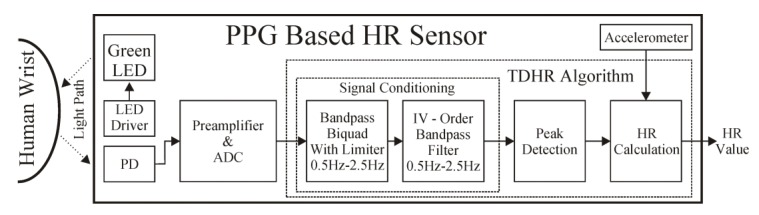
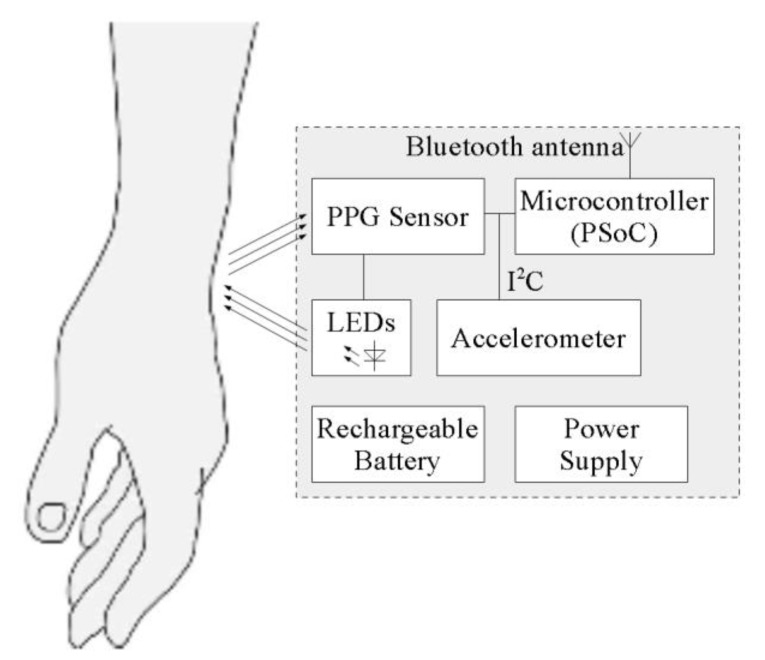
This paper presents an algorithm for the measurement of the human heart rate, using photoplethysmography (PPG), i.e., the detection of the light at the skin surface. The signal from the PPG sensor is processed in time-domain; the peaks in the preprocessed and conditioned PPG waveform are detected by using a peak detection algorithm to find the heart rate in real time. Apart from the PPG sensor, the accelerometer is also used to detect body movement and to indicate the moments in time, for which the PPG waveform can be unreliable. This paper describes in detail the signal conditioning path and the modified algorithm, and it also gives an example of implementation in a resource-constrained wrist-wearable device. The algorithm was evaluated by using the publicly available PPG-DaLia dataset containing samples collected during real-life activities with a PPG sensor and accelerometer and with an ECG signal as ground truth. The quality of the results is comparable to the other algorithms from the literature, while the required hardware resources are lower, which can be significant for wearable applications.
本文提出了一种使用光电容积脉搏波描记法(PPG)测量人体心率的算法,即检测皮肤表面的光。PPG 传感器的信号在时域中进行处理;通过使用峰值检测算法检测预处理和调节后的 PPG 波形中的峰值,以实时找到心率。除了 PPG 传感器,加速度计也用于检测身体运动,并指示 PPG 波形不可靠的时间点。本文详细描述了信号调理路径和修改后的算法,并给出了在资源受限的腕戴式设备中实现的示例。该算法通过使用公开的 PPG-DaLia 数据集进行评估,该数据集包含使用 PPG 传感器和加速度计以及 ECG 信号作为基准在真实生活活动中采集的样本。结果的质量与文献中的其他算法相当,而所需的硬件资源较低,这对于可穿戴应用可能具有重要意义。