Exploratory Science Center, Merck & Co., Inc., Cambridge, Massachusetts, USA.
Sci Rep. 2020 Mar 24;10(1):5321. doi: 10.1038/s41598-020-62139-z.
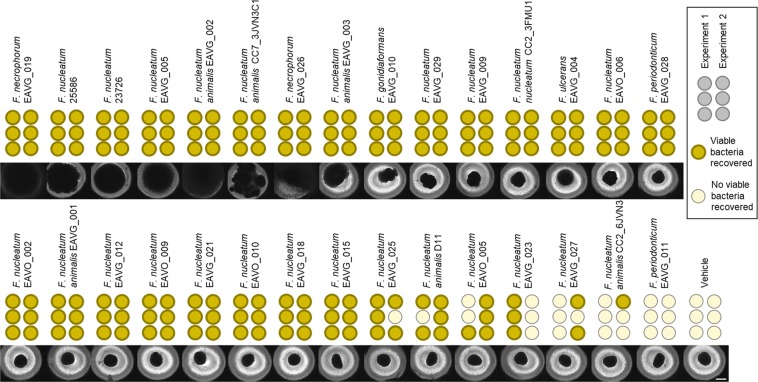
Recent reports show that colorectal tumors contain microbiota that are distinct from those that reside in a 'normal' colon environment, and that these microbiota can contribute to cancer progression. Fusobacterium nucleatum is the most commonly observed species in the colorectal tumor microenvironment and reportedly influences disease progression through numerous mechanisms. However, a detailed understanding of the role of this organism in cancer progression is limited, in part due to challenges in maintaining F. nucleatum viability under standard aerobic cell culture conditions. Herein we describe the development of a 3-dimensional (3D) tumor spheroid model that can harbor and promote the growth of anaerobic bacteria. Bacteria-tumor cell interactions and metabolic crosstalk were extensively studied by measuring the kinetics of bacterial growth, cell morphology and lysis, cancer-related gene expression, and metabolomics. We observed that viable F. nucleatum assembles biofilm-like structures in the tumor spheroid microenvironment, whereas heat-killed F. nucleatum is internalized and sequestered in the cancer cells. Lastly, we use the model to co-culture 28 Fusobacterium clinical isolates and demonstrate that the model successfully supports co-culture with diverse fusobacterial species. This bacteria-spheroid co-culture model enables mechanistic investigation of the role of anaerobic bacteria in the tumor microenvironment.
最近的报告表明,结直肠肿瘤中存在的微生物群与“正常”结肠环境中的微生物群不同,这些微生物群可能有助于癌症的进展。具核梭杆菌是结直肠肿瘤微环境中最常观察到的物种,据报道,它通过多种机制影响疾病的进展。然而,由于在标准有氧细胞培养条件下维持具核梭杆菌活力的挑战,该生物体在癌症进展中的作用的详细理解是有限的。在此,我们描述了一种能够容纳和促进厌氧菌生长的 3 维(3D)肿瘤球体模型的开发。通过测量细菌生长、细胞形态和裂解、与癌症相关的基因表达和代谢组学的动力学,广泛研究了细菌-肿瘤细胞相互作用和代谢串扰。我们观察到,在肿瘤球体微环境中,存活的具核梭杆菌组装成类似生物膜的结构,而热灭活的具核梭杆菌则被内化并隔离在癌细胞中。最后,我们使用该模型共培养 28 株梭杆菌临床分离株,并证明该模型成功地支持与多种梭杆菌物种的共培养。这种细菌-球体共培养模型能够对厌氧菌在肿瘤微环境中的作用进行机制研究。