Yu Ya-Nan, Yu Ta-Chung, Zhao Hui-Jun, Sun Tian-Tian, Chen Hui-Min, Chen Hao-Yan, An Hui-Fang, Weng Yu-Rong, Yu Jun, Li Min, Qin Wen-Xin, Ma Xiong, Shen Nan, Hong Jie, Fang Jing-Yuan
State Key Laboratory of Oncogenes and Related Genes, Division of Gastroenterology and Hepatology, Renji Hospital, School of Medicine, Shanghai Jiaotong University, Shanghai Cancer Institute, Shanghai Institute of Digestive Disease, Shanghai, China.
Department of Gastroenterology, The Affiliated Hospital of Qingdao University, Qingdao, Shandong Province, China.
Oncotarget. 2015 Oct 13;6(31):32013-26. doi: 10.18632/oncotarget.5166.
Accumulating evidence links colorectal cancer (CRC) with the intestinal microbiota. However, the disturbance of intestinal microbiota and the role of Fusobacterium nucleatum during the colorectal adenoma-carcinoma sequence have not yet been evaluated.
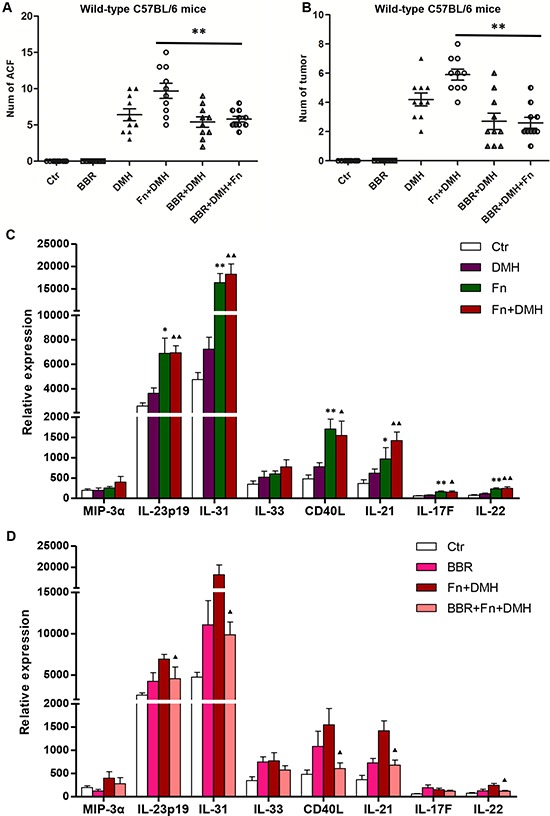
454 FLX pyrosequencing was used to evaluate the disturbance of intestinal microbiota during the adenoma-carcinoma sequence pathway of CRC. Intestinal microbiota and mucosa tumor-immune cytokines were detected in mice after introducing 1,2-dimethylhydrazine (DMH), F. nucleatum or Berberine (BBR), using pyrosequencing and Bio-Plex Pro™ cytokine assays, respectively. Protein expressions were detected by western blotting.
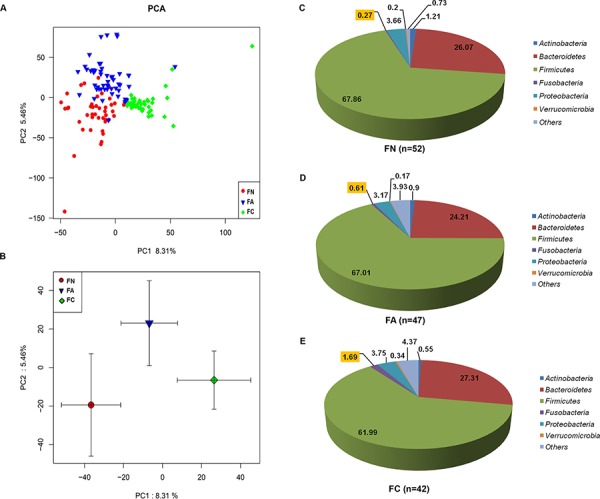
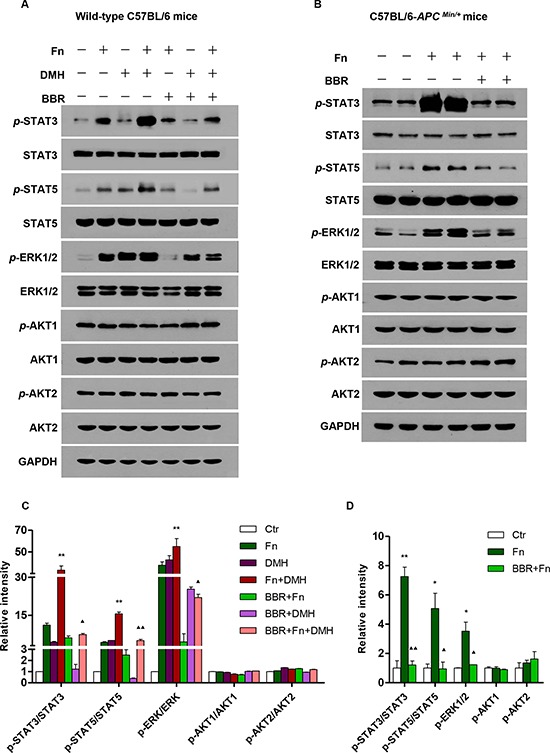
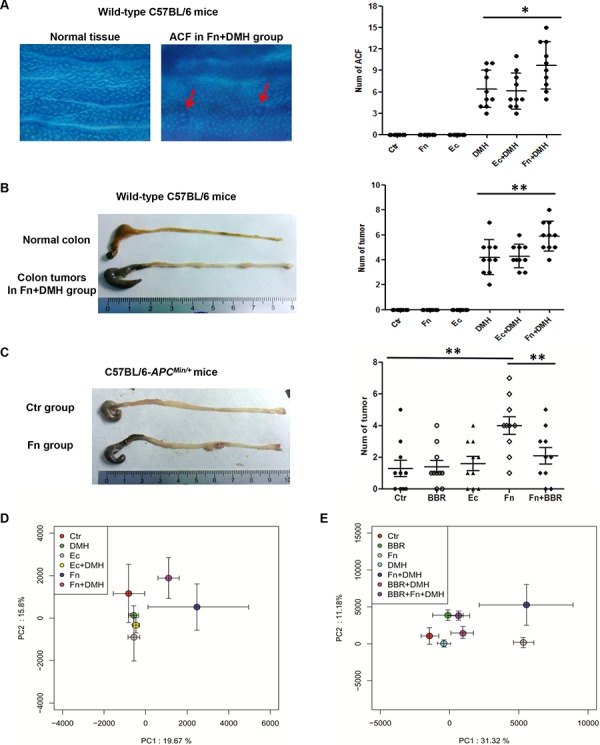
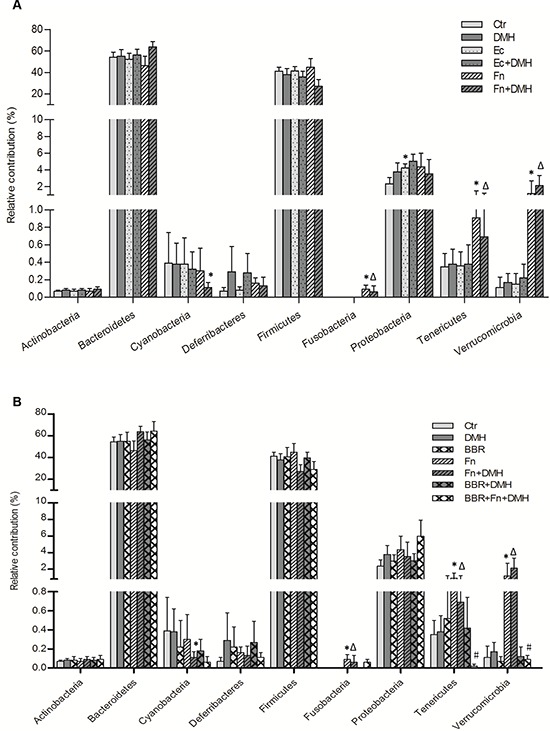
The levels of opportunistic pathogens, such as Fusobacterium, Streptococcus and Enterococcus spp. gradually increased during the colorectal adenoma-carcinoma sequence in human fecal and mucosal samples. F. nucleatum treatment significantly altered lumen microbial structures, with increased Tenericutes and Verrucomicrobia (opportunistic pathogens) (P < 0.05 = in wild-type C57BL/6 and mice with DMH treatment). BBR intervention reversed the F. nucleatum-mediated increase in opportunistic pathogens, and the secretion of IL-21/22/31, CD40L and the expression of p-STAT3, p-STAT5 and p-ERK1/2 in mice, compared with mice fed with F. nucleatum alone.
F. nucleatum colonization in the intestine may prompt colorectal tumorigenesis. BBR could rescue F. nucleatum-induced colorectal tumorigenesis by modulating the tumor microenvironment and blocking the activation of tumorigenesis-related pathways.
越来越多的证据表明结直肠癌(CRC)与肠道微生物群有关。然而,肠道微生物群的紊乱以及具核梭杆菌在结直肠腺瘤-癌序列中的作用尚未得到评估。
采用454 FLX焦磷酸测序技术评估结直肠癌腺瘤-癌序列途径中肠道微生物群的紊乱情况。分别使用焦磷酸测序和Bio-Plex Pro™细胞因子检测法,在给小鼠注射1,2-二甲基肼(DMH)、具核梭杆菌或小檗碱(BBR)后,检测其肠道微生物群和黏膜肿瘤免疫细胞因子。通过蛋白质印迹法检测蛋白质表达。
在人类粪便和黏膜样本的结直肠腺瘤-癌序列过程中,诸如具核梭杆菌、链球菌和肠球菌等机会性病原体的水平逐渐升高。具核梭杆菌处理显著改变了肠腔微生物结构,厚壁菌门和疣微菌门(机会性病原体)增加(在野生型C57BL/6小鼠和接受DMH处理的小鼠中P < 0.05)。与仅喂食具核梭杆菌的小鼠相比,BBR干预逆转了具核梭杆菌介导的机会性病原体增加以及小鼠中IL-21/22/31、CD40L的分泌和p-STAT3、p-STAT5及p-ERK1/2的表达。
具核梭杆菌在肠道中的定植可能促使结直肠癌发生。BBR可通过调节肿瘤微环境和阻断肿瘤发生相关途径的激活来挽救具核梭杆菌诱导的结直肠癌发生。