The HIV Netherlands Australia Thailand Research Collaboration (HIV-NAT), Thai Red Cross AIDS Research Centre, Bangkok, Thailand.
Division of Endocrinology and Metabolism, Department of Medicine, and Hormonal and Metabolic Disorders Research Unit, Faculty of Medicine, Chulalongkorn University, Bangkok, Thailand.
PLoS One. 2020 Mar 25;15(3):e0230368. doi: 10.1371/journal.pone.0230368. eCollection 2020.
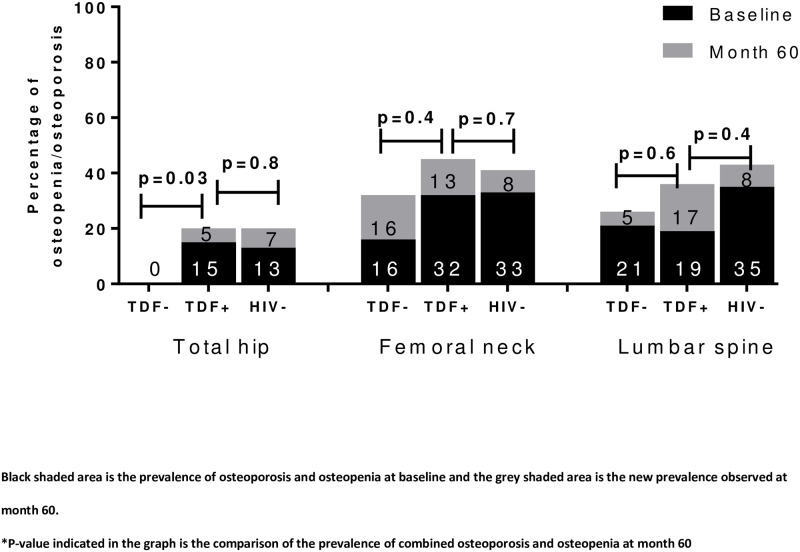
There are limited data regarding long-term BMD changes over time among treatment-naïve people living with HIV (PLHIV) after initiating combined antiretroviral therapy (cART) in Asia. We aimed to study bone mineral density (BMD) changes among treatment-naïve PLHIV started treatment with tenofovir disoproxil fumarate (TDF)- or non-TDF-containing regimen and HIV-uninfected controls in an Asian setting. The study was a five-year prospective study. BMD at lumbar spine (LS) (L1 to L4), total hip (TH), and femoral neck (FN) were measured by dual energy X-ray absorptiometry (DEXA) scans at baseline, months 12, 24 and 60. Multivariate logistic regression models were used to explore factors associated with mean BMD ≥5% reduction after 5 years of cART. A total of 106 PLHIV (75 and 31 started TDF- and non-TDF-containing regimen, respectively) and 66 HIV-uninfected individuals were enrolled. The mean percent changes of BMD were significantly different longitudinally between TDF and non-TDF users (p<0.001 for LS, p = 0.006 for TH and p = 0.02 for FN). HIV-positive status and on TDF-containing regimen was independently associated with BMD loss ≥5% at month 60 (adjusted odds ratio [aOR] 7.0, 95% confidence interval [95%CI] 2.3-21.0, P = 0.001 for LS; aOR 4.9, 95%CI 1.7-14.3, P = 0.003 for TH and aOR 4.3, 95%CI 1.6-11.2, P = 0.003 for FN) compared to HIV-uninfected individuals. In a multivariate model for PLHIV only, TDF use (vs. non-TDF, P = 0.005) and pre-treatment CD4+ count <350 cells/mm3 (vs. ≥350 cells/mm3, P = 0.02) were independently associated with ≥5% BMD loss in TH at month 60. Treatment-naïve PLHIV initiating treatment with TDF-containing regimen have higher BMD loss in a Thai cohort. TDF use and low pre-treatment CD4 count were independently associated with BMD loss at month 60 at TH. Earlier treatment initiation and interventions to prevent bone loss could improve skeletal health among PLHIV. Clinicaltrials.gov: NCT01634607.
在亚洲,开始联合抗逆转录病毒疗法 (cART) 治疗后,初治 HIV 感染者 (PLHIV) 的骨密度 (BMD) 随时间的长期变化数据有限。我们旨在研究在亚洲环境中,使用替诺福韦二吡呋酯 (TDF) 或非 TDF 方案治疗的初治 PLHIV 和未感染 HIV 的对照组中,BMD 的变化。该研究是一项为期五年的前瞻性研究。基线、第 12、24 和 60 个月时,使用双能 X 线吸收仪 (DEXA) 扫描测量腰椎 (LS) (L1 至 L4)、全髋 (TH) 和股骨颈 (FN) 的 BMD。使用多变量逻辑回归模型探索 5 年后 cART 后平均 BMD 降低≥5%的相关因素。共纳入 106 名 PLHIV(分别有 75 名和 31 名开始使用 TDF 和非 TDF 方案)和 66 名未感染 HIV 的个体。TDF 和非 TDF 使用者的 BMD 百分比变化在纵向差异具有统计学意义(LS 差异有统计学意义,p<0.001;TH 差异有统计学意义,p=0.006;FN 差异有统计学意义,p=0.02)。HIV 阳性状态和 TDF 方案与第 60 个月时 BMD 丢失≥5%独立相关(LS 的调整优势比[aOR]7.0,95%置信区间[95%CI]2.3-21.0,P=0.001;TH 的 aOR 4.9,95%CI 1.7-14.3,P=0.003;FN 的 aOR 4.3,95%CI 1.6-11.2,P=0.003),与未感染 HIV 的个体相比。仅在 PLHIV 的多变量模型中,与非 TDF 方案相比,使用 TDF(P=0.005)和治疗前 CD4+计数<350 个细胞/mm3(P=0.02)与第 60 个月时 TH 的 BMD 丢失≥5%独立相关。在泰国队列中,初治 PLHIV 开始使用 TDF 方案治疗时,BMD 丢失更高。TDF 治疗和治疗前低 CD4 计数与第 60 个月时 TH 的 BMD 丢失独立相关。早期治疗开始和预防骨质流失的干预措施可能会改善 PLHIV 的骨骼健康。Clinicaltrials.gov:NCT01634607。