Paredes-Montero Jorge R, Zia-Ur-Rehman Muhammad, Hameed Usman, Haider Muhammad Saleem, Herrmann Hans-Werner, Brown Judith K
School of Plant Sciences University of Arizona Tucson AZ USA.
Facultad de Ciencias de la Vida Escuela Superior Politécnica del Litoral (ESPOL) Guayaquil Ecuador.
Ecol Evol. 2020 Feb 12;10(6):2928-2943. doi: 10.1002/ece3.6107. eCollection 2020 Mar.
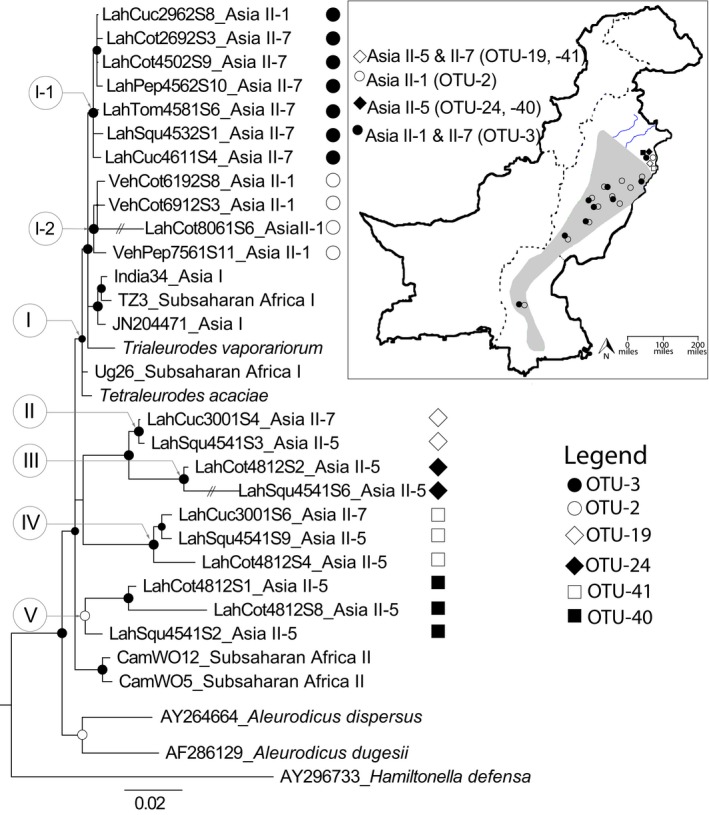
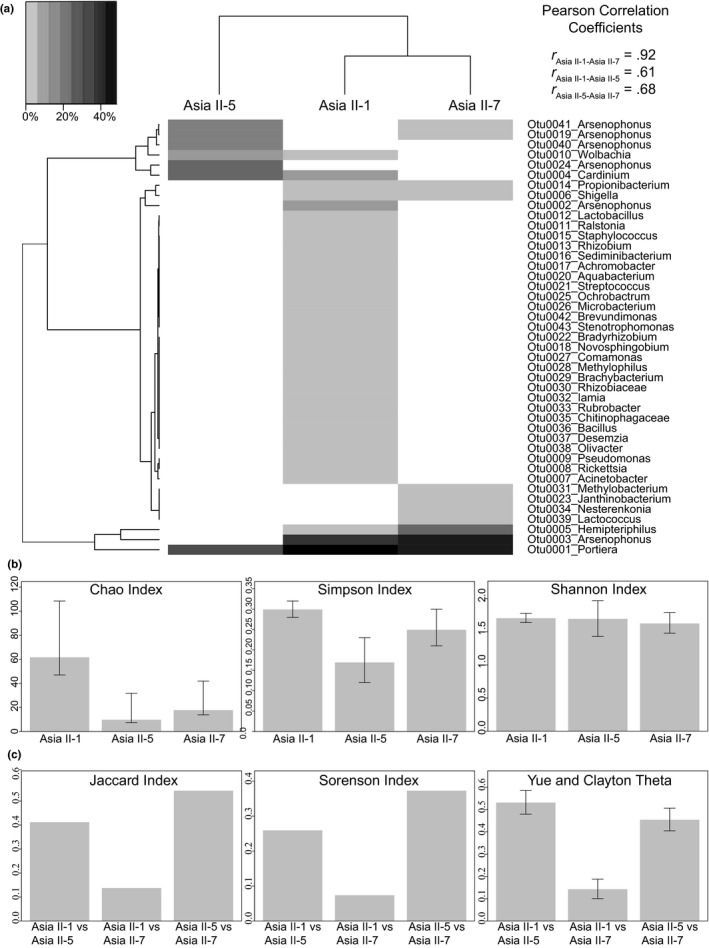
Endosymbionts associated with the whitefly cryptic species are known to contribute to host fitness and environmental adaptation. The genetic diversity and population complexity were investigated for endosymbiont communities of occupying different micro-environments in Pakistan. Mitotypes of were identified by comparative sequence analysis of the mitochondria cytochrome oxidase I (mt) gene sequence. Whitefly mitotypes belonged to the Asia II-1, -5, and -7 mitotypes of the Asia II major clade. The whitefly-endosymbiont communities were characterized based on 16S ribosomal RNA operational taxonomic unit (OTU) assignments, resulting in 43 OTUs. Most of the OTUs occurred in the Asia II-1 and II-7 mitotypes ( = .9, < .005), while the Asia II-5 microbiome was less complex. The microbiome OTU groups were mitotype-specific, clustering with a basis in phylogeographical distribution and the corresponding ecological niche of their whitefly host, suggesting mitotype-microbiome co-adaptation. The primary endosymbiont was represented by a single, highly homologous OTU (0%-0.67% divergence). Two of six OTUs were uniquely associated with Asia II-5 and -7, and one occurred exclusively in Asia II-1, two only in Asia II-5, and one in both Asia II-1 and -7. Four other secondary endosymbionts, , , , and OTUs, were found at ≤29% frequencies. The most prevalent OTU was found in all three Asia II mitotypes (55% frequency), whereas the same strain of and was found in both Asia II-1 and -5, and a single OTU occurred in Asia II-1 and -7. This pattern is indicative of horizontal transfer, suggestive of a proximity between mitotypes sufficient for gene flow at overlapping mitotype ecological niches.
与粉虱隐性物种相关的内共生体已知有助于宿主的适应性和环境适应。对巴基斯坦占据不同微环境的粉虱内共生体群落的遗传多样性和种群复杂性进行了研究。通过线粒体细胞色素氧化酶I(mt)基因序列的比较序列分析确定了粉虱的线粒体类型。粉虱线粒体类型属于亚洲II主要分支的亚洲II-1、-5和-7线粒体类型。基于16S核糖体RNA操作分类单元(OTU)分类对粉虱-内共生体群落进行了表征,共得到43个OTU。大多数OTU出现在亚洲II-1和II-7线粒体类型中(F = 0.9,P < 0.005),而亚洲II-5微生物群落的复杂性较低。微生物群落OTU组具有线粒体类型特异性,根据其粉虱宿主的系统地理分布和相应生态位进行聚类,表明线粒体类型-微生物群落共同适应。主要内共生体由一个高度同源的单一OTU代表(差异为0%-0.67%)。六个Hamiltonella OTU中的两个与亚洲II-5和-7独特相关,一个仅出现在亚洲II-1中,两个仅出现在亚洲II-5中,一个同时出现在亚洲II-1和-7中。另外四个次生内共生体,即Arsenophonus、Cardinium、Rickettsia OTU,出现频率≤29%。最普遍的Rickettsia OTU在所有三种亚洲II线粒体类型中均有发现(频率为55%),而相同菌株的Arsenophonus和Cardinium在亚洲II-1和-5中均有发现,单个Rickettsia OTU出现在亚洲II-1和-7中。这种模式表明存在水平转移,暗示在重叠的线粒体类型生态位中,线粒体类型之间的距离足以实现基因流动。