Canfield Michael, Savoy Lawrence, Cote Mark P, Halawi Mohamad J
Department of Orthopaedic Surgery, University Connecticut Health Center, Farmington, CT, USA.
Arthroplast Today. 2019 Nov 25;6(1):62-67. doi: 10.1016/j.artd.2019.10.003. eCollection 2020 Mar.
The purpose of this study was to determine the optimal window for collection of patient-reported outcome measures (PROMs) after total joint arthroplasty (TJA).
Our prospectively collected institutional joint registry was queried for patients who underwent primary, unilateral TJAs. The primary outcomes were the net changes in WOMAC, SF-12 MCS, SF-12 PCS, OHS, KSCRS, and UCLA activity rating system at 6, 12, and 24 months postoperatively. Secondary outcomes were data acquisition costs and follow-up attrition rates.
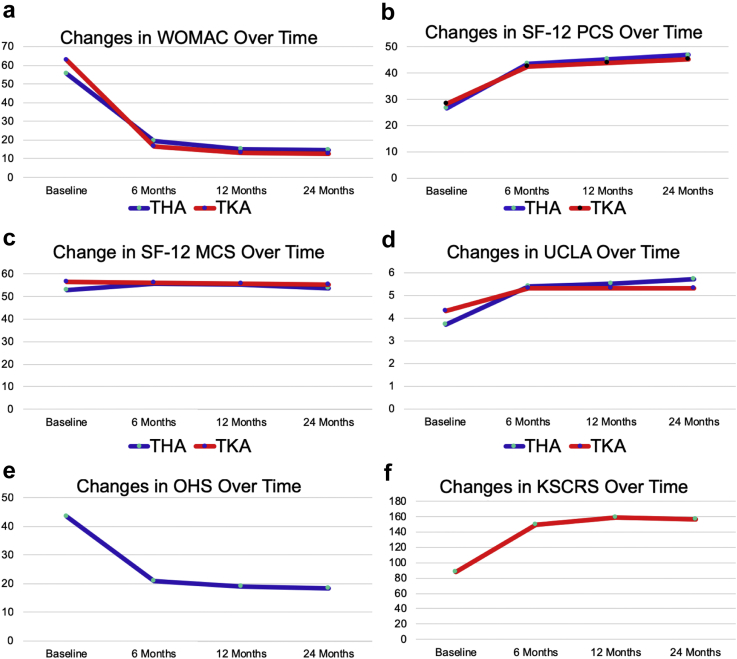
Eight hundred sixty-six procedures (450 total hip arthroplasties, 416 TKAs) were analyzed. A consistent plateau in all PROMs was noted by 6 months postoperatively-except for SF-12 MCS which showed no significant changes at any time interval. For TKA, the percentage of overall improvement achieved by 6 months was 88.7%, 84.5%, 100%, and 90.5% for the WOMAC, SF-12 PCS, UCLA, and KSCRS, respectively. For total hip arthroplasty, these values were 92.7%, 83.5%, 88.0%, and 89.8% for WOMAC, SF-12 PCS, UCLA, and OHS, respectively. There were marginal improvements from 6 to 12 months and no improvement from 12 to 24 months. Follow-up rates at 6, 12, and 24 months were 85%, 69%, and 40%, respectively. Our institutional costs for collecting a complete data set per patient were $128, $158, and $272 for 6, 12, and 24 months, respectively.
Most of the improvement in PROMs after primary TJA occurs within the first 6 months. In addition, limiting PROMs collection to 6 months appears to be cost-efficient owing to increased attrition rates beyond this time interval.
本研究的目的是确定全关节置换术(TJA)后患者报告结局测量(PROMs)的最佳收集窗口。
我们前瞻性收集的机构关节登记处查询了接受初次单侧TJA的患者。主要结局是术后6、12和24个月时WOMAC、SF-12 MCS、SF-12 PCS、OHS、KSCRS和UCLA活动评分系统的净变化。次要结局是数据采集成本和随访失访率。
分析了866例手术(450例全髋关节置换术,416例全膝关节置换术)。术后6个月时所有PROMs均出现一致的平台期——除了SF-12 MCS在任何时间间隔均无显著变化。对于全膝关节置换术,6个月时WOMAC、SF-12 PCS、UCLA和KSCRS总体改善的百分比分别为88.7%、84.5%、100%和90.5%。对于全髋关节置换术,WOMAC、SF-12 PCS、UCLA和OHS的这些值分别为92.7%、83.5%、88.0%和89.8%。6至12个月有轻微改善,12至24个月无改善。6、12和24个月时的随访率分别为85%、69%和40%。我们机构为每位患者收集完整数据集的成本在6、12和24个月时分别为128美元、158美元和272美元。
初次TJA后PROMs的大部分改善发生在最初6个月内。此外,由于在此时间间隔后失访率增加,将PROMs收集限制在6个月似乎具有成本效益。