Hsiue Peter P, Chen Clark J, Villalpando Cristina, Ponzio Danielle, Khoshbin Amir, Stavrakis Alexandra I
Department of Orthopaedic Surgery, David Geffen School of Medicine at the University of California Los Angeles, Los Angeles, CA, USA.
Rothman Institute at Thomas Jefferson University, Egg Harbor Township, NJ, USA.
Arthroplast Today. 2020 Mar 9;6(1):112-117.e1. doi: 10.1016/j.artd.2019.12.009. eCollection 2020 Mar.
Technology-assisted total hip arthroplasty (TA-THA) using either computer-assisted navigation or robotic assistance has become increasingly more popular. The purpose of this study was to examine the trends and patient factors associated with TA-THA.
This is a retrospective review utilizing the National Inpatient Sample, a large national database incorporating inpatient hospitalization information. International Classification of Diseases, 9th Revision codes were used to identify patients with hip osteoarthritis who underwent primary total hip arthroplasty (THA). Patients were then separated into those who underwent TA-THA or conventional THA. Outcomes of interest included annual TA-THA utilization; patient and hospital characteristics associated with TA-THA; and trends for length of stay (LOS), cost, and discharge to home.
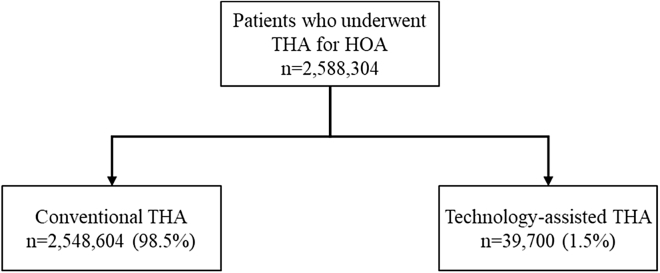
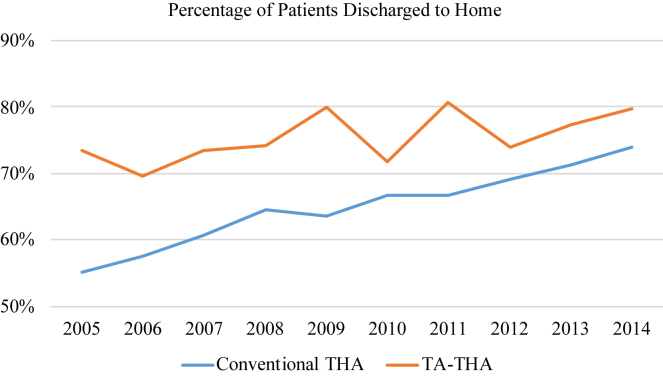
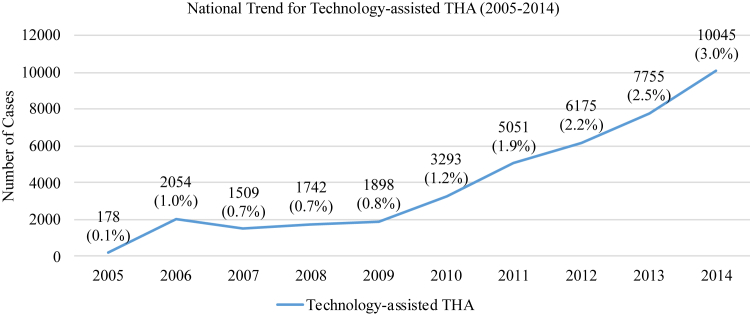
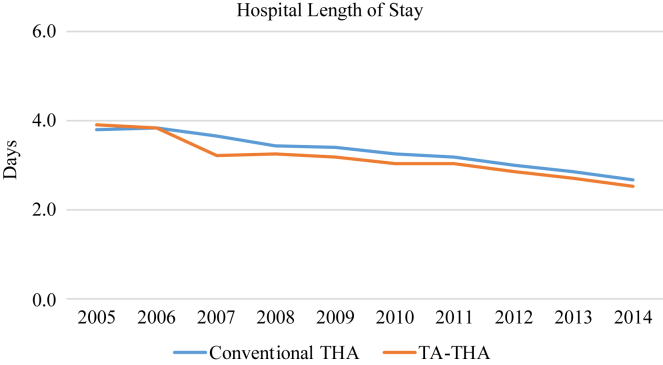
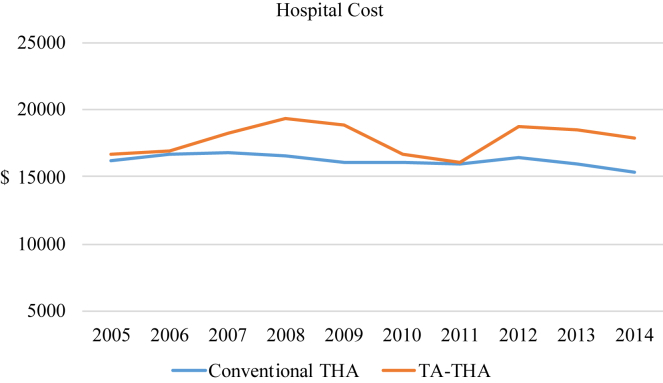
From 2005 to 2014, a total of 2,588,304 patients with hip osteoarthritis who underwent THA were identified in the National Inpatient Sample database. Of those, 39,700 (1.5%) underwent TA-THA. The number of TA-THA procedures increased from 178 (0.1% of all THA) in 2005 to 10,045 (3.0% of all THA) in 2014, which represented a 30-fold increase in incidence (-trend <.0001). TA-THA was associated with Hispanic race, higher patient income, and the Western region of the United States. During the study period, there was a trend toward decreased LOS and increased discharge to home for both TA-THA and conventional THA. TA-THA was associated with higher inpatient cost.
TA-THA is being increasingly used in the United States and is associated with specific patient factors. However, the value of TA-THA compared to conventional THA remains unclear and should be assessed with future research.
III (retrospective cohort study).
使用计算机辅助导航或机器人辅助的技术辅助全髋关节置换术(TA-THA)越来越受欢迎。本研究的目的是研究与TA-THA相关的趋势和患者因素。
这是一项利用国家住院样本进行的回顾性研究,国家住院样本是一个包含住院患者住院信息的大型国家级数据库。使用国际疾病分类第九版编码来识别接受初次全髋关节置换术(THA)的髋骨关节炎患者。然后将患者分为接受TA-THA或传统THA的患者。感兴趣的结果包括年度TA-THA利用率;与TA-THA相关的患者和医院特征;以及住院时间(LOS)、费用和出院回家的趋势。
2005年至2014年期间,在国家住院样本数据库中确定了总共2588304例接受THA的髋骨关节炎患者。其中,39700例(1.5%)接受了TA-THA。TA-THA手术数量从2005年的178例(占所有THA的0.1%)增加到2014年的10045例(占所有THA的3.0%),发病率增加了30倍(-趋势<.0001)。TA-THA与西班牙裔种族、患者收入较高以及美国西部地区相关。在研究期间,TA-THA和传统THA的住院时间都有缩短的趋势,出院回家的比例都有增加的趋势。TA-THA与住院费用较高相关。
TA-THA在美国的使用越来越多,并且与特定的患者因素相关。然而,与传统THA相比,TA-THA的价值仍不明确,应通过未来的研究进行评估。
III(回顾性队列研究)。