Tormoen Garth W, Crittenden Marka R, Gough Michael J
Department of Radiation Medicine, Oregon Health & Science University, Portland, OR 97239, U.S.A.
Earle A. Chiles Research Institute, Robert W. Franz Cancer Center, Providence Portland Medical Center, 4805 NE Glisan St, Portland, OR 97213, U.S.A.
Emerg Top Life Sci. 2017 Dec;1(5):493-500. doi: 10.1042/etls20170066. Epub 2017 Dec 12.
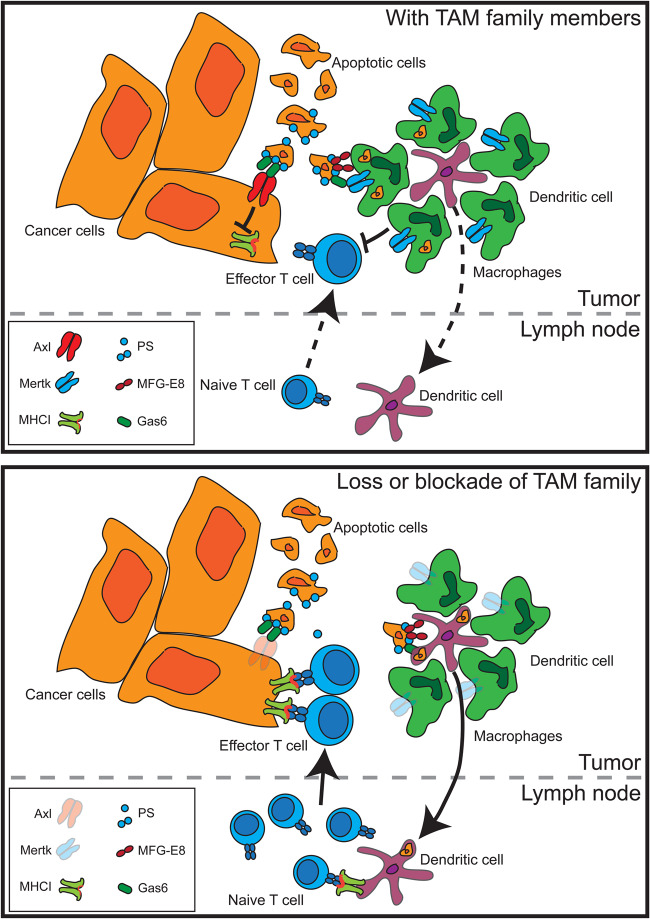
Radiation therapy is primarily a modality to kill cancer cells in the treatment field. It is becoming increasingly clear that radiation therapy can also be used to direct immune responses that have the potential to clear residual local or distant disease outside the treatment field. We believe that cancer cell death is the critical link between these processes. Understanding the handling of dying cancer cells by immune cells in the tumor environment is crucial to facilitate immune responses following radiation therapy. We review the role of the TAM (yro3 xl ertk) group of receptor tyrosine kinases and their role following radiation-induced cancer cell death in the tumor environment.
放射治疗主要是一种在治疗区域杀死癌细胞的方法。越来越清楚的是,放射治疗还可用于引导免疫反应,这些免疫反应有可能清除治疗区域外残留的局部或远处疾病。我们认为癌细胞死亡是这些过程之间的关键联系。了解肿瘤环境中免疫细胞对垂死癌细胞的处理方式对于促进放射治疗后的免疫反应至关重要。我们综述了受体酪氨酸激酶TAM(yro3 xl ertk)组的作用及其在肿瘤环境中辐射诱导癌细胞死亡后的作用。 (注:原文中“yro3 xl ertk”可能有误,不太明确准确含义)