Boo Gianluca, Darin Edith, Thomson Dana R, Tatem Andrew J
WorldPop, School of Geography and Environmental Science, University of Southampton, Southampton, SO17 1BJ, UK.
Department of Social Statistics and Demography, University of Southampton, Southampton, SO17 1BJ, UK.
Gates Open Res. 2020 Jan 27;4:13. doi: 10.12688/gatesopenres.13107.1. eCollection 2020.
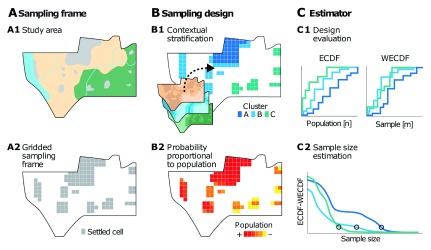
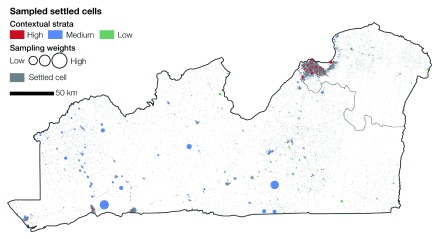
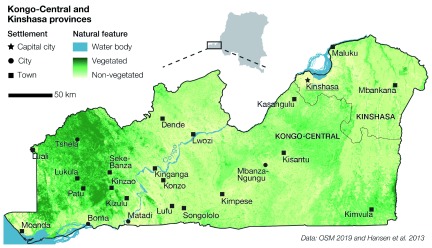
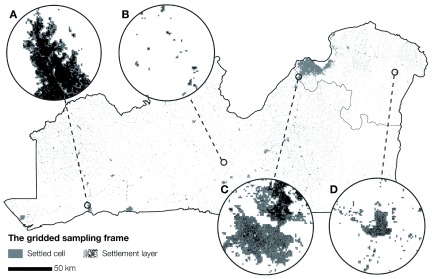
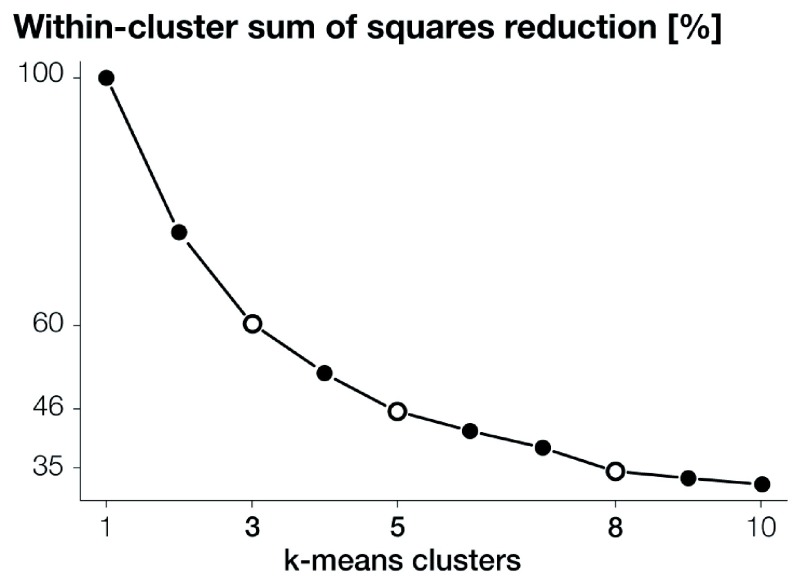
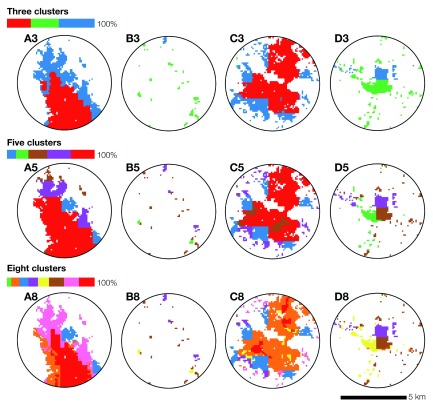
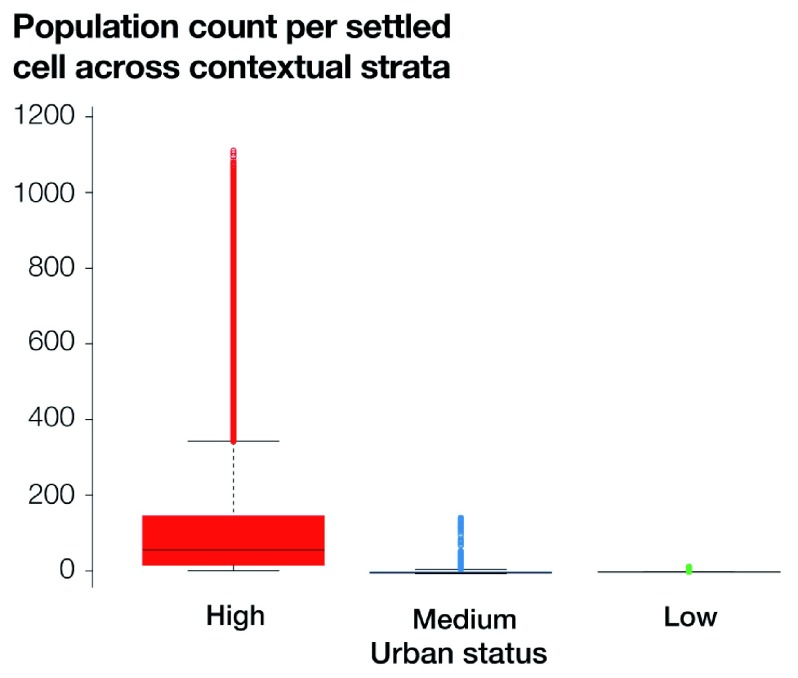
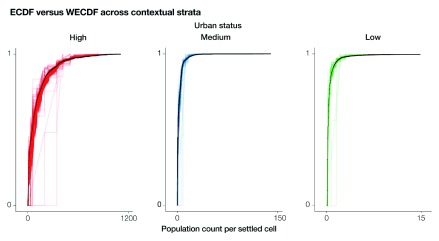
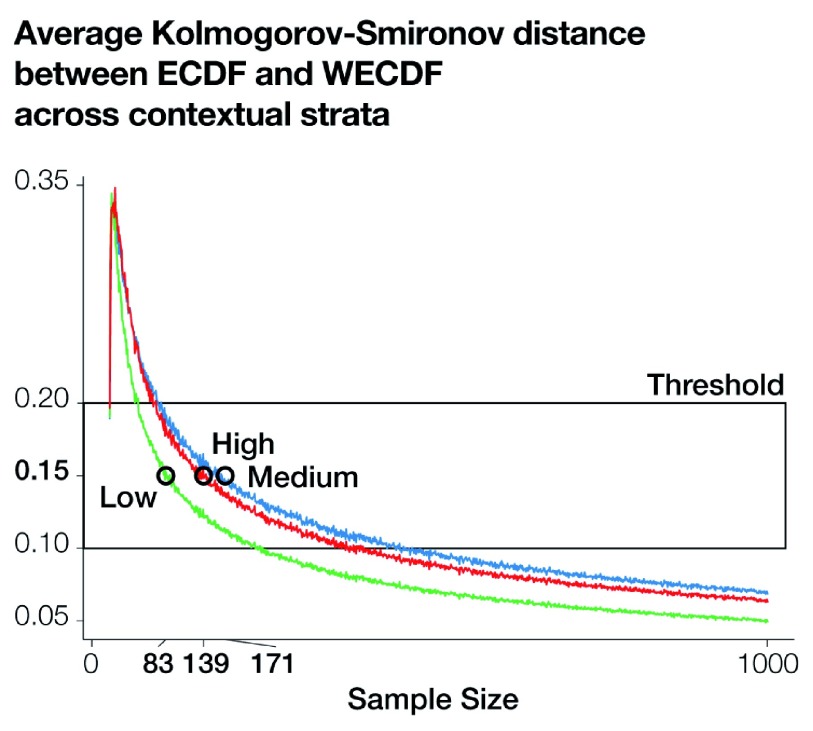
Traditional sample designs for household surveys are contingent upon the availability of a representative primary sampling frame. This is defined using enumeration units and population counts retrieved from decennial national censuses that can become rapidly inaccurate in highly dynamic demographic settings. To tackle the need for representative sampling frames, we propose an original grid-based sample design framework introducing essential concepts of spatial sampling in household surveys. In this framework, the sampling frame is defined based on gridded population estimates and formalized as a bi-dimensional random field, characterized by spatial trends, spatial autocorrelation, and stratification. The sampling design reflects the characteristics of the random field by combining contextual stratification and proportional to population size sampling. A nonparametric estimator is applied to evaluate the sampling design and inform sample size estimation. We demonstrate an application of the proposed framework through a case study developed in two provinces located in the western part of the Democratic Republic of the Congo. We define a sampling frame consisting of settled cells with associated population estimates. We then perform a contextual stratification by applying a principal component analysis (PCA) and -means clustering to a set of gridded geospatial covariates, and sample settled cells proportionally to population size. Lastly, we evaluate the sampling design by contrasting the empirical cumulative distribution function for the entire population of interest and its weighted counterpart across different sample sizes and identify an adequate sample size using the Kolmogorov-Smirnov distance between the two functions. The results of the case study underscore the strengths and limitations of the proposed grid-based sample design framework and foster further research into the application of spatial sampling concepts in household surveys.
传统的住户调查样本设计取决于是否有具有代表性的初级抽样框。这是通过从十年一次的全国人口普查中获取的枚举单位和人口计数来定义的,而在人口动态变化很大的情况下,这些信息可能很快就会不准确。为了满足对具有代表性的抽样框的需求,我们提出了一个基于网格的原创样本设计框架,引入了住户调查中空间抽样的基本概念。在这个框架中,抽样框是基于网格化的人口估计来定义的,并被形式化为一个二维随机场,其特征是空间趋势、空间自相关性和分层。抽样设计通过结合上下文分层和按人口规模成比例抽样来反映随机场的特征。应用非参数估计器来评估抽样设计并为样本量估计提供信息。我们通过在刚果民主共和国西部的两个省份开展的案例研究展示了所提出框架的应用。我们定义了一个由定居单元及其相关人口估计组成的抽样框。然后,我们通过对一组网格化的地理空间协变量进行主成分分析(PCA)和K均值聚类来进行上下文分层,并按人口规模对定居单元进行抽样。最后,我们通过对比感兴趣的整个人口的经验累积分布函数及其在不同样本量下的加权对应函数来评估抽样设计,并使用这两个函数之间的柯尔莫哥洛夫-斯米尔诺夫距离来确定合适的样本量。案例研究的结果强调了所提出的基于网格的样本设计框架的优势和局限性,并促进了对空间抽样概念在住户调查中的应用的进一步研究。