Weise Friederike, Vieth Michael, Reinhold Dirk, Haybaeck Johannes, Goni Elisabetta, Lippert Hans, Ridwelski Karsten, Lingohr Philipp, Schildberg Claus, Vassos Nikolaos, Kruschewski Martin, Krasniuk Iurii, Grimminger Peter P, Waidmann Oliver, Peitz Ulrich, Veits Lothar, Kreuser Nicole, Lang Hauke, Bruns Christiane, Moehler Markus, Lordick Florian, Gockel Ines, Schumacher Johannes, Malfertheiner Peter, Venerito Marino
Department of Gastroenterology, Hepatology and Infectious Diseases, Otto-von-Guericke University Hospital, Magdeburg, Germany.
Institute of Pathology, Klinikum Bayreuth, Bayreuth, Germany.
United European Gastroenterol J. 2020 Mar;8(2):175-184. doi: 10.1177/2050640619891580. Epub 2019 Nov 26.
Patients with autoimmune gastritis (AIG) are reported to have an increased risk of developing gastric cancer (GC). In this study, we assess the characteristics and outcomes of GC patients with AIG in a multicenter case-control study.
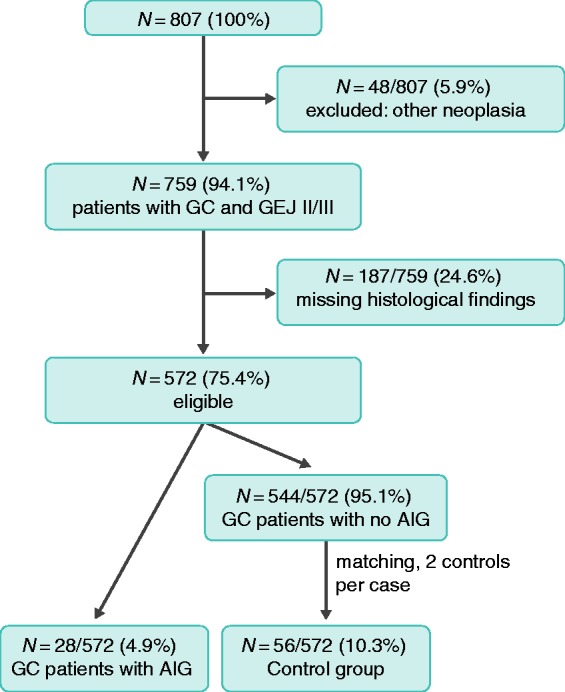
Between April 2013 and May 2017, patients with GC, including cancers of the esophagogastric junction (EGJ) Siewert type II and III, were recruited. Patients with histological characteristics of AIG were identified and matched in a 1:2 fashion for age and gender to GC patients with no AIG. Presenting symptoms were documented using a self-administered questionnaire.
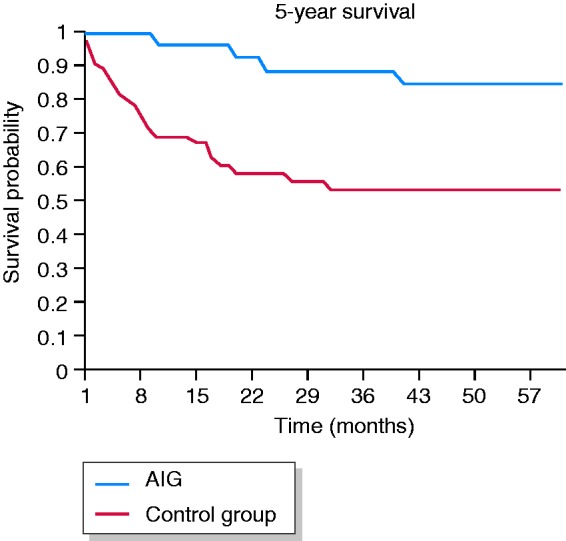
Histological assessment of gastric mucosa was available for 572/759 GC patients. Overall, 28 (4.9%) of GC patients had AIG (67 ± 9 years, female-to-male ratio 1.3:1). In patients with AIG, GC was more likely to be localized in the proximal (i.e. EGJ, fundus, corpus) stomach (odds ratio (OR) 2.7, 95% confidence interval (CI) 1.0-7.1). In GC patients with AIG, pernicious anemia was the leading clinical sign (OR 22.0, 95% CI 2.6-187.2), and the most common indication for esophagogastroduodenoscopy (OR 29.0, 95% CI 7.2-116.4). GC patients with AIG were more likely to present without distant metastases (OR 6.2, 95% CI 1.3-28.8) and to be treated with curative intention (OR 3.0, 95% CI 1.0-9.0). The five-year survival rates with 95% CI in GC patients with and with no AIG were 84.7% (83.8-85.6) and 53.5% (50.9-56.1), respectively (OR 0.25, 95% CI 0.08-0.75, = 0.001).
Pernicious anemia leads to earlier diagnosis of GC in AIG patients and contributes significantly to a better clinical outcome.
据报道,自身免疫性胃炎(AIG)患者患胃癌(GC)的风险增加。在本多中心病例对照研究中,我们评估了AIG相关GC患者的特征和预后。
2013年4月至2017年5月期间,招募了GC患者,包括食管胃交界(EGJ)Siewert II型和III型癌患者。识别出具有AIG组织学特征的患者,并按年龄和性别以1:2的比例与无AIG的GC患者进行匹配。使用自行填写的问卷记录患者的症状表现。
759例GC患者中有572例可进行胃黏膜组织学评估。总体而言,28例(4.9%)GC患者患有AIG(67±9岁,女性与男性比例为1.3:1)。在AIG患者中,GC更可能局限于胃近端(即EGJ、胃底、胃体)(比值比(OR)2.7,95%置信区间(CI)1.0 - 7.1)。在AIG相关GC患者中,恶性贫血是主要临床体征(OR 22.0,95% CI 2.6 - 187.2),也是食管胃十二指肠镜检查最常见的指征(OR 29.0,95% CI 7.2 - 116.4)。AIG相关GC患者更可能无远处转移(OR 6.2,95% CI 1.3 - 28.8)且接受根治性治疗(OR 3.0,95% CI