Hou Yi-Chou, Fan Yu-Ming, Huang Ya-Ching, Chen Ruei-Ming, Wang Cheng-Hsu, Lin Yi-Te, Yen Tzung-Hai, Lu Kuo-Cheng, Lin Yuh-Feng
Graduate Institute of Clinical Medicine, College of Medicine, Taipei Medical University, Taipei 110, Taiwan.
Department of Internal Medicine, Cardinal Tien Hospital, New Taipei City 231,Taiwan.
J Clin Med. 2020 Mar 24;9(3):889. doi: 10.3390/jcm9030889.
Rationales: Restless leg syndrome (RLS) is a common complication in patients with end-stage renal disease (ESRD). However, there is a lack of biomarkers linking uremic RLS to dopaminergic neurons. Previous studies demonstrated that Tc-99m TRODAT-1 SPECT was a biomarker for RLS but the correlation between the physiologic parameter was lacking.
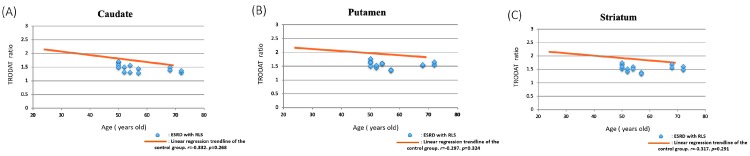
Overall, 32 patients were enrolled in the study and divided into the following 3 groups: (1) control ( = 13), (2) ESRD without RLS ( = 8) and (3) ESRD with RLS ( = 11). All patients had a clinical diagnosis of RLS and received Tc-99m TRODAT-1 SPECT. A subgroup analysis was performed to compare differences between the control and ESRD with RLS groups. Tc-99m TRODAT-1 SPECT was performed and activities in the striatum and occipital areas were measured using manually delineated regions of interest (ROIs) by an experienced nuclear medicine radiologist who was blinded to clinical data.
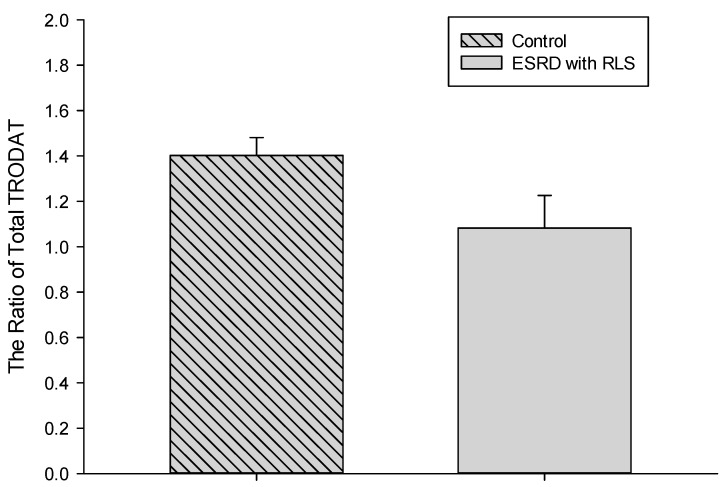
The total ratio of Tc-99m TRODAT SPECT was lower in the ESRD with RLS group ( = 0.046). The uptake ratio of TRODAT negatively correlated with serum parathyroid hormone ( = -0.577, = 0.015) and ferritin ( = -0.464, = 0.039) concentrations. However, the uptake positively correlated with the hemoglobin concentration ( = 0.531, = 0.011). The sensitivity and specificity of the total TRODAT ratio for predicting RLS in the overall population were 95.0% and 67.7%, respectively, at a cutoff value of 0.980 (area under the curve of receiver operating characteristic curve was 0.767, = 0.024).
In patients with ESRD and RLS, Tc-99m TRODAT might be a potential biomarker. Dysregulated hemoglobin, serum parathyroid hormone and serum ferritin concentrations might influence the uptake of the TRODAT ratio.
理论依据:不宁腿综合征(RLS)是终末期肾病(ESRD)患者的常见并发症。然而,缺乏将尿毒症性RLS与多巴胺能神经元联系起来的生物标志物。先前的研究表明,Tc-99m TRODAT-1单光子发射计算机断层扫描(SPECT)是RLS的一种生物标志物,但缺乏生理参数之间的相关性。
本研究共纳入32例患者,分为以下3组:(1)对照组(n = 13),(2)无RLS的ESRD组(n = 8)和(3)有RLS的ESRD组(n = 11)。所有患者均有RLS的临床诊断并接受了Tc-99m TRODAT-1 SPECT检查。进行亚组分析以比较对照组和有RLS的ESRD组之间的差异。进行了Tc-99m TRODAT-1 SPECT检查,并由一位对临床数据不知情的经验丰富的核医学放射科医生使用手动勾勒的感兴趣区域(ROI)测量纹状体和枕叶区域的活性。
有RLS的ESRD组中Tc-99m TRODAT SPECT的总比值较低(P = 0.046)。TRODAT的摄取比值与血清甲状旁腺激素(r = -0.577,P = 0.015)和铁蛋白(r = -0.464,P = 0.039)浓度呈负相关。然而,摄取与血红蛋白浓度呈正相关(r = 0.531,P = 0.011)。在总体人群中,总TRODAT比值预测RLS的敏感性和特异性分别为95.0%和67.7%,临界值为0.980(受试者操作特征曲线下面积为0.767,P = 0.024)。
在患有ESRD和RLS的患者中,Tc-99m TRODAT可能是一种潜在的生物标志物。血红蛋白、血清甲状旁腺激素和血清铁蛋白浓度失调可能会影响TRODAT比值的摄取。