Moing Annick, Allwood J William, Aharoni Asaph, Baker John, Beale Michael H, Ben-Dor Shifra, Biais Benoît, Brigante Federico, Burger Yosef, Deborde Catherine, Erban Alexander, Faigenboim Adi, Gur Amit, Goodacre Royston, Hansen Thomas H, Jacob Daniel, Katzir Nurit, Kopka Joachim, Lewinsohn Efraim, Maucourt Mickael, Meir Sagit, Miller Sonia, Mumm Roland, Oren Elad, Paris Harry S, Rogachev Ilana, Rolin Dominique, Saar Uzi, Schjoerring Jan K, Tadmor Yaakov, Tzuri Galil, de Vos Ric C H, Ward Jane L, Yeselson Elena, Hall Robert D, Schaffer Arthur A
INRAE, Univ. Bordeaux, UMR1332 Fruit Biology and Pathology, Bordeaux Metabolome Facility MetaboHUB, Centre INRAE de Nouvelle Aquitaine - Bordeaux, 33140 Villenave d'Ornon, France.
The James Hutton Institute, Environmental & Biochemical Sciences, Invergowrie, Dundee, DD2 5DA Scotland, UK.
Metabolites. 2020 Mar 24;10(3):121. doi: 10.3390/metabo10030121.
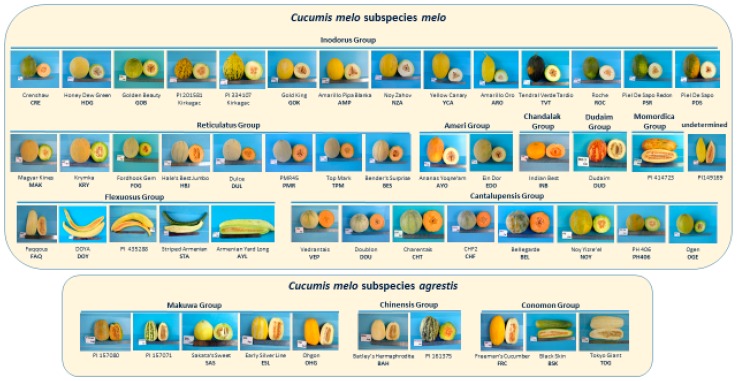
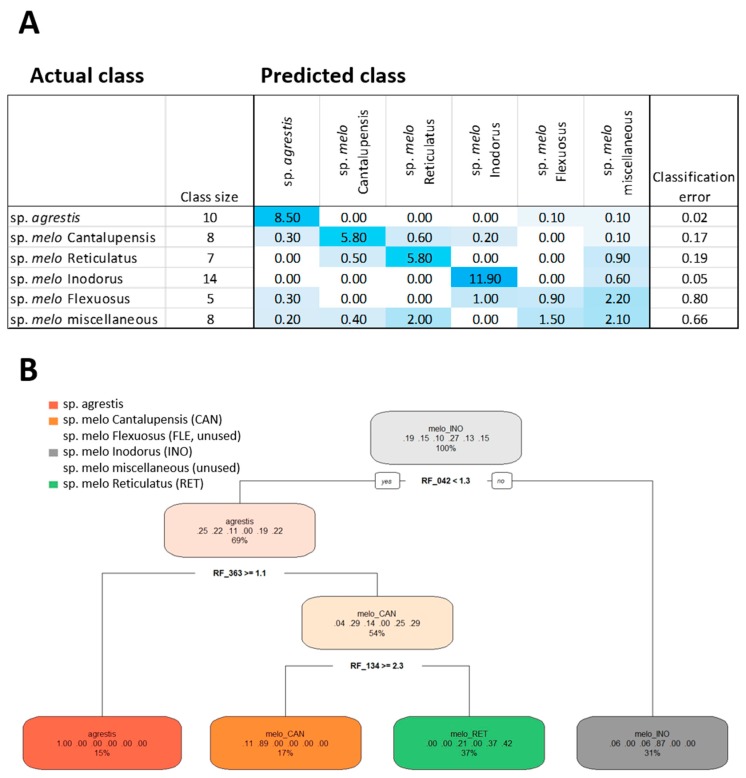
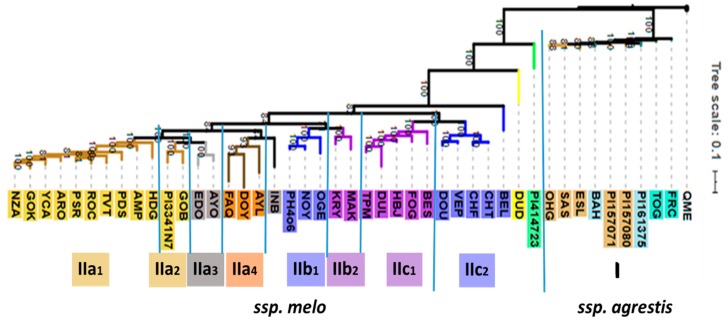
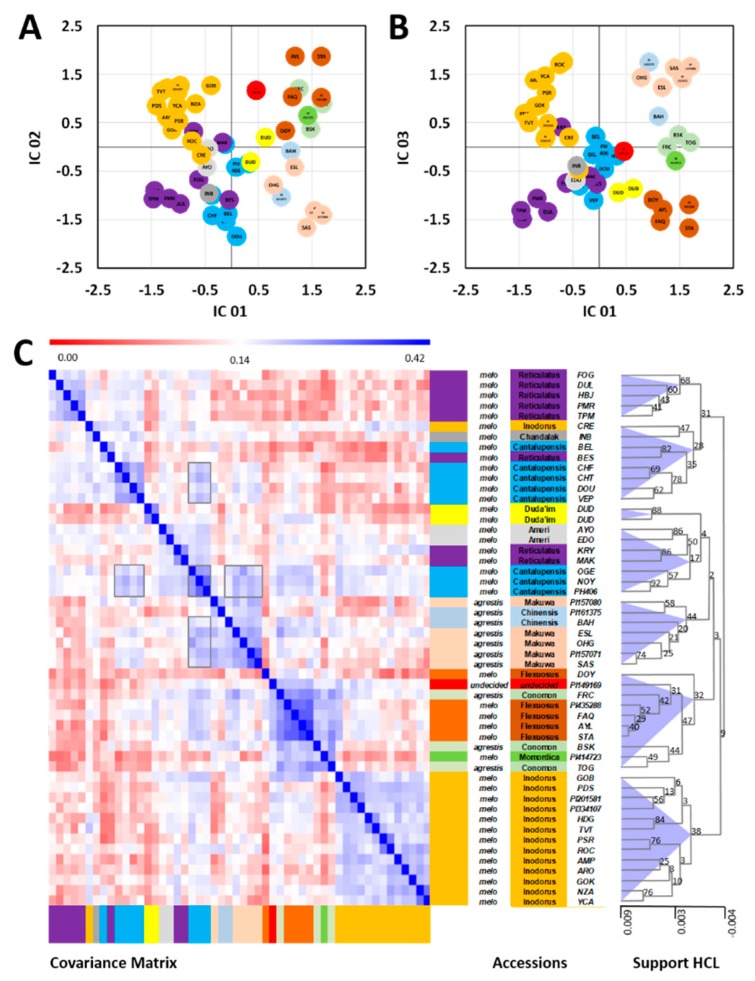
The broad variability of (melon, Cucurbitaceae) presents a challenge to conventional classification and organization within the species. To shed further light on the infraspecific relationships within , we compared genotypic and metabolomic similarities among 44 accessions representative of most of the cultivar-groups. Genotyping-by-sequencing (GBS) provided over 20,000 single-nucleotide polymorphisms (SNPs). Metabolomics data of the mature fruit flesh and rind provided over 80,000 metabolomic and elemental features via an orchestra of six complementary metabolomic platforms. These technologies probed polar, semi-polar, and non-polar metabolite fractions as well as a set of mineral elements and included both flavor- and taste-relevant volatile and non-volatile metabolites. Together these results enabled an estimate of "metabolomic/elemental distance" and its correlation with the genetic GBS distance of melon accessions. This study indicates that extensive and non-targeted metabolomics/elemental characterization produced classifications that strongly, but not completely, reflect the current and extensive genetic classification. Certain melon Groups, such as Inodorous, clustered in parallel with the genetic classifications while other genome to metabolome/element associations proved less clear. We suggest that the combined genomic, metabolic, and element data reflect the extensive sexual compatibility among melon accessions and the breeding history that has, for example, targeted metabolic quality traits, such as taste and flavor.
甜瓜(葫芦科)的广泛变异性对该物种内的传统分类和组织提出了挑战。为了进一步阐明甜瓜种下的亲缘关系,我们比较了代表大多数栽培品种组的44份种质的基因型和代谢组相似性。简化基因组测序(GBS)提供了超过20,000个单核苷酸多态性(SNP)。成熟果肉和果皮的代谢组学数据通过六个互补代谢组学平台组合提供了超过80,000个代谢组学和元素特征。这些技术探测了极性、半极性和非极性代谢物组分以及一组矿质元素,包括与风味和口感相关的挥发性和非挥发性代谢物。这些结果共同使得能够估计甜瓜种质的“代谢组学/元素距离”及其与遗传GBS距离的相关性。本研究表明,广泛的非靶向代谢组学/元素表征产生的分类强烈但不完全反映当前广泛的遗传分类。某些甜瓜组,如无香味组,与遗传分类平行聚类,而其他基因组与代谢组/元素的关联则不太清晰。我们认为,基因组、代谢组和元素数据的组合反映了甜瓜种质之间广泛的有性兼容性以及例如针对口感和风味等代谢品质性状的育种历史。