Sakurai Nozomu
Bioinformation and DDBJ Center, National Institute of Genetics, 1111 Yata, Mishima, Shizuoka 411-8540, Japan.
Breed Sci. 2022 Mar;72(1):56-65. doi: 10.1270/jsbbs.21065. Epub 2022 Feb 3.
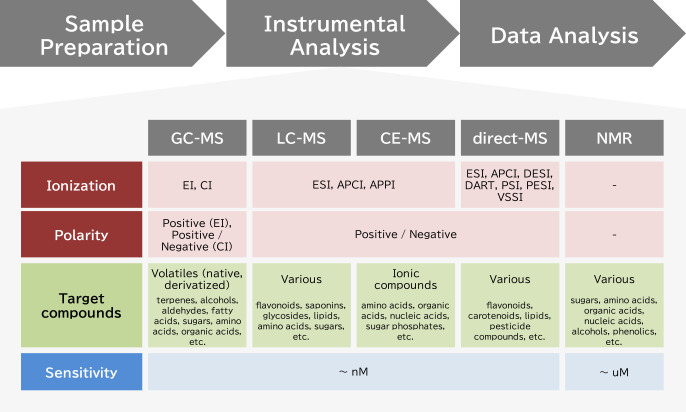
Metabolites play a central role in maintaining organismal life and in defining crop phenotypes, such as nutritional value, fragrance, color, and stress resistance. Among the 'omes' in biology, the metabolome is the closest to the phenotype. Consequently, metabolomics has been applied to crop improvement as method for monitoring changes in chemical compositions, clarifying the mechanisms underlying cellular functions, discovering markers and diagnostics, and phenotyping for mQTL, mGWAS, and metabolite-genome predictions. In this review, 359 reports of the most recent applications of metabolomics to plant breeding-related studies were examined. In addition to the major crops, more than 160 other crops including rare medicinal plants were considered. One bottleneck associated with using metabolomics is the wide array of instruments that are used to obtain data and the ambiguity associated with metabolite identification and quantification. To further the application of metabolomics to plant breeding, the features and perspectives of the technology are discussed.
代谢物在维持生物体生命以及界定作物表型(如营养价值、香气、颜色和抗逆性)方面发挥着核心作用。在生物学的诸多“组学”中,代谢组最接近表型。因此,代谢组学已被应用于作物改良,作为监测化学成分变化、阐明细胞功能潜在机制、发现标记物和诊断方法以及进行代谢物数量性状位点(mQTL)、代谢物全基因组关联研究(mGWAS)和代谢物 - 基因组预测的表型分析的一种方法。在本综述中,研究了359篇关于代谢组学在植物育种相关研究中最新应用的报告。除了主要作物外,还考虑了160多种其他作物,包括珍稀药用植物。与使用代谢组学相关的一个瓶颈是用于获取数据的仪器种类繁多,以及代谢物鉴定和定量存在的不确定性。为了进一步将代谢组学应用于植物育种,本文讨论了该技术的特点和前景。