Department of Biochemistry and Technological Chemistry, Institute of Chemistry, São Paulo State University (UNESP), Araraquara, Brazil.
Department of Clinical Analysis, School of Pharmaceutical Sciences, São Paulo State University (UNESP), Araraquara, Brazil.
PLoS One. 2020 Mar 26;15(3):e0228740. doi: 10.1371/journal.pone.0228740. eCollection 2020.
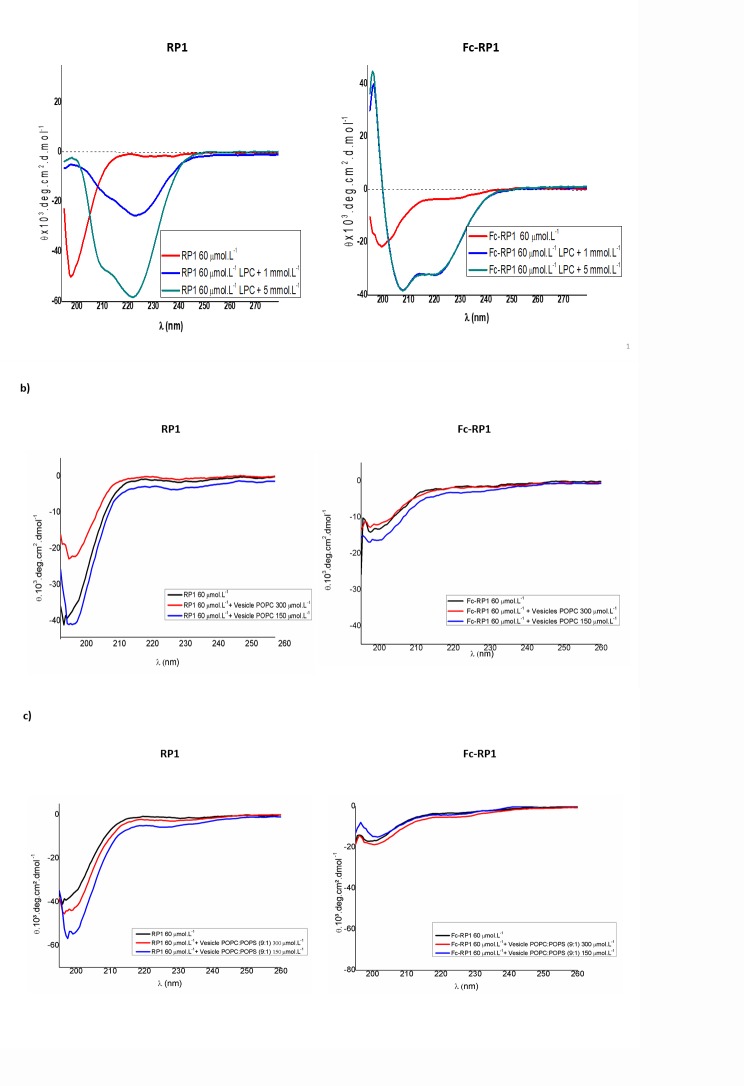
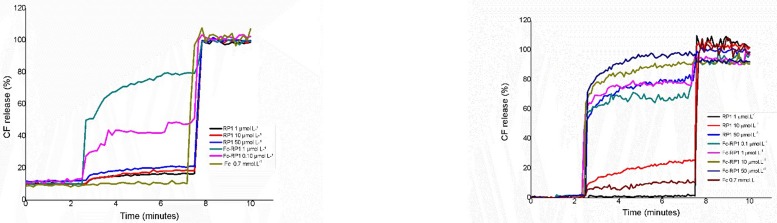
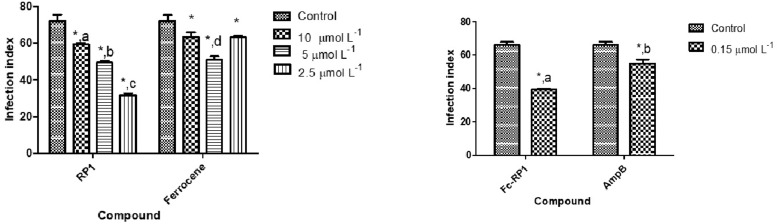
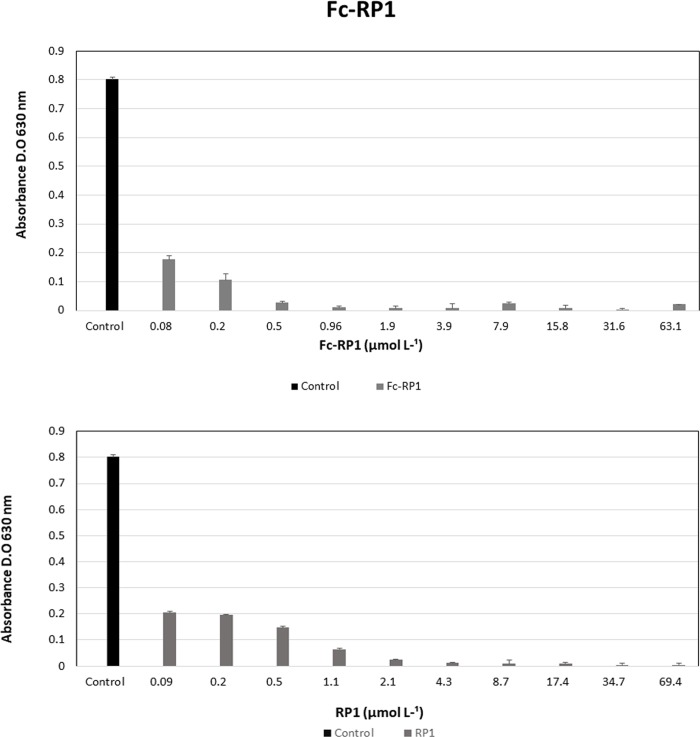
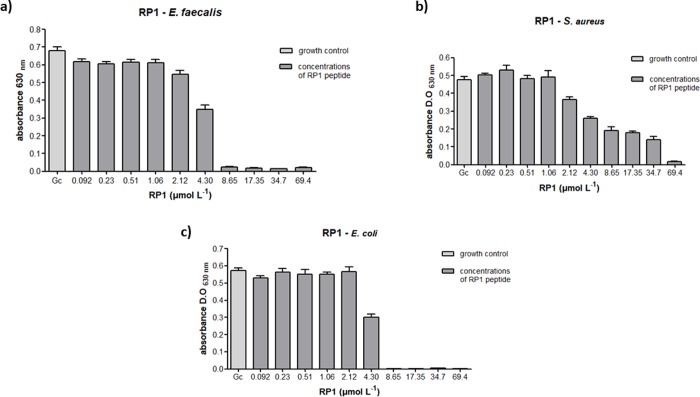
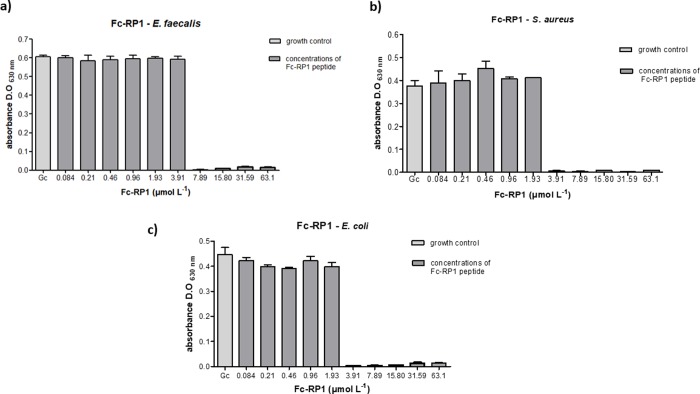
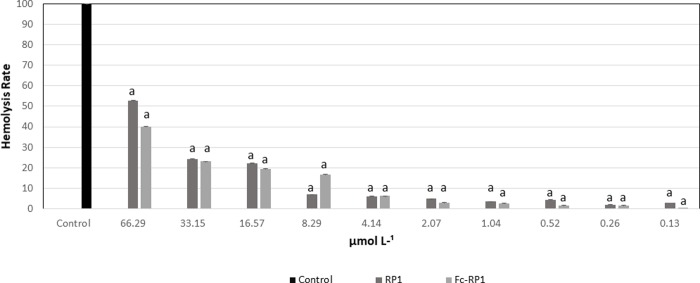
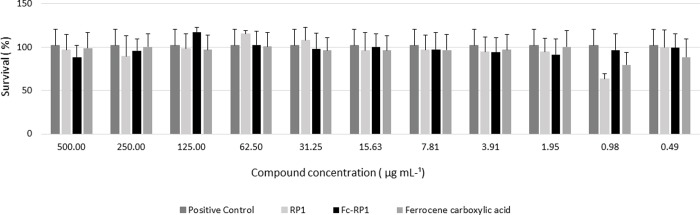
Parasitic diseases are a neglected and serious problem, especially in underdeveloped countries. Among the major parasitic diseases, Leishmaniasis figures as an urgent challenge due to its high incidence and severity. At the same time, the indiscriminate use of antibiotics by the population is increasing together with resistance to medicines. To address this problem, new antibiotic-like molecules that directly kill or inhibit the growth of microorganisms are necessary, where antimicrobial peptides (AMPs) can be of great help. In this work, the ferrocene molecule, one active compound with low levels of in vivo toxicity, was coupled to the N-terminus of the RP1 peptide (derived from the human chemokine CXCL4), aiming to evaluate how this change modifies the structure, biological activity, and toxicity of the peptide. The peptide and the conjugate were synthesized using the solid phase peptide synthesis (SPPS). Circular dichroism assays in PBS showed that the RP1 peptide and its conjugate had a typical spectrum for disordered structures. The Fc-RP1 presented anti-amastigote activity against Leishmania amazonensis (IC50 = 0.25 μmol L-1). In comparison with amphotericin B, a second-line drug approved for leishmaniasis treatment, (IC50 = 0.63 μmol L-1), Fc-RP1 was more active and showed a 2.5-fold higher selectivity index. The RP1 peptide presented a MIC of 4.3 μmol L-1 against S. agalactiae, whilst Fc-RP1 was four times more active (MIC = 0.96 μmol L-1), indicating that ferrocene improved the antimicrobial activity against Gram-positive bacteria. The Fc-RP1 peptide also decreased the minimum inhibitory concentration (MIC) in the assays against E. faecalis (MIC = 7.9 μmol L-1), E. coli (MIC = 3.9 μmol L-1) and S. aureus (MIC = 3.9 μmol L-1). The cytotoxicity of the compounds was tested against HaCaT cells, and no significant activity at the highest concentration tested (500 μg. mL-1) was observed, showing the high potential of this new compound as a possible new drug. The coupling of ferrocene also increased the vesicle permeabilization of the peptide, showing a direct relation between high peptide concentration and high carboxyfluorescein release, which indicates the action mechanism by pore formation on the vesicles. Several studies have shown that ferrocene destabilizes cell membranes through lipid peroxidation, leading to cell lysis. It is noteworthy that the Fc-RP1 peptide synthesized here is a prototype of a bioconjugation strategy, but it still is a compound with great biological activity against neglected and fish diseases.
寄生虫病是一个被忽视的严重问题,尤其是在欠发达国家。在主要的寄生虫病中,利什曼病由于其高发病率和严重性,是一个紧迫的挑战。同时,由于抗生素的滥用,以及对药物的耐药性,情况变得更加严重。为了解决这个问题,我们需要寻找新的抗生素样分子,这些分子可以直接杀死或抑制微生物的生长,其中抗菌肽(AMPs)可以提供很大的帮助。在这项工作中,将具有低体内毒性的活性化合物二茂铁偶联到 RP1 肽(来源于人趋化因子 CXCL4)的 N 端,目的是评估这种变化如何修饰肽的结构、生物活性和毒性。肽和缀合物使用固相肽合成(SPPS)合成。在 PBS 中的圆二色性分析表明,RP1 肽及其缀合物具有典型的无规结构谱。Fc-RP1 对利什曼原虫(IC50 = 0.25 μmol L-1)具有抗变形虫活性。与两性霉素 B 相比,后者是一种批准用于治疗利什曼病的二线药物(IC50 = 0.63 μmol L-1),Fc-RP1 更具活性,其选择性指数高 2.5 倍。RP1 肽对无乳链球菌的 MIC 为 4.3 μmol L-1,而 Fc-RP1 的活性高 4 倍(MIC = 0.96 μmol L-1),表明二茂铁提高了对革兰氏阳性菌的抗菌活性。Fc-RP1 肽还降低了对粪肠球菌(MIC = 7.9 μmol L-1)、大肠杆菌(MIC = 3.9 μmol L-1)和金黄色葡萄球菌(MIC = 3.9 μmol L-1)的最小抑菌浓度(MIC)。对化合物的细胞毒性进行了测试,在测试的最高浓度(500 μg. mL-1)下没有观察到明显的活性,表明这种新化合物作为一种潜在新药具有很高的潜力。二茂铁的偶联也增加了肽对囊泡的通透性,表明高肽浓度与高羧基荧光素释放之间存在直接关系,这表明了在囊泡上形成孔的作用机制。多项研究表明,二茂铁通过脂质过氧化作用破坏细胞膜的稳定性,导致细胞裂解。值得注意的是,这里合成的 Fc-RP1 肽是生物偶联策略的原型,但它仍然是一种对被忽视的鱼类疾病具有强大生物活性的化合物。