Seed Barbara, Lang Tim, Caraher Martin, Ostry Aleck
1Centre for Food Policy, City University, Northampton Square, London, EC1V 0HB UK.
2Department of Geography, Faculty of Social Sciences, University of Victoria, Cornett Building, B332, 3800 Finnerty Road (Ring Road), Victoria, BC V8P 5C2 Canada.
Agric Human Values. 2013;30(3):457-470. doi: 10.1007/s10460-013-9426-x. Epub 2013 Jan 21.
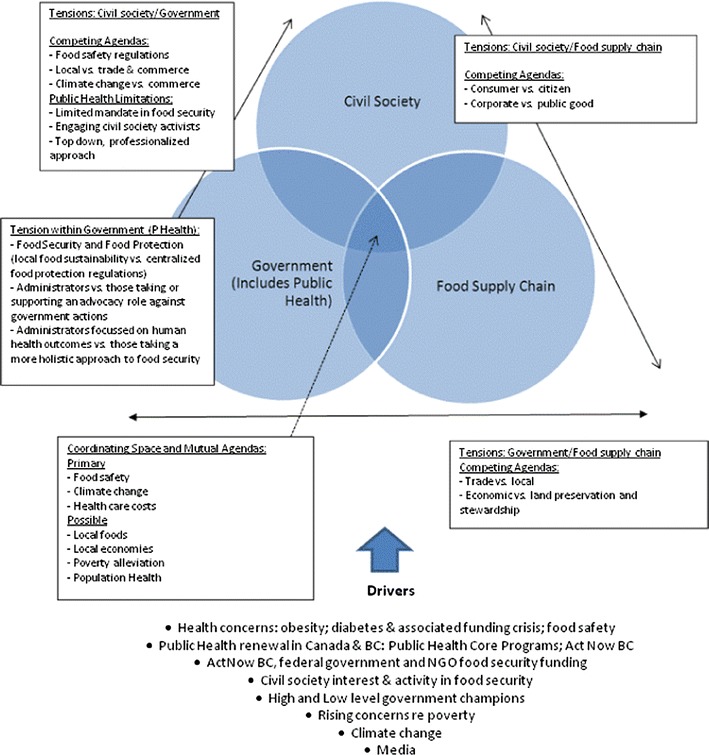
Food security policy, programs, and infrastructure have been incorporated into Public Health and other areas of the Provincial Government in British Columbia, including the adoption of food security as a Public Health Core Program. A policy analysis of the integration into Public Health is completed by merging findings from 48 key informant interviews conducted with government, civil society, and food supply chain representatives involved in the initiatives along with relevant documents and participant/direct observations. The paper then examines the results within the context of historic and international trends and theoretical models of food policy, community food security, and applied policy research. Public Health re-emerged as a driver of food security in BC-both as a key player and in positing the public's health as a driver in food security and food systems. While Public Health's lead role supported an increase in legitimacy for food security in BC, interviewees described a clash of cultures between Public Health and civil society. The clash of cultures occurred partly as a result of Public Health's limited food security mandate and top down approach. Consequently civil society voice at the provincial level was marginalized. A social policy movement toward a new political paradigm-regulatory pluralism-calls for greater engagement of civil society, and for all sectors to work together toward common goals. A new, emerging policy map is proposed for analyzing the dynamics of food security and health promotion initiatives in BC.
食品安全政策、项目和基础设施已被纳入不列颠哥伦比亚省政府的公共卫生及其他领域,包括将食品安全作为一项公共卫生核心项目采用。通过合并对参与这些举措的政府、民间社会和食品供应链代表进行的48次关键信息人访谈的结果以及相关文件和参与观察/直接观察,完成了对融入公共卫生情况的政策分析。本文随后在食品政策、社区食品安全和应用政策研究的历史及国际趋势以及理论模型的背景下审视这些结果。公共卫生在不列颠哥伦比亚省再度成为食品安全的推动力量——既是关键角色,也将公众健康视为食品安全和食品系统的推动因素。虽然公共卫生的主导作用为不列颠哥伦比亚省食品安全的合法性提升提供了支持,但受访者描述了公共卫生与民间社会之间的文化冲突。文化冲突部分是由于公共卫生有限的食品安全任务规定和自上而下的方法导致的。因此,省级层面的民间社会声音被边缘化。一场朝着新的政治范式——监管多元主义——发展的社会政策运动,呼吁民间社会更多地参与,并要求所有部门共同朝着共同目标努力。本文提出了一张新的、正在形成的政策地图,用于分析不列颠哥伦比亚省食品安全和健康促进举措的动态情况。