Madden Joah R, Hall Andrew, Whiteside Mark A
Centre for Research in Animal Behaviour, Psychology, University of Exeter, Exeter, EX4 4QG UK.
Eur J Wildl Res. 2018;64(4):40. doi: 10.1007/s10344-018-1199-5. Epub 2018 Jun 22.
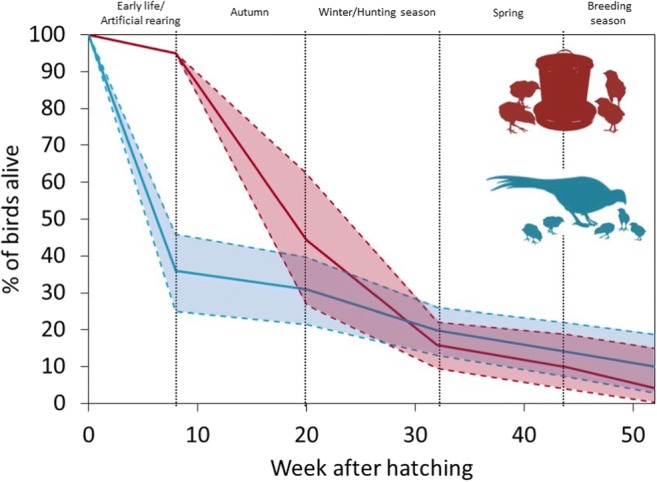
Around 60% of pheasants released for shooting in the UK, an estimated 21 million birds, do not end up at their intended fate: being shot. This constitutes wastage, raising economic, environmental and ethical questions. We review what is known of the fates of released pheasants and consider why they do not directly contribute to the numbers harvested. We focus on four main explanations: predation, disease, starvation and dispersal, and highlight other important causes of mortality. For each explanation, we attempt to attribute levels of loss and identify timings or conditions when such losses may be heaviest. We review factors that exacerbate losses and methods available to mitigate them. Opportunities for amelioration may arise at all stages of the rearing and release of pheasants and involve changes to the conditions under which eggs are produced, the way young pheasants are reared or the management of the environment into which they are released. We found few studies investigating impacts of post-release management techniques on pheasant survival outside of the breeding season within a UK context. We found that a number of less commonly deployed practices focusing on early-life, pre-release management may improve survival. Given the scale of pheasant releasing in the UK, even improvements in survival of 1% would mean that ~ 350,000 fewer birds die of natural causes. Complementing current post-release management with proven novel pre-release management interventions could reduce the number of pheasants required for release, whilst maintaining current shooting levels. Lowering release numbers would lower financial costs, benefit the environment and reduce some ethical concerns over the release and shooting of reared pheasants.
在英国,为狩猎而放生的雉鸡中,约60%(估计有2100万只)最终并未落得它们预期的命运:被射杀。这构成了浪费,引发了经济、环境和伦理问题。我们回顾了已知的放生雉鸡的命运,并思考它们为何没有直接成为被猎获的数量。我们重点关注四个主要原因:捕食、疾病、饥饿和扩散,并强调其他重要的死亡原因。对于每个原因,我们试图确定损失程度,并找出此类损失可能最严重的时间或条件。我们回顾了加剧损失的因素以及可用于减轻损失的方法。在雉鸡饲养和放生的各个阶段都可能出现改善的机会,这涉及到产蛋条件的改变、幼雉饲养方式的改变或它们被放生环境的管理方式的改变。我们发现,在英国背景下,很少有研究调查繁殖季节之外放生后管理技术对雉鸡生存的影响。我们发现,一些较少采用的侧重于早期、放生前期管理的做法可能会提高生存率。鉴于英国放生雉鸡的规模,即使生存率提高1%,也意味着死于自然原因的鸟类减少约35万只。用经过验证的新型放生前期管理干预措施补充当前的放生后管理,可以减少所需放生的雉鸡数量,同时维持当前的狩猎水平。降低放生数量将降低财务成本,有利于环境,并减少一些关于饲养雉鸡放生和狩猎的伦理担忧。