Oleaga Alvaro, García Amalia, Balseiro Ana, Casais Rosa, Mata Enrique, Crespo Elena
SERPA, Sociedad de Servicios del Principado de Asturias S.A., 33203 Gijón, Spain.
Centro de Estudio para las Rapaces Ibéricas (CERI); GEACAM; JCCM, Toledo, Spain.
Eur J Wildl Res. 2019;65(3):40. doi: 10.1007/s10344-019-1283-5. Epub 2019 Apr 24.
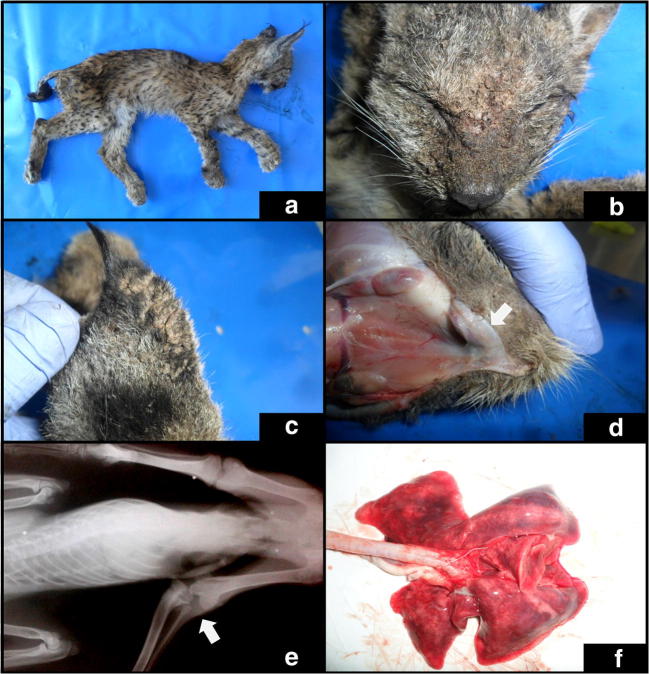
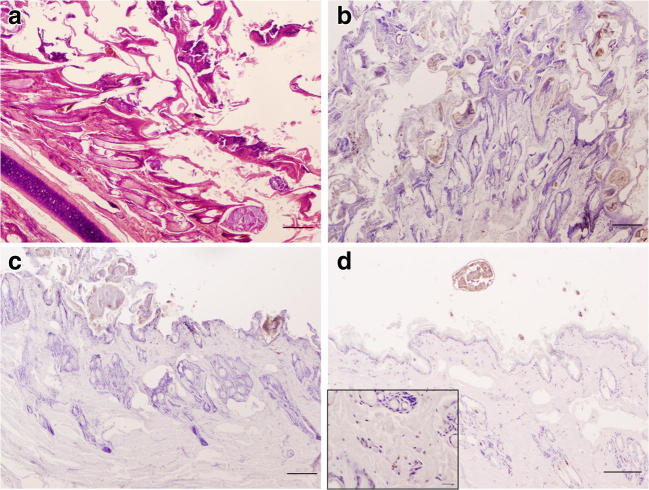
A 6-month-old female Iberian lynx () cub that was severely affected by mange died in September 2016 in the Montes de Toledo (Spain) with crusts and fissures on its face, outer ears, nipples and footpads. The body condition of the cub was very poor, and it also had a mandibular abscess and a severely ankylosed luxation on its left knee. After confirming that the origin of the deceased cub's dermal lesions was , the subsequent search for ectoparasites and a comparison of histopathological and immunohistochemical findings in all sympatric lynxes handled ( = 30) and submitted for necropsy ( = 4) during 2016 and 2017 revealed the presence of mites and/or milder mange compatible lesions in five members of her family group, which was treated against mange together with two exposed contiguous family groups. An ELISA developed by the authors showed the presence of antibodies against in the deceased female cub and one brother. The presence of concomitant immunosuppressive factors in the dead female cub and the results obtained for the other sympatric lynxes studied since 2016 suggest that had a limited effect on immune-competent Iberian lynxes in the local population of the Montes de Toledo. However, a different evolution and relevance of sarcoptic mange in different populations-or even in the same one in the presence of immunosuppressive factors-cannot be ruled out, thus confirming the need for further research in order to attain a complete comprehension of the epidemiology and the real threat that this ectoparasitic disease may imply for
一只6个月大的雌性伊比利亚猞猁幼崽于2016年9月在西班牙托莱多山死亡,它受到严重疥螨感染,面部、外耳、乳头和脚垫出现结痂和裂缝。幼崽身体状况很差,还患有下颌脓肿和左膝严重的关节强硬性脱位。在确认这只死亡幼崽皮肤损伤的病因后,随后在2016年和2017年对所有同域猞猁(n = 30)进行体外寄生虫检查,并对送检尸检的猞猁(n = 4)进行组织病理学和免疫组织化学检查对比,结果发现其家族群中的5只猞猁身上存在疥螨和/或疥螨感染较轻的病变,这些猞猁与另外两个相邻的受感染家族群一起接受了疥螨治疗。作者开发的一种酶联免疫吸附测定(ELISA)显示,这只死亡的雌性幼崽及其一个兄弟体内存在抗疥螨抗体。这只死亡雌性幼崽体内存在伴随的免疫抑制因子,以及自2016年以来对其他同域猞猁研究所得的结果表明,疥螨对托莱多山当地有免疫能力的伊比利亚猞猁影响有限。然而,不能排除疥螨感染在不同种群——甚至在存在免疫抑制因子的同一种群中——有不同的演变过程和影响,因此证实有必要进行进一步研究,以便全面了解这种体外寄生虫病的流行病学以及它可能带来的真正威胁。