• 文献检索
  • 文档翻译
  • 深度研究
  • 学术资讯
  • Suppr Zotero 插件Zotero 插件
  • 邀请有礼
  • 套餐&价格
  • 历史记录
应用&插件
Suppr Zotero 插件Zotero 插件浏览器插件Mac 客户端Windows 客户端微信小程序
定价
高级版会员购买积分包购买API积分包
服务
文献检索文档翻译深度研究API 文档MCP 服务
关于我们
关于 Suppr公司介绍联系我们用户协议隐私条款
关注我们

Suppr 超能文献

核心技术专利:CN118964589B侵权必究
粤ICP备2023148730 号-1Suppr @ 2026

文献检索

告别复杂PubMed语法,用中文像聊天一样搜索,搜遍4000万医学文献。AI智能推荐,让科研检索更轻松。

立即免费搜索

文件翻译

保留排版,准确专业,支持PDF/Word/PPT等文件格式,支持 12+语言互译。

免费翻译文档

深度研究

AI帮你快速写综述,25分钟生成高质量综述,智能提取关键信息,辅助科研写作。

立即免费体验

靶向磷脂酰肌醇蛋白聚糖-3的分裂嵌合抗原受体修饰T细胞可抑制肝细胞癌生长并减少细胞因子释放。

Split chimeric antigen receptor-modified T cells targeting glypican-3 suppress hepatocellular carcinoma growth with reduced cytokine release.

作者信息

Liu Xuan, Wen Jianyun, Yi Honglei, Hou Xiaorui, Yin Yue, Ye Guofu, Wu Xuedong, Jiang Xiaotao

机构信息

Department of Pediatrics, Nanfang Hospital, Southern Medical University, Guangzhou, China.

Department of Orthopedics, General Hospital of Southern Theater Command, Guangzhou, China.

出版信息

Ther Adv Med Oncol. 2020 Mar 9;12:1758835920910347. doi: 10.1177/1758835920910347. eCollection 2020.

DOI:10.1177/1758835920910347
PMID:32215059
原文链接:https://pmc.ncbi.nlm.nih.gov/articles/PMC7065297/
Abstract

BACKGROUND

Human glypican-3 (hGPC3) is a protein highly expressed in hepatocellular carcinoma (HCC) but limited in normal tissues, making it an ideal target for immunotherapy. The adoptive transfer of hGPC3-specific chimeric antigen receptor T (CAR-T) cells for HCC treatment has been conducted in clinical trials. Due to the rigid construction, conventional CAR-T cells have some intrinsic limitations, like uncontrollable overactivation and inducing severe cytokine release syndrome.

METHODS

We redesigned the hGPC3-specific CAR by splitting the traditional CAR into two parts. By using coculturing assays and a xenograft mouse model, the and cytotoxicity and cytokine release of the split anti-hGPC3 CAR-T cells were evaluated against various HCC cell lines and compared with conventional CAR-T cells.

RESULTS

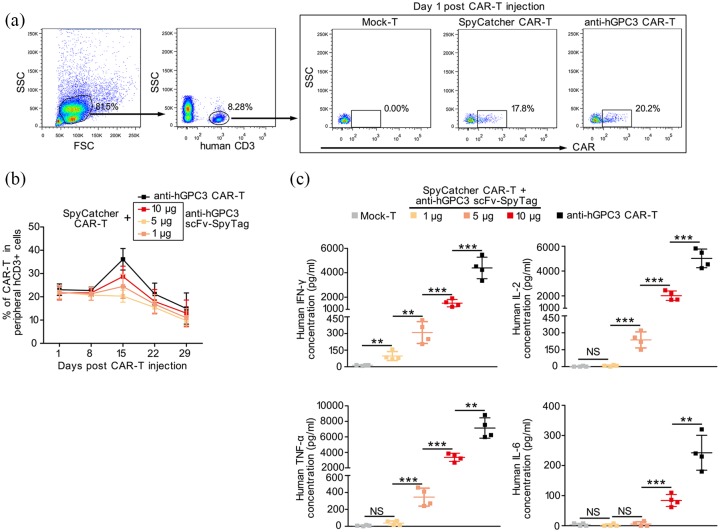
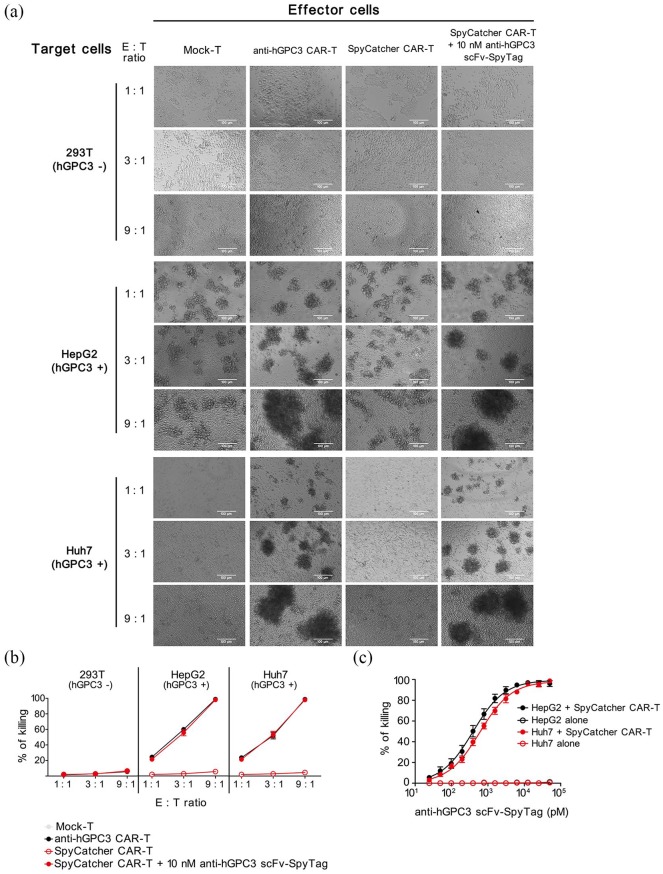
data demonstrated that split anti-hGPC3 CAR-T cells could recognize and lyse hGPC3 HepG2 and Huh7 cells in a dose-dependent manner. Impressively, split anti-hGPC3 CAR-T cells produced and released a significantly lower amount of proinflammatory cytokines, including IFN-γ, TNF-α, IL-6, and GM-CSF, than conventional CAR-T cells. When injected into immunodeficient mice inoculated subcutaneously with HepG2 cells, our split anti-hGPC3 CAR-T cells could suppress HCC tumor growth, but released significantly lower levels of cytokines than conventional CAR-T cells.

CONCLUSIONS

We describe here for the first time the use of split anti-hGPC3 CAR-T cells to treat HCC; split anti-hGPC3 CAR-T cells could suppress tumor growth and reduce cytokine release, and represent a more versatile and safer alternative to conventional CAR-T cells treatment.

摘要

背景

人磷脂酰肌醇蛋白聚糖-3(hGPC3)是一种在肝细胞癌(HCC)中高表达但在正常组织中表达受限的蛋白质,使其成为免疫治疗的理想靶点。针对HCC治疗的hGPC3特异性嵌合抗原受体T(CAR-T)细胞的过继性转移已在临床试验中进行。由于结构刚性,传统的CAR-T细胞存在一些内在局限性,如不可控的过度激活和诱导严重的细胞因子释放综合征。

方法

我们通过将传统的CAR拆分为两部分,重新设计了hGPC3特异性CAR。通过共培养试验和异种移植小鼠模型,评估了分裂型抗hGPC3 CAR-T细胞对各种HCC细胞系的杀伤活性和细胞因子释放情况,并与传统CAR-T细胞进行比较。

结果

数据表明,分裂型抗hGPC3 CAR-T细胞能够以剂量依赖的方式识别并裂解hGPC3阳性的HepG2和Huh7细胞。令人印象深刻的是,分裂型抗hGPC3 CAR-T细胞产生和释放的促炎细胞因子(包括IFN-γ、TNF-α、IL-6和GM-CSF)的量明显低于传统CAR-T细胞。当注射到皮下接种HepG2细胞的免疫缺陷小鼠体内时,我们的分裂型抗hGPC3 CAR-T细胞能够抑制HCC肿瘤生长,但释放的细胞因子水平明显低于传统CAR-T细胞。

结论

我们首次描述了使用分裂型抗hGPC3 CAR-T细胞治疗HCC;分裂型抗hGPC3 CAR-T细胞能够抑制肿瘤生长并减少细胞因子释放,是传统CAR-T细胞治疗更通用、更安全的替代方案。
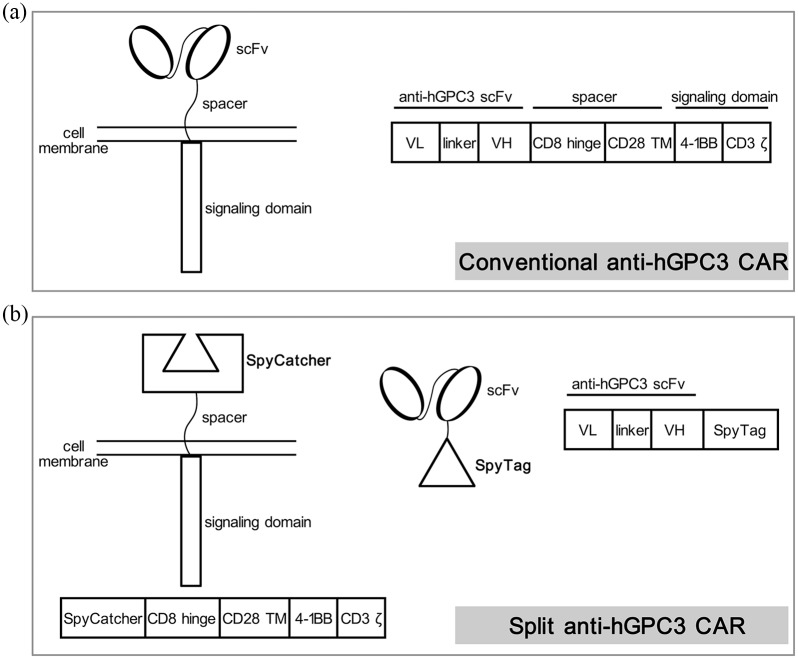
https://cdn.ncbi.nlm.nih.gov/pmc/blobs/4eb7/7065297/93f9ba61d234/10.1177_1758835920910347-fig7.jpg
https://cdn.ncbi.nlm.nih.gov/pmc/blobs/4eb7/7065297/e8c97eb6a4dc/10.1177_1758835920910347-fig1.jpg
https://cdn.ncbi.nlm.nih.gov/pmc/blobs/4eb7/7065297/aa56d6302d31/10.1177_1758835920910347-fig2.jpg
https://cdn.ncbi.nlm.nih.gov/pmc/blobs/4eb7/7065297/0246e6c0acd4/10.1177_1758835920910347-fig3.jpg
https://cdn.ncbi.nlm.nih.gov/pmc/blobs/4eb7/7065297/36889b5f9394/10.1177_1758835920910347-fig4.jpg
https://cdn.ncbi.nlm.nih.gov/pmc/blobs/4eb7/7065297/40150c97a8b6/10.1177_1758835920910347-fig5.jpg
https://cdn.ncbi.nlm.nih.gov/pmc/blobs/4eb7/7065297/43dd33395ca2/10.1177_1758835920910347-fig6.jpg
https://cdn.ncbi.nlm.nih.gov/pmc/blobs/4eb7/7065297/93f9ba61d234/10.1177_1758835920910347-fig7.jpg
https://cdn.ncbi.nlm.nih.gov/pmc/blobs/4eb7/7065297/e8c97eb6a4dc/10.1177_1758835920910347-fig1.jpg
https://cdn.ncbi.nlm.nih.gov/pmc/blobs/4eb7/7065297/aa56d6302d31/10.1177_1758835920910347-fig2.jpg
https://cdn.ncbi.nlm.nih.gov/pmc/blobs/4eb7/7065297/0246e6c0acd4/10.1177_1758835920910347-fig3.jpg
https://cdn.ncbi.nlm.nih.gov/pmc/blobs/4eb7/7065297/36889b5f9394/10.1177_1758835920910347-fig4.jpg
https://cdn.ncbi.nlm.nih.gov/pmc/blobs/4eb7/7065297/40150c97a8b6/10.1177_1758835920910347-fig5.jpg
https://cdn.ncbi.nlm.nih.gov/pmc/blobs/4eb7/7065297/43dd33395ca2/10.1177_1758835920910347-fig6.jpg
https://cdn.ncbi.nlm.nih.gov/pmc/blobs/4eb7/7065297/93f9ba61d234/10.1177_1758835920910347-fig7.jpg

相似文献

1
Split chimeric antigen receptor-modified T cells targeting glypican-3 suppress hepatocellular carcinoma growth with reduced cytokine release.靶向磷脂酰肌醇蛋白聚糖-3的分裂嵌合抗原受体修饰T细胞可抑制肝细胞癌生长并减少细胞因子释放。
Ther Adv Med Oncol. 2020 Mar 9;12:1758835920910347. doi: 10.1177/1758835920910347. eCollection 2020.
2
Off-the-shelf Vδ1 gamma delta T cells engineered with glypican-3 (GPC-3)-specific chimeric antigen receptor (CAR) and soluble IL-15 display robust antitumor efficacy against hepatocellular carcinoma.现货即用型 Vδ1 γδ T 细胞经 GPC-3 特异性嵌合抗原受体(CAR)和可溶性 IL-15 修饰后,显示出针对肝细胞癌的强大抗肿瘤疗效。
J Immunother Cancer. 2021 Dec;9(12). doi: 10.1136/jitc-2021-003441.
3
[Construction and function of Glypican-3-targeted fourth-generation chimeric antigen receptor T cells (secreting IL-7 and CCL19)].靶向磷脂酰肌醇蛋白聚糖-3的第四代嵌合抗原受体T细胞(分泌白细胞介素-7和C-C基序趋化因子19)的构建与功能
Sheng Wu Gong Cheng Xue Bao. 2020 May 25;36(5):979-991. doi: 10.13345/j.cjb.200106.
4
Armored Inducible Expression of IL-12 Enhances Antitumor Activity of Glypican-3-Targeted Chimeric Antigen Receptor-Engineered T Cells in Hepatocellular Carcinoma.装甲诱导型白细胞介素-12 增强了针对磷脂酰聚糖-3 的嵌合抗原受体工程 T 细胞在肝细胞癌中的抗肿瘤活性。
J Immunol. 2019 Jul 1;203(1):198-207. doi: 10.4049/jimmunol.1800033. Epub 2019 May 29.
5
DNAM1 and 2B4 Costimulatory Domains Enhance the Cytotoxicity of Anti-GPC3 Chimeric Antigen Receptor-Modified Natural Killer Cells Against Hepatocellular Cancer Cells in vitro.DNAM1和2B4共刺激结构域增强抗GPC3嵌合抗原受体修饰的自然杀伤细胞对肝癌细胞的体外细胞毒性。
Cancer Manag Res. 2020 May 8;12:3247-3255. doi: 10.2147/CMAR.S253565. eCollection 2020.
6
EGFRvIII-specific CAR-T cells produced by piggyBac transposon exhibit efficient growth suppression against hepatocellular carcinoma.猪内源性逆转录病毒转座子载体系统制备的针对 EGFRvIII 的 CAR-T 细胞对肝癌具有高效的抑制作用。
Int J Med Sci. 2020 Jun 5;17(10):1406-1414. doi: 10.7150/ijms.45603. eCollection 2020.
7
Development of GPC3 and EGFR-dual-targeting chimeric antigen receptor-T cells for adoptive T cell therapy.用于过继性T细胞治疗的GPC3和EGFR双靶点嵌合抗原受体T细胞的开发
Am J Transl Res. 2021 Jan 15;13(1):156-167. eCollection 2021.
8
Tyrosine kinase signaling-independent MET-targeting with CAR-T cells.使用 CAR-T 细胞进行非酪氨酸激酶信号依赖性 MET 靶向治疗。
J Transl Med. 2023 Oct 1;21(1):682. doi: 10.1186/s12967-023-04521-9.
9
Disruption of PD-1 Enhanced the Anti-tumor Activity of Chimeric Antigen Receptor T Cells Against Hepatocellular Carcinoma.程序性死亡受体1(PD-1)的破坏增强了嵌合抗原受体T细胞对肝细胞癌的抗肿瘤活性。
Front Pharmacol. 2018 Oct 1;9:1118. doi: 10.3389/fphar.2018.01118. eCollection 2018.
10
Anti-GPC3-CAR T Cells Suppress the Growth of Tumor Cells in Patient-Derived Xenografts of Hepatocellular Carcinoma.抗GPC3嵌合抗原受体T细胞抑制人源化肝癌异种移植模型中肿瘤细胞的生长。
Front Immunol. 2017 Jan 11;7:690. doi: 10.3389/fimmu.2016.00690. eCollection 2016.

引用本文的文献

1
Dual targeting of BCMA and SLAMF7 with the CARtein system: chimeric antigen receptors with intein-mediated splicing elicit specific T cell activation against multiple myeloma.利用CARtein系统对BCMA和SLAMF7进行双重靶向:具有内含肽介导剪接的嵌合抗原受体引发针对多发性骨髓瘤的特异性T细胞活化。
Front Immunol. 2025 Jul 31;16:1613222. doi: 10.3389/fimmu.2025.1613222. eCollection 2025.
2
Click biology highlights the opportunities from reliable biological reactions.点击化学突出了可靠生物反应带来的机遇。
Nat Chem Biol. 2025 Jul;21(7):991-1005. doi: 10.1038/s41589-025-01944-x. Epub 2025 Jun 19.
3
Elevated CD10 neutrophils correlate with non-response and poor prognosis of CD19 CAR T-cell therapy for B-cell acute lymphoblastic leukemia.

本文引用的文献

1
Adoptive CD8 T cell therapy against cancer:Challenges and opportunities.过继性 CD8 T 细胞疗法治疗癌症:挑战与机遇。
Cancer Lett. 2019 Oct 10;462:23-32. doi: 10.1016/j.canlet.2019.07.017. Epub 2019 Jul 26.
2
Driving CAR T cell translation forward.推动 CAR T 细胞治疗的转化。
Sci Transl Med. 2019 Feb 27;11(481). doi: 10.1126/scitranslmed.aaw2127.
3
Adoptive cell transfer therapy for hepatocellular carcinoma.过继细胞转移疗法治疗肝细胞癌。
CD10升高的中性粒细胞与B细胞急性淋巴细胞白血病的CD19嵌合抗原受体T细胞疗法无反应及预后不良相关。
BMC Med. 2025 Mar 5;23(1):138. doi: 10.1186/s12916-025-03968-5.
4
Advancing Immunotherapy in Pancreatic Cancer: A Brief Review of Emerging Adoptive Cell Therapies.胰腺癌免疫治疗进展:新兴过继性细胞疗法简要综述
Cancers (Basel). 2025 Feb 9;17(4):589. doi: 10.3390/cancers17040589.
5
Modular (universal) CAR-T platforms : a comprehensive systematic review.模块化(通用)嵌合抗原受体T细胞平台:一项全面的系统评价
Front Immunol. 2024 Dec 6;15:1409665. doi: 10.3389/fimmu.2024.1409665. eCollection 2024.
6
Application of novel CAR technologies to improve treatment of autoimmune disease.新型 CAR 技术在改善自身免疫性疾病治疗中的应用。
Front Immunol. 2024 Oct 9;15:1465191. doi: 10.3389/fimmu.2024.1465191. eCollection 2024.
7
State of the Art in CAR-T Cell Therapy for Solid Tumors: Is There a Sweeter Future?嵌合抗原受体 T 细胞疗法治疗实体瘤的最新进展:未来是否更加美好?
Cells. 2024 Apr 23;13(9):725. doi: 10.3390/cells13090725.
8
Synthetic biology approaches for improving the specificity and efficacy of cancer immunotherapy.合成生物学方法提高癌症免疫治疗的特异性和疗效。
Cell Mol Immunol. 2024 May;21(5):436-447. doi: 10.1038/s41423-024-01153-x. Epub 2024 Apr 11.
9
Tuning CARs: recent advances in modulating chimeric antigen receptor (CAR) T cell activity for improved safety, efficacy, and flexibility.调整 CAR:修饰嵌合抗原受体 (CAR) T 细胞活性以提高安全性、疗效和灵活性的最新进展。
J Transl Med. 2023 Mar 15;21(1):197. doi: 10.1186/s12967-023-04041-6.
10
Immunotherapy for hepatocellular carcinoma: Current status and future perspectives.肝细胞癌的免疫治疗:现状与展望。
World J Gastroenterol. 2023 Feb 14;29(6):1054-1075. doi: 10.3748/wjg.v29.i6.1054.
Front Med. 2019 Feb;13(1):3-11. doi: 10.1007/s11684-019-0684-x. Epub 2019 Jan 18.
4
Emerging Cellular Therapies for Cancer.新兴的癌症细胞疗法
Annu Rev Immunol. 2019 Apr 26;37:145-171. doi: 10.1146/annurev-immunol-042718-041407. Epub 2018 Dec 10.
5
Switchable control over in vivo CAR T expansion, B cell depletion, and induction of memory.可切换控制体内 CAR T 细胞扩增、B 细胞耗竭和诱导记忆。
Proc Natl Acad Sci U S A. 2018 Nov 13;115(46):E10898-E10906. doi: 10.1073/pnas.1810060115. Epub 2018 Oct 29.
6
Chimeric Antigen Receptor Therapy.嵌合抗原受体疗法
N Engl J Med. 2018 Jul 5;379(1):64-73. doi: 10.1056/NEJMra1706169.
7
Cancer immunotherapy using checkpoint blockade.使用免疫检查点阻断的癌症免疫疗法。
Science. 2018 Mar 23;359(6382):1350-1355. doi: 10.1126/science.aar4060. Epub 2018 Mar 22.
8
CAR-T cells: the long and winding road to solid tumors.嵌合抗原受体 T 细胞:漫漫实体瘤征途。
Cell Death Dis. 2018 Feb 15;9(3):282. doi: 10.1038/s41419-018-0278-6.
9
Identification of α-fetoprotein-specific T-cell receptors for hepatocellular carcinoma immunotherapy.鉴定用于肝癌免疫治疗的甲胎蛋白特异性 T 细胞受体。
Hepatology. 2018 Aug;68(2):574-589. doi: 10.1002/hep.29844. Epub 2018 Jun 12.
10
Lenvatinib versus sorafenib in first-line treatment of patients with unresectable hepatocellular carcinoma: a randomised phase 3 non-inferiority trial.乐伐替尼与索拉非尼用于不可切除肝细胞癌患者一线治疗的比较:一项随机、III 期非劣效性试验。
Lancet. 2018 Mar 24;391(10126):1163-1173. doi: 10.1016/S0140-6736(18)30207-1.