Jiang Zhiwu, Jiang Xiaofeng, Chen Suimin, Lai Yunxin, Wei Xinru, Li Baiheng, Lin Simiao, Wang Suna, Wu Qiting, Liang Qiubin, Liu Qifa, Peng Muyun, Yu Fenglei, Weng Jianyu, Du Xin, Pei Duanqing, Liu Pentao, Yao Yao, Xue Ping, Li Peng
State Key Laboratory of Respiratory Disease, Guangzhou Institutes of Biomedicine and Health, Chinese Academy of Sciences, Guangzhou, China; Key Laboratory of Regenerative Biology, South China Institute for Stem Cell Biology and Regenerative Medicine, Guangzhou Institutes of Biomedicine and Health, Chinese Academy of Sciences, Guangzhou, China; Guangdong Provincial Key Laboratory of Stem Cell and Regenerative Medicine, South China Institute for Stem Cell Biology and Regenerative Medicine, Guangzhou Institutes of Biomedicine and Health, Chinese Academy of Sciences, Guangzhou, China.
Department of Surgery, The Second Affiliated Hospital of Guangzhou Medical University , Guangzhou , China.
Front Immunol. 2017 Jan 11;7:690. doi: 10.3389/fimmu.2016.00690. eCollection 2016.
The lack of a general clinic-relevant model for human cancer is a major impediment to the acceleration of novel therapeutic approaches for clinical use. We propose to establish and characterize primary human hepatocellular carcinoma (HCC) xenografts that can be used to evaluate the cytotoxicity of adoptive chimeric antigen receptor (CAR) T cells and accelerate the clinical translation of CAR T cells used in HCC.
Primary HCCs were used to establish the xenografts. The morphology, immunological markers, and gene expression characteristics of xenografts were detected and compared to those of the corresponding primary tumors. CAR T cells were adoptively transplanted into patient-derived xenograft (PDX) models of HCC. The cytotoxicity of CAR T cells was evaluated.
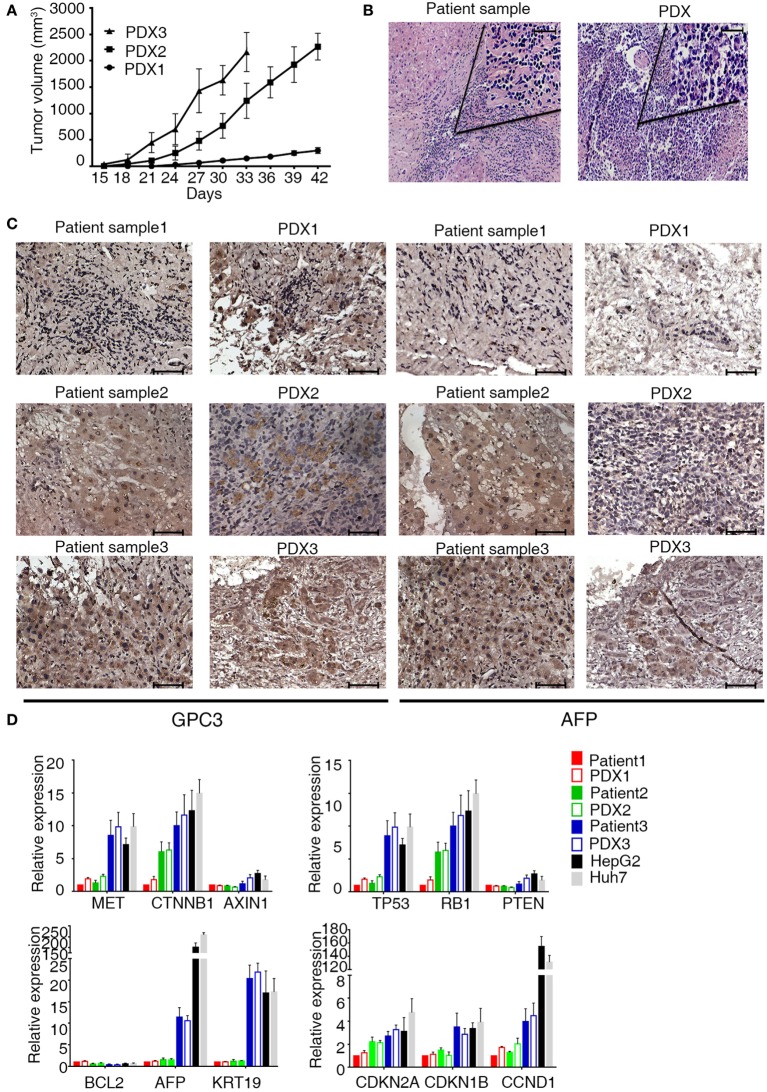
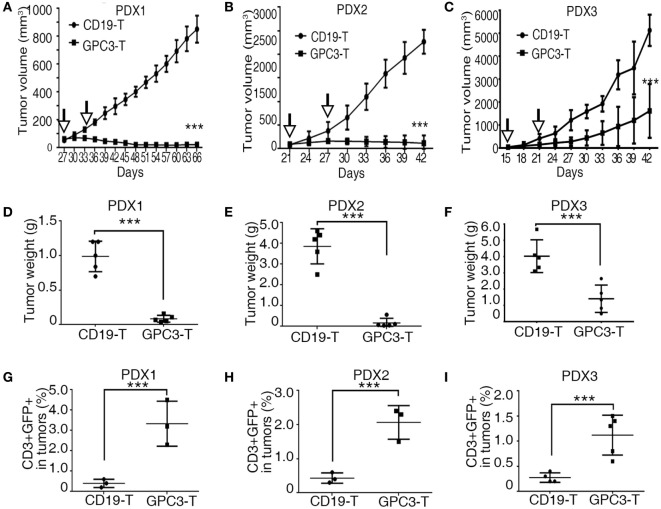
PDX1, PDX2, and PDX3 were established using primary tumors from three individual HCC patients. All three PDXs maintained original tumor characteristics in their morphology, immunological markers, and gene expression. Tumors in PDX1 grew relatively slower than that in PDX2 and PDX3. Glypican 3 (GPC3)-CAR T cells efficiently suppressed tumor growth in PDX3 and impressively eradicated tumor cells from PDX1 and PDX2, in which GPC3 proteins were highly expressed.
GPC3-CAR T cells were capable of effectively eliminating tumors in PDX model of HCC. Therefore, GPC3-CAR T cell therapy is a promising candidate for HCC treatment.
缺乏适用于人类癌症的通用临床相关模型是加速新型治疗方法临床应用的主要障碍。我们建议建立并表征原发性人类肝细胞癌(HCC)异种移植模型,该模型可用于评估过继性嵌合抗原受体(CAR)T细胞的细胞毒性,并加速用于HCC的CAR T细胞的临床转化。
使用原发性HCC建立异种移植模型。检测异种移植模型的形态、免疫标志物和基因表达特征,并与相应原发性肿瘤的特征进行比较。将CAR T细胞过继移植到HCC患者来源的异种移植(PDX)模型中。评估CAR T细胞的细胞毒性。
使用来自三名个体HCC患者的原发性肿瘤建立了PDX1、PDX2和PDX3。所有三个PDX在形态、免疫标志物和基因表达方面均保持了原始肿瘤特征。PDX1中的肿瘤生长相对比PDX2和PDX3中的肿瘤生长慢。Glypican 3(GPC3)-CAR T细胞有效地抑制了PDX3中的肿瘤生长,并显著消除了PDX1和PDX2中的肿瘤细胞,其中GPC3蛋白高度表达。
GPC3-CAR T细胞能够有效消除HCC的PDX模型中的肿瘤。因此,GPC3-CAR T细胞疗法是HCC治疗的一个有前景的候选方法。