The Stephen J. Ryan Initiative for Macular Research (RIMR), Doheny Eye Institute, Los Angeles, CA 90033, USA.
Department of Pathology, Keck School of Medicine of the University of Southern California, Los Angeles, CA 90033, USA.
Oxid Med Cell Longev. 2020 Mar 9;2020:2583601. doi: 10.1155/2020/2583601. eCollection 2020.
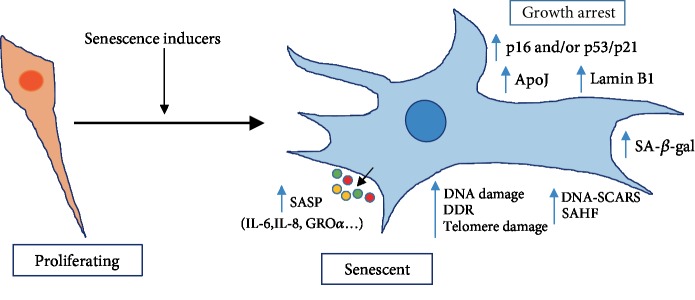
Cellular senescence is a state of irreversible cell cycle arrest in response to an array of cellular stresses. An important role for senescence has been shown for a number of pathophysiological conditions that include cardiovascular disease, pulmonary fibrosis, and diseases of the skin. However, whether senescence contributes to the progression of age-related macular degeneration (AMD) has not been studied in detail so far and the present review describes the recent research on this topic. We present an overview of the types of senescence, pathways of senescence, senescence-associated secretory phenotype (SASP), the role of mitochondria, and their functional implications along with antisenescent therapies. As a central mechanism, senescent cells can impact the surrounding tissue microenvironment via the secretion of a pool of bioactive molecules, termed the SASP. An updated summary of a number of new members of the ever-growing SASP family is presented. Further, we introduce the significance of mechanisms by which mitochondria may participate in the development of cellular senescence. Emerging evidence shows that extracellular vesicles (EVs) are important mediators of the effects of senescent cells on their microenvironment. Based on recent studies, there is reasonable evidence that senescence could be a modifiable factor, and hence, it may be possible to delay age-related diseases by modulating basic aging mechanisms using SASP inhibitors/senolytic drugs. Thus, antisenescent therapies in aging and age-related diseases appear to have a promising potential.
细胞衰老(Cellular senescence)是细胞对一系列细胞应激反应的不可逆细胞周期停滞状态。衰老在许多病理生理条件中都具有重要作用,包括心血管疾病、肺纤维化和皮肤疾病。然而,衰老是否会导致年龄相关性黄斑变性(AMD)的进展,目前尚未进行详细研究,本综述描述了这一主题的最新研究。我们概述了衰老的类型、衰老的途径、衰老相关分泌表型(SASP)、线粒体的作用及其功能意义以及抗衰疗法。作为一种核心机制,衰老细胞可以通过分泌一组称为 SASP 的生物活性分子来影响周围组织微环境。我们对不断增长的 SASP 家族的一些新成员进行了最新的总结。此外,我们介绍了线粒体可能参与细胞衰老发展的机制的重要性。新出现的证据表明,细胞外囊泡(EVs)是衰老细胞对其微环境影响的重要介质。基于最近的研究,有合理的证据表明,衰老可能是一个可调节的因素,因此,通过使用 SASP 抑制剂/衰老细胞溶解药物调节基本衰老机制,可能有可能延缓与年龄相关的疾病。因此,衰老和与年龄相关的疾病中的抗衰疗法似乎具有广阔的应用前景。