Department of Ophthalmology, Shanghai Tenth People's Hospital Affiliated with Tongji University, Shanghai, People's Republic of China.
Department of Ophthalmology, The First Affiliated Hospital of Soochow University, Suzhou, Jiangsu Province, People's Republic of China.
Clin Interv Aging. 2019 Jul 11;14:1277-1283. doi: 10.2147/CIA.S200637. eCollection 2019.
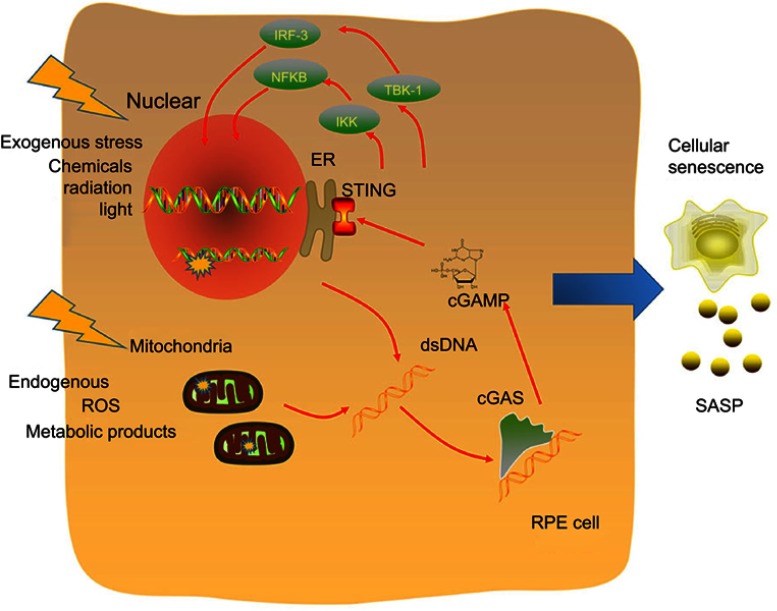
Age-related macular degeneration (AMD) is the leading cause of irreversible blindness among the elderly. Considering the relatively limited effect of therapy on early AMD, it is important to focus on the pathogenesis of AMD, especially early AMD. Ageing is one of the strongest risk factors for AMD, and analysis of the impact of ageing on AMD development is valuable. Among all the ageing hallmarks, increased DNA damage accumulation is regarded as the beginning of cellular senescence and is related to abnormal expression of inflammatory cytokines, which is called the senescence-associated secretory phenotype (SASP). The exact pathway for DNA damage that triggers senescence-associated hallmarks is poorly understood. Recently, mounting evidence has shown that the cGAS/STING pathway is an important DNA sensor related to proinflammatory factor secretion and is associated with another hallmark of ageing, SASP. Thus, we hypothesized that the cGAS/STING pathway is a vital signalling pathway for early AMD development and that inhibition of STING might be a potential therapeutic strategy for AMD cases.
年龄相关性黄斑变性(AMD)是老年人不可逆性失明的主要原因。鉴于早期 AMD 的治疗效果相对有限,因此关注 AMD 的发病机制,尤其是早期 AMD,非常重要。衰老被认为是 AMD 的最强危险因素之一,分析衰老对 AMD 发展的影响具有重要意义。在所有衰老特征中,DNA 损伤积累的增加被认为是细胞衰老的开始,并与炎症细胞因子的异常表达有关,这被称为衰老相关分泌表型(SASP)。引发衰老相关特征的 DNA 损伤的确切途径尚不清楚。最近,越来越多的证据表明,cGAS/STING 通路是一种与促炎因子分泌相关的重要 DNA 传感器,与另一个衰老特征 SASP 有关。因此,我们假设 cGAS/STING 通路是早期 AMD 发展的重要信号通路,抑制 STING 可能是 AMD 病例的一种潜在治疗策略。