Cardiff University Brain Research Imaging Centre (CUBRIC), School of Psychology, Cardiff University, Wales, UK.
Experimental MRI Centre (EMRIC), School of Biosciences, Cardiff University, Wales, UK.
Hum Brain Mapp. 2020 Jul;41(10):2583-2595. doi: 10.1002/hbm.24964. Epub 2020 Mar 26.
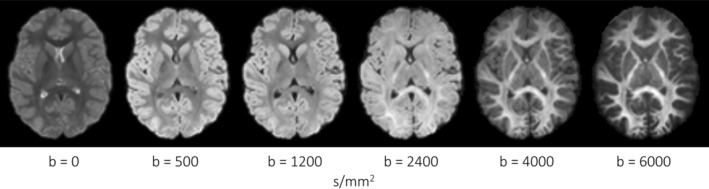
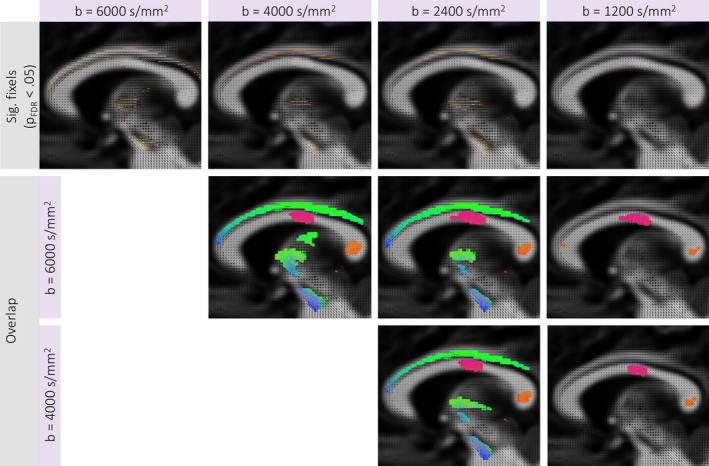
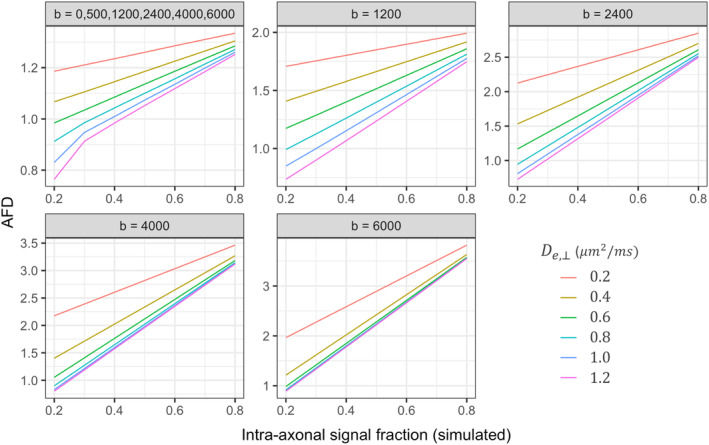
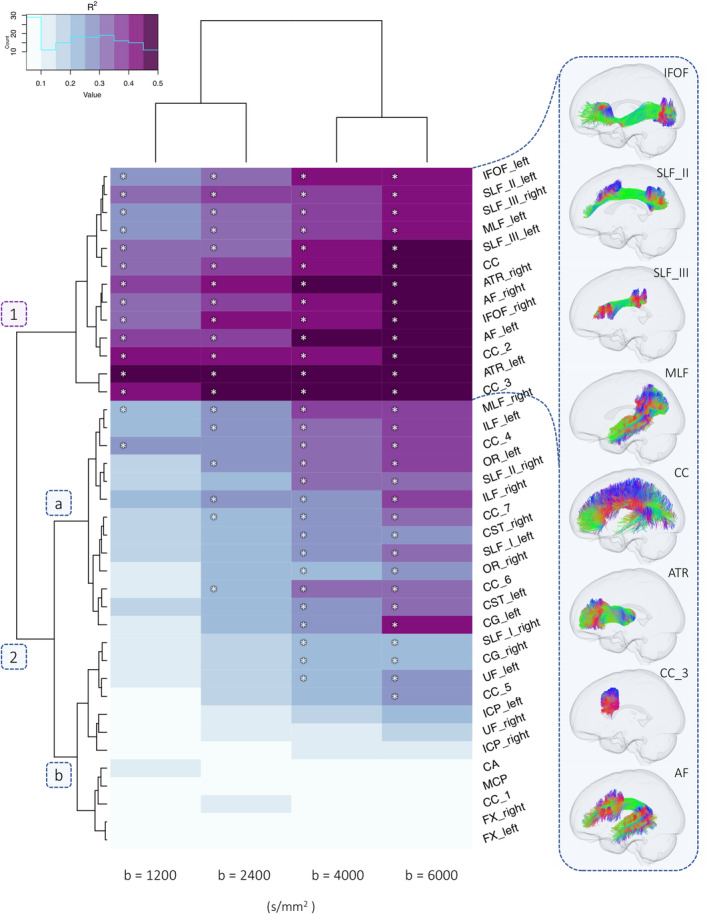
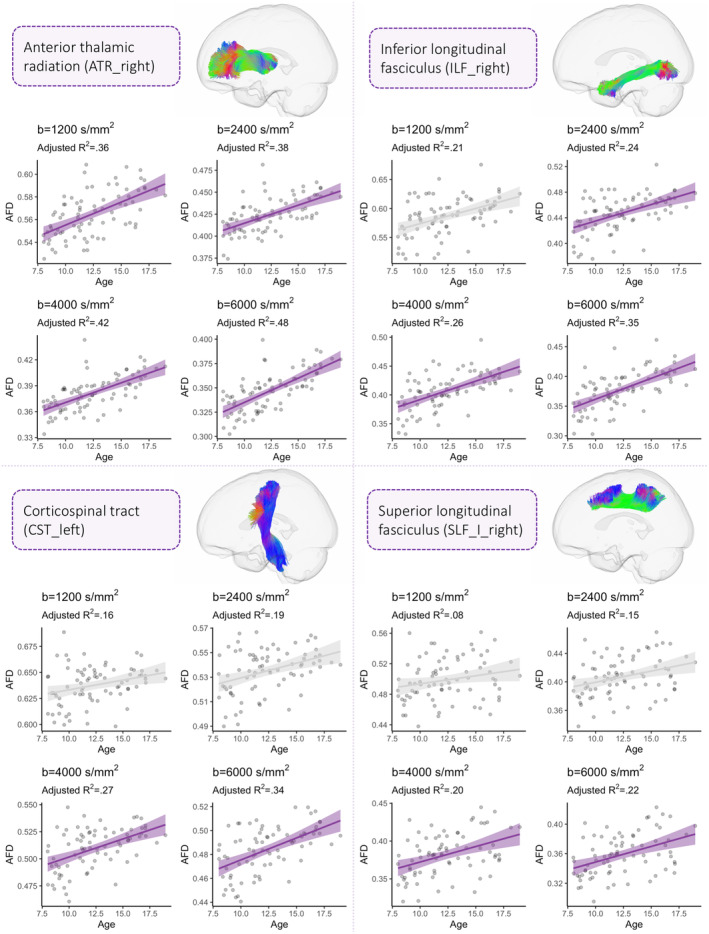
Recent advances in diffusion magnetic resonance imaging (dMRI) analysis techniques have improved our understanding of fibre-specific variations in white matter microstructure. Increasingly, studies are adopting multi-shell dMRI acquisitions to improve the robustness of dMRI-based inferences. However, the impact of b-value choice on the estimation of dMRI measures such as apparent fibre density (AFD) derived from spherical deconvolution is not known. Here, we investigate the impact of b-value sampling scheme on estimates of AFD. First, we performed simulations to assess the correspondence between AFD and simulated intra-axonal signal fraction across multiple b-value sampling schemes. We then studied the impact of sampling scheme on the relationship between AFD and age in a developmental population (n = 78) aged 8-18 (mean = 12.4, SD = 2.9 years) using hierarchical clustering and whole brain fixel-based analyses. Multi-shell dMRI data were collected at 3.0T using ultra-strong gradients (300 mT/m), using 6 diffusion-weighted shells ranging from b = 0 to 6,000 s/mm . Simulations revealed that the correspondence between estimated AFD and simulated intra-axonal signal fraction was improved with high b-value shells due to increased suppression of the extra-axonal signal. These results were supported by in vivo data, as sensitivity to developmental age-relationships was improved with increasing b-value (b = 6,000 s/mm , median R = .34; b = 4,000 s/mm , median R = .29; b = 2,400 s/mm , median R = .21; b = 1,200 s/mm , median R = .17) in a tract-specific fashion. Overall, estimates of AFD and age-related microstructural development were better characterised at high diffusion-weightings due to improved correspondence with intra-axonal properties.
最近,扩散磁共振成像(dMRI)分析技术的进展提高了我们对白质微观结构中纤维特异性变化的理解。越来越多的研究采用多壳层 dMRI 采集来提高基于 dMRI 的推论的稳健性。然而,b 值选择对基于球谐反卷积得出的 dMRI 测量值(如表观纤维密度(AFD))的估计的影响尚不清楚。在这里,我们研究了 b 值采样方案对 AFD 估计的影响。首先,我们进行了模拟,以评估在多个 b 值采样方案下 AFD 与模拟的轴内信号分数之间的对应关系。然后,我们使用层次聚类和全脑固定分析研究了采样方案对发育人群(n = 78,年龄 8-18 岁,平均 = 12.4,SD = 2.9 岁)中 AFD 与年龄之间关系的影响。在 3.0T 上使用超强梯度(300 mT/m)采集多壳层 dMRI 数据,使用 6 个扩散加权壳,范围从 b = 0 到 6,000 s/mm。模拟结果表明,由于增加了对轴外信号的抑制,高 b 值壳提高了估计的 AFD 与模拟的轴内信号分数之间的对应关系。体内数据也支持了这些结果,因为随着 b 值的增加(b = 6,000 s/mm,中位数 R = 0.34;b = 4,000 s/mm,中位数 R = 0.29;b = 2,400 s/mm,中位数 R = 0.21;b = 1,200 s/mm,中位数 R = 0.17),对发育年龄相关性的敏感性得到了提高,这种相关性具有纤维特异性。总的来说,由于与轴内特性的对应关系得到了改善,因此在高扩散加权下,AFD 及其与年龄相关的微观结构发育的估计得到了更好的描述。