Department of Biological Regulation, School of Health Science, Faculty of Medicine, Tottori University, 86 Nishi-cho, Yonago, 683-8503, Japan.
Research Institute for Bioscience & Fine Chemicals, Ajinomoto Co., Inc., 1-1, Suzuki-Cho, Kawasaki-Ku, Kawasaki-Shi, 210-8681, Japan.
BMC Neurol. 2020 Mar 26;20(1):110. doi: 10.1186/s12883-020-01691-7.
Patients with Alzheimer's disease dementia (ADD) are thought to exhibit taste disorders; however, this has not been extensively studied. We investigated gustatory functions and factors affecting taste in patients with ADD or mild cognitive impairment (MCI) and in non-demented controls (NDCs) and evaluated associations between cognitive impairment and gustatory functions.
We recruited 29 patients with ADD, 43 with MCI, and 14 with NDCs. We obtained medical and medication history, measured salivary secretion volumes, and performed cognitive function tests, blood tests, whole-mouth gustatory tests, and dietary and gustatory questionnaires.
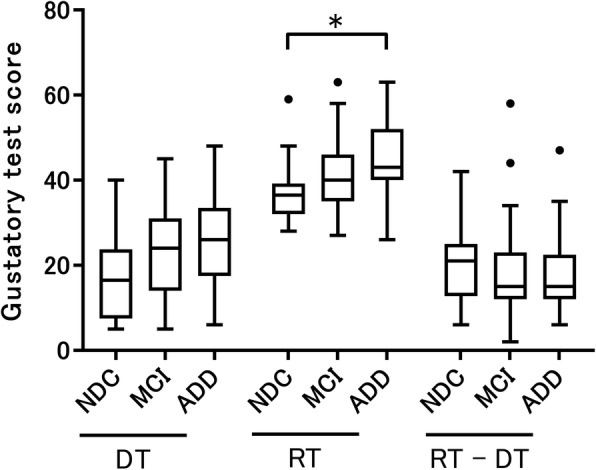
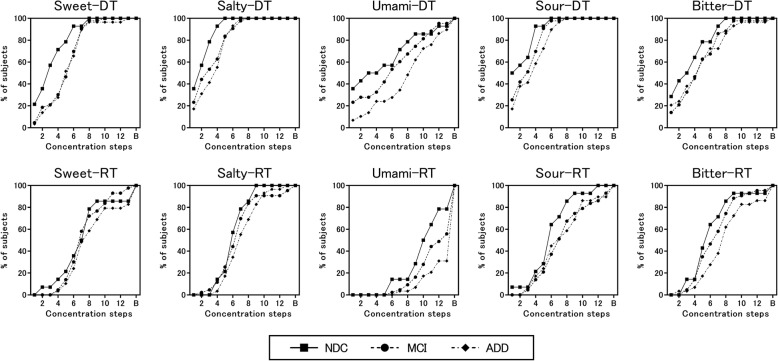
Patients with ADD showed significantly higher recognition threshold values than NDCs (p < 0.05). Many individuals did not recognize umami at the maximum concentration, and this happened more frequently in patients with ADD or MCI than in NDCs. Evaluation items other than cognitive function tests did not show significant differences among the groups, but many individuals had decreased salivation, low serum zinc levels, and were on multiple medications. We found a significant correlation between recognition threshold and age (r = 0.229, p < 0.05) and cognitive function test score (r = 0.268, p < 0.05).
Patients with ADD showed impairment of gustatory function. Gustatory impairment in patients with MCI could not be confirmed. However, many individuals with MCI did not recognize umami, either. Our results suggest that taste disorders in elderly people with cognitive decline occur independently of factors affecting taste such as salivation, zinc levels, or prescription drugs.
The study was registered in the UMIN Clinical Trials Registry on February 10, 2017, with reference number UMIN000026087.
据认为,阿尔茨海默病痴呆症(ADD)患者存在味觉障碍;然而,这方面尚未得到广泛研究。我们调查了 ADD 或轻度认知障碍(MCI)患者以及非痴呆对照(NDC)的味觉功能和影响味觉的因素,并评估了认知障碍与味觉功能之间的关系。
我们招募了 29 名 ADD 患者、43 名 MCI 患者和 14 名 NDC。我们获得了医疗和用药史,测量了唾液分泌量,并进行了认知功能测试、血液测试、全口味觉测试以及饮食和味觉问卷。
ADD 患者的识别阈值明显高于 NDC(p < 0.05)。许多人无法识别最高浓度的鲜味,而且 ADD 或 MCI 患者比 NDC 更常见。除认知功能测试外,各组的评估项目无明显差异,但许多人唾液分泌减少,血清锌水平低,且服用多种药物。我们发现识别阈值与年龄(r = 0.229,p < 0.05)和认知功能测试评分(r = 0.268,p < 0.05)之间存在显著相关性。
ADD 患者的味觉功能受损。MCI 患者的味觉障碍无法得到证实。然而,许多 MCI 患者也无法识别鲜味。我们的结果表明,认知能力下降的老年人口味障碍独立于影响味觉的因素(如唾液分泌、锌水平或处方药)发生。
该研究于 2017 年 2 月 10 日在 UMIN 临床试验注册处注册,注册号为 UMIN000026087。