Rikhotso Mpumelelo Casper, Khumela Ronewa, Kabue Jean Pierre, Traoré-Hoffman Afsatou Ndama, Potgieter Natasha
Department of Microbiology, School of Mathematical and Natural Science, University of Venda, Thohoyandou 0950, South Africa.
Dean, School of Mathematical and Natural Sciences, University of Venda, Thohoyandou 0950, South Africa.
Pathogens. 2020 Mar 25;9(4):245. doi: 10.3390/pathogens9040245.
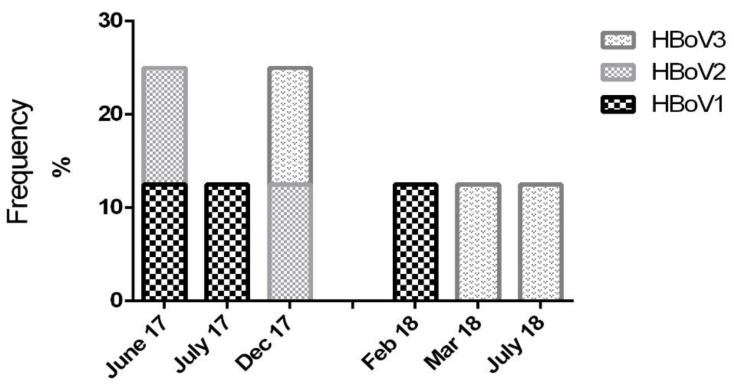
Human bocavirus (HBoV) is an emerging virus globally associated with diarrhea in young children. This study aims to investigate the prevalence of HBoV genotypes in children (≤5 years) from rural communities in South Africa (SA) suffering from acute gastroenteritis (AGE). A total of 141 fecal samples of children ≤5 years with acute gastroenteritis (AGE) were collected from rural primary health care facilities in the Vhembe district of SA between June 2017 and July 2018. Clinical symptoms and demographic data were also recorded. A total of 102 (72%) were outpatients, and 39 (28%) were hospitalized patients. Human bocavirus (HBoV) genotypes were determined using real-time multiplex PCR. DNA extracts of positive samples were confirmed by conventional PCR targeting the NS1 gene. Co-infection with other enteric viruses were determined in HBoV-positive samples using real-time PCR. HBoV was detected in eight (5.7%) children with AGE, of which three (37.5%) were HBoV1, three (37.5%) were HBoV3, and two (25%) were HBoV2. The majority of positive cases were identified in outpatients (62%) between the ages of 1 and 24 months. Co-infection in HBoV-positive samples with other enteric viruses included rotavirus (37.5%), adenovirus (37.5%), norovirus (25%), and astrovirus (12.5%). HBoV infections could be seen as a potential emerging diarrheal pathogen in South Africa. However, more studies are needed to understand the role of HBoV infections in children with AGE.
人博卡病毒(HBoV)是一种在全球范围内新出现的病毒,与幼儿腹泻有关。本研究旨在调查南非(SA)农村社区5岁及以下患急性胃肠炎(AGE)儿童中HBoV基因型的流行情况。2017年6月至2018年7月期间,从南非Vhembe区的农村初级卫生保健机构收集了141份5岁及以下患急性胃肠炎(AGE)儿童的粪便样本。还记录了临床症状和人口统计学数据。其中共有102名(72%)为门诊患者,39名(28%)为住院患者。使用实时多重PCR确定人博卡病毒(HBoV)基因型。通过靶向NS1基因的常规PCR确认阳性样本的DNA提取物。使用实时PCR在HBoV阳性样本中确定是否与其他肠道病毒共感染。在8名(5.7%)患AGE的儿童中检测到HBoV,其中3名(37.5%)为HBoV1,3名(37.5%)为HBoV3,2名(25%)为HBoV2。大多数阳性病例在1至24个月大的门诊患者中发现(62%)。HBoV阳性样本与其他肠道病毒的共感染包括轮状病毒(37.5%)、腺病毒(37.5%)、诺如病毒(25%)和星状病毒(12.5%)。在南非,HBoV感染可被视为一种潜在的新出现的腹泻病原体。然而,需要更多的研究来了解HBoV感染在患AGE儿童中的作用。