Mastej Emily, Gillenwater Lucas, Zhuang Yonghua, Pratte Katherine A, Bowler Russell P, Kechris Katerina
Computational Bioscience Program, University of Colorado Anschutz Medical Campus, Aurora, CO 80045, USA.
National Jewish Health, Denver 80206, CO, USA.
Metabolites. 2020 Mar 25;10(4):124. doi: 10.3390/metabo10040124.
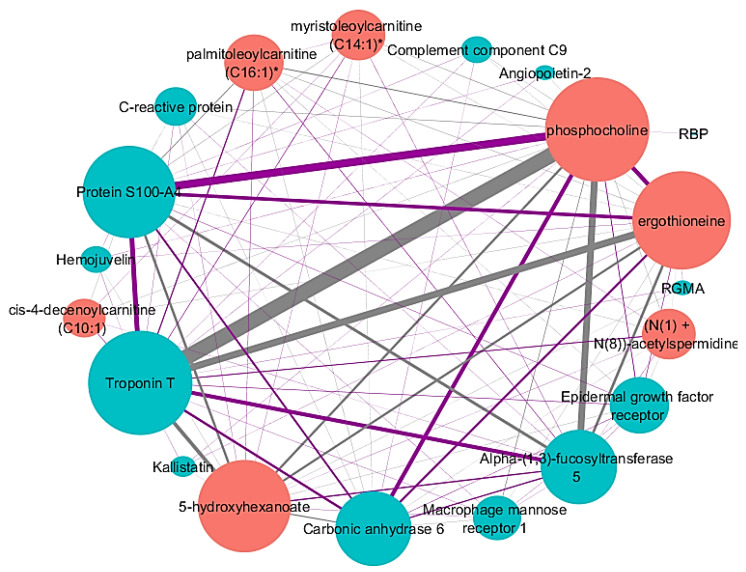
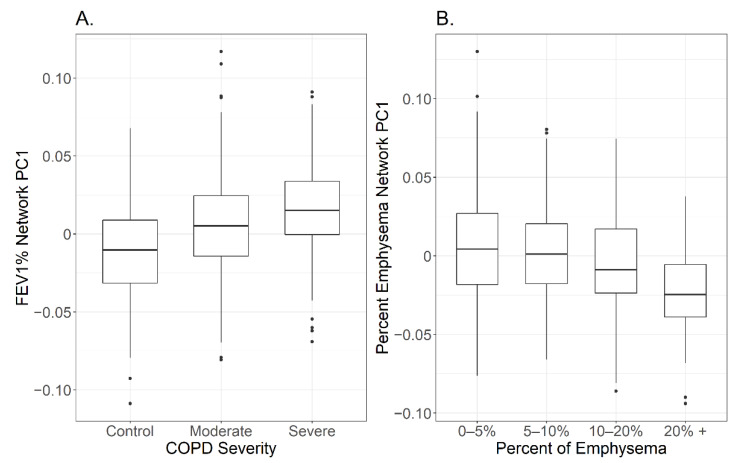
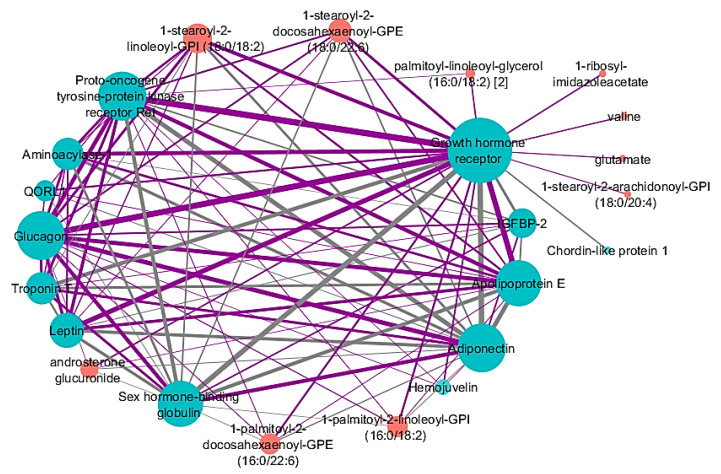
Chronic obstructive pulmonary disease (COPD) is a disease in which airflow obstruction in the lung makes it difficult for patients to breathe. Although COPD occurs predominantly in smokers, there are still deficits in our understanding of the additional risk factors in smokers. To gain a deeper understanding of the COPD molecular signatures, we used Sparse Multiple Canonical Correlation Network (SmCCNet), a recently developed tool that uses sparse multiple canonical correlation analysis, to integrate proteomic and metabolomic data from the blood of 1008 participants of the COPDGene study to identify novel protein-metabolite networks associated with lung function and emphysema. Our aim was to integrate -omic data through SmCCNet to build interpretable networks that could assist in the discovery of novel biomarkers that may have been overlooked in alternative biomarker discovery methods. We found a protein-metabolite network consisting of 13 proteins and 7 metabolites which had a -0.34 correlation (-value = 2.5 × 10) to lung function. We also found a network of 13 proteins and 10 metabolites that had a -0.27 correlation (-value = 2.6 × 10) to percent emphysema. Protein-metabolite networks can provide additional information on the progression of COPD that complements single biomarker or single -omic analyses.
慢性阻塞性肺疾病(COPD)是一种肺部气流受阻导致患者呼吸困难的疾病。尽管COPD主要发生在吸烟者中,但我们对吸烟者其他风险因素的理解仍存在不足。为了更深入地了解COPD的分子特征,我们使用了稀疏多重典型相关网络(SmCCNet),这是一种最近开发的工具,它使用稀疏多重典型相关分析,整合了来自COPDGene研究中1008名参与者血液中的蛋白质组学和代谢组学数据,以识别与肺功能和肺气肿相关的新型蛋白质-代谢物网络。我们的目标是通过SmCCNet整合组学数据,构建可解释的网络,以帮助发现可能在其他生物标志物发现方法中被忽视的新型生物标志物。我们发现了一个由13种蛋白质和7种代谢物组成的蛋白质-代谢物网络,其与肺功能的相关性为-0.34(P值=2.5×10)。我们还发现了一个由13种蛋白质和10种代谢物组成的网络,其与肺气肿百分比的相关性为-0.27(P值=2.6×10)。蛋白质-代谢物网络可以提供关于COPD进展的额外信息,补充单一生物标志物或单一组学分析。