Liu Li, Huber Harald, Berg Ivan A
Institute for Molecular Microbiology and Biotechnology, University of Münster, Münster, Germany.
Institute for Microbiology and Archaeal Center, University of Regensburg, Regensburg, Germany.
Front Microbiol. 2020 Mar 11;11:354. doi: 10.3389/fmicb.2020.00354. eCollection 2020.
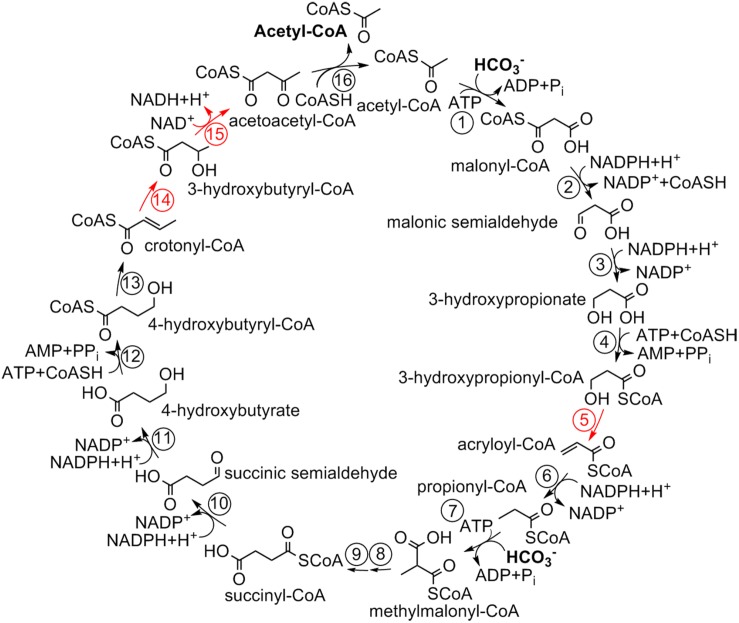
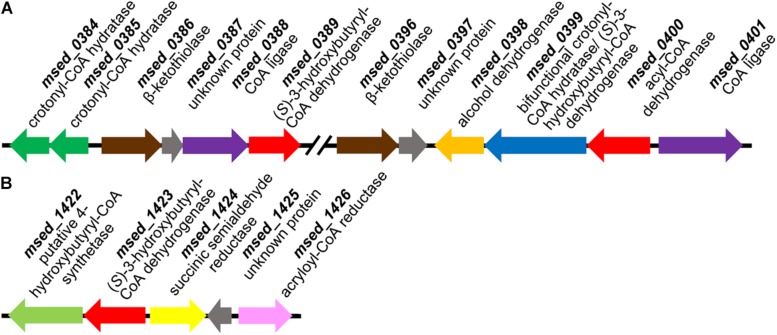
Autotrophic Crenarchaeota use two different cycles for carbon dioxide fixation. Members of the Sulfolobales use the 3-hydroxypropionate/4-hydroxybutyrate (HP/HB) cycle, whereas Desulfurococcales and Thermoproteales use the dicarboxylate/4-hydroxybutyrate cycle. While these two cycles differ in the carboxylation reactions resulting in the conversion of acetyl-CoA + 2 CO to succinyl-CoA, they have a common regeneration part in which succinyl-CoA is reconverted to two acetyl-CoA molecules. This common part includes crotonyl-CoA conversion to acetoacetyl-CoA, which has unequivocally been shown in (Desulfurococcales) and (Thermoproteales) to be catalyzed by a bifunctional crotonase/3-hydroxybutyryl-CoA dehydrogenase. It is a fusion protein consisting of an enoyl-CoA hydratase and a dehydrogenase domain. As the homologous bifunctional protein is present in Sulfolobales as well, its common functioning in the conversion of crotonyl-CoA to acetoacetyl-CoA was proposed. Here we show that a model autotrophic member of Sulfolobales, , possesses in addition to the bifunctional protein (Msed_0399) several separate genes coding for crotonyl-CoA hydratase and ()-3-hydroxybutyryl-CoA dehydrogenase. Their genes were previously shown to be transcribed under autotrophic and mixotrophic conditions. The dehydrogenase Msed_1423 (and not the bifunctional protein Msed_0399) appears to be the main enzyme catalyzing the ()-3-hydroxybutyryl-CoA dehydrogenase reaction. Homologs of this dehydrogenase are the only ()-3-hydroxybutyryl-CoA dehydrogenases present in all autotrophic Sulfolobales, strengthening this conclusion. Two uncharacterized crotonase homologs present in genome (Msed_0336 and Msed_0384) were heterologously produced and characterized. Both proteins were highly efficient crotonyl-CoA hydratases and may contribute (or be responsible) for the corresponding reaction in the HP/HB cycle .
自养泉古菌利用两种不同的循环来固定二氧化碳。硫化叶菌目成员使用3-羟基丙酸/4-羟基丁酸(HP/HB)循环,而脱硫球菌目和热变形菌目使用二羧酸/4-羟基丁酸循环。虽然这两个循环在羧化反应上有所不同,羧化反应导致乙酰辅酶A + 2CO转化为琥珀酰辅酶A,但它们有一个共同的再生部分,其中琥珀酰辅酶A会重新转化为两个乙酰辅酶A分子。这个共同部分包括巴豆酰辅酶A转化为乙酰乙酰辅酶A,在脱硫球菌目和热变形菌目中已明确表明这一转化由一种双功能巴豆酸酶/3-羟基丁酰辅酶A脱氢酶催化。它是一种融合蛋白,由烯酰辅酶A水合酶和脱氢酶结构域组成。由于同源双功能蛋白也存在于硫化叶菌目中,因此有人提出它在巴豆酰辅酶A转化为乙酰乙酰辅酶A的过程中具有共同功能。在这里我们表明,硫化叶菌目的一个自养模式成员,除了双功能蛋白(Msed_0399)外,还拥有几个分别编码巴豆酰辅酶A水合酶和()-3-羟基丁酰辅酶A脱氢酶的基因。它们的基因先前已表明在自养和兼养条件下会转录。脱氢酶Msed_1423(而非双功能蛋白Msed_0399)似乎是催化()-3-羟基丁酰辅酶A脱氢酶反应的主要酶。这种脱氢酶的同源物是所有自养硫化叶菌目中仅有的()-3-羟基丁酰辅酶A脱氢酶,这强化了这一结论。在该基因组中存在的两个未表征的巴豆酸酶同源物(Msed_0336和Msed_0384)被异源表达并进行了表征。这两种蛋白都是高效的巴豆酰辅酶A水合酶,可能在HP/HB循环中对相应反应有贡献(或起作用)。