Grond Kirsten, Guilani Hannah, Hird Sarah M
Department of Molecular and Cell Biology, University of Connecticut, Storrs, CT, USA.
R Soc Open Sci. 2020 Jan 15;7(1):191609. doi: 10.1098/rsos.191609. eCollection 2020 Jan.
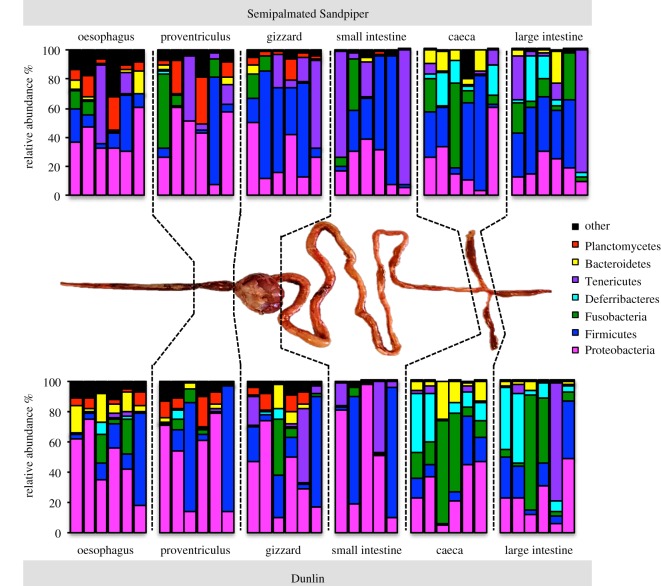
The gastrointestinal tract (GIT) consists of connected structures that vary in function and physiology, and different GIT sections potentially provide different habitats for microorganisms. Birds possess unique GIT structures, including the oesophagus, proventriculus, gizzard, small intestine, caeca and large intestine. To understand birds as hosts of microbial ecosystems, we characterized the microbial communities in six sections of the GIT of two shorebird species, the Dunlin and Semipalmated Sandpiper, identified potential host species effects on the GIT microbiome and used microbial source tracking to determine microbial origin throughout the GIT. The upper three GIT sections had higher alpha diversity and genus richness compared to the lower sections, and microbial communities in the upper GIT showed no clustering. The proventriculus and gizzard microbiomes primarily originated from upstream sections, while the majority of the large intestine microbiome originated from the caeca. The heterogeneity of the GIT sections shown in our study urges caution in equating data from faeces or a single GIT component to the entire GIT microbiome but confirms that ecologically similar species may share many attributes in GIT microbiomes.
胃肠道(GIT)由功能和生理各异的相连结构组成,不同的胃肠道部分可能为微生物提供不同的栖息地。鸟类拥有独特的胃肠道结构,包括食管、腺胃、肌胃、小肠、盲肠和大肠。为了将鸟类理解为微生物生态系统的宿主,我们对两种滨鸟——黑腹滨鹬和半蹼滨鹬——胃肠道六个部分的微生物群落进行了特征分析,确定了潜在的宿主物种对胃肠道微生物组的影响,并使用微生物源追踪来确定整个胃肠道中微生物的来源。与下部相比,胃肠道上部的三个部分具有更高的α多样性和属丰富度,并且上部胃肠道中的微生物群落没有聚类。腺胃和肌胃微生物组主要起源于上游部分,而大肠微生物组的大部分起源于盲肠。我们研究中显示的胃肠道各部分的异质性提醒我们,在将粪便或单个胃肠道成分的数据等同于整个胃肠道微生物组时要谨慎,但证实了生态上相似的物种在胃肠道微生物组中可能具有许多共同特征。