MRC/CSO Social and Public Health Sciences Unit, University of Glasgow, Glasgow, UK.
Institute of Law, Politics and Development, Sant'Anna School of Advanced Studies, Pisa, Italy.
Addiction. 2020 Dec;115(12):2303-2314. doi: 10.1111/add.15068. Epub 2020 May 30.
Public health policy development is subject to a range of stakeholders presenting their arguments to influence opinion on the best options for policy action. This paper compares stakeholders' positions in the discourse networks of two pricing policy debates in the United Kingdom: minimum unit pricing for alcohol (MUP) and the soft drinks industry levy (SDIL).
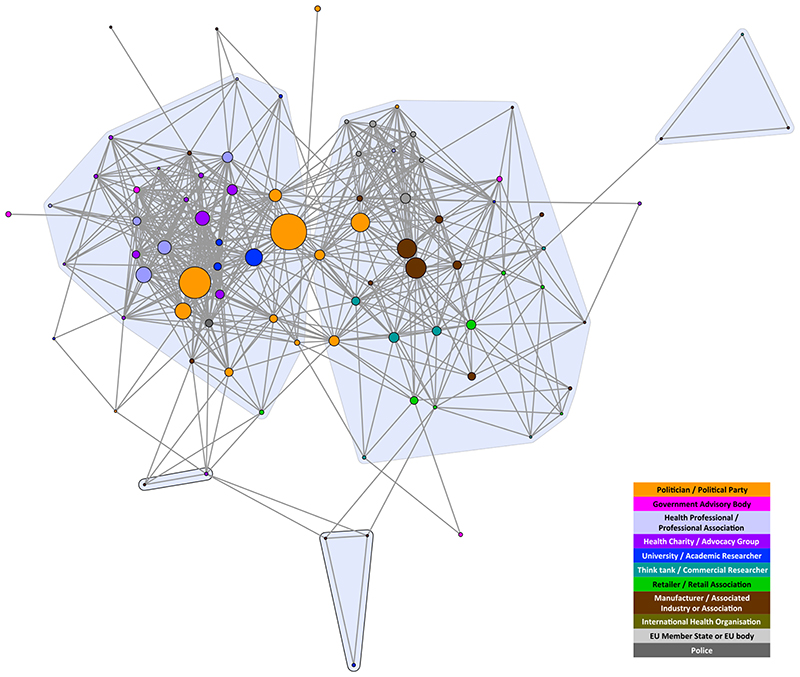
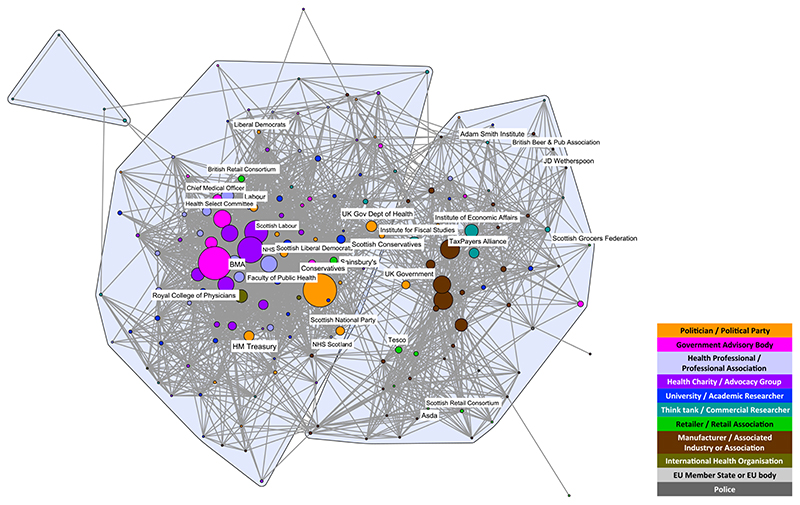
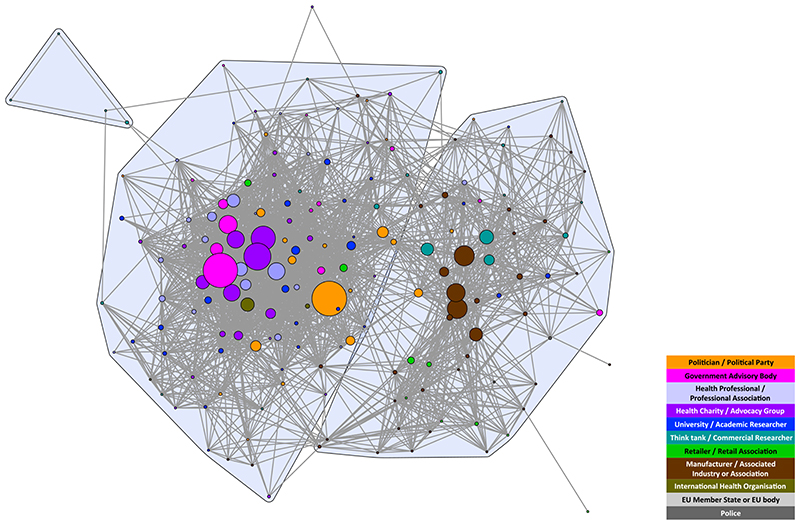
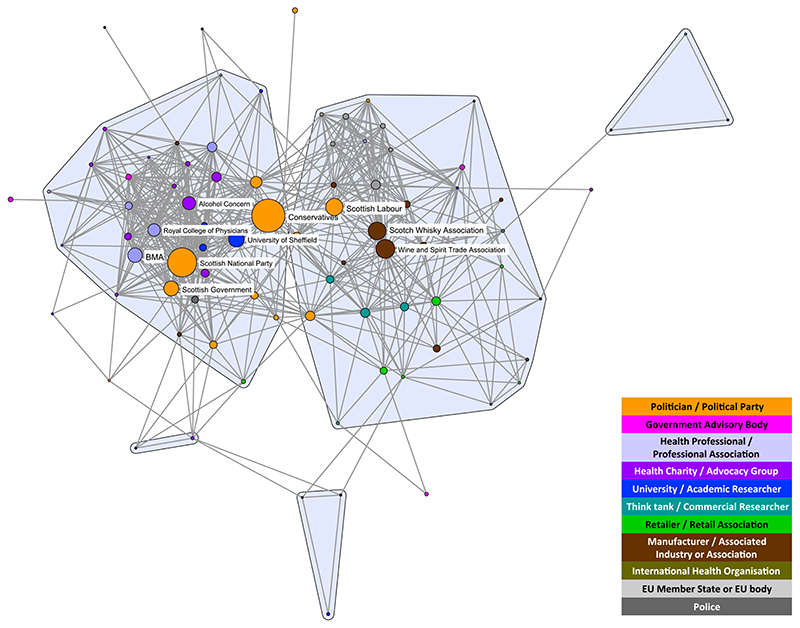
Discourse analysis was combined with network visualization to create representations of stakeholders' positions across the two policy debates as they were represented in 11 national UK newspapers.
United Kingdom.
For the MUP debate 1924 statements by 152 people from 87 organizations were coded from 348 articles. For the SDIL debate 3883 statements by 214 people from 175 organizations were coded from 511 articles.
Network analysis techniques were used to identify robust argumentative similarities and maximize the identification of network structures. Network measures of size, connectedness and cohesion were used to compare discourse networks.
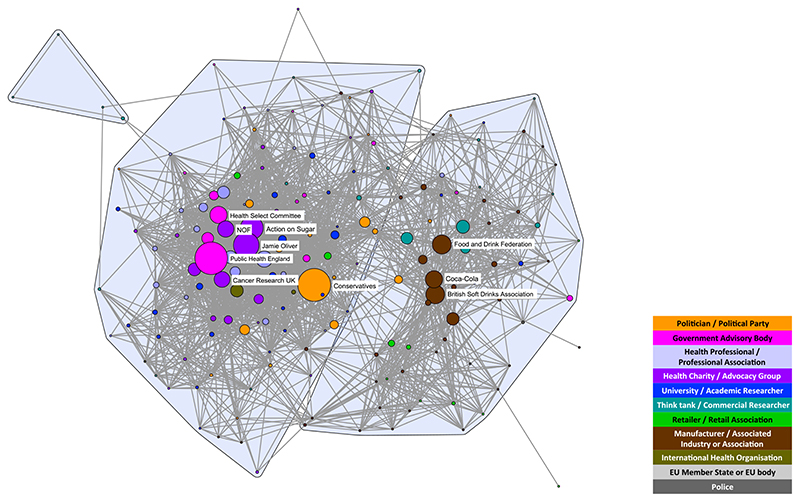
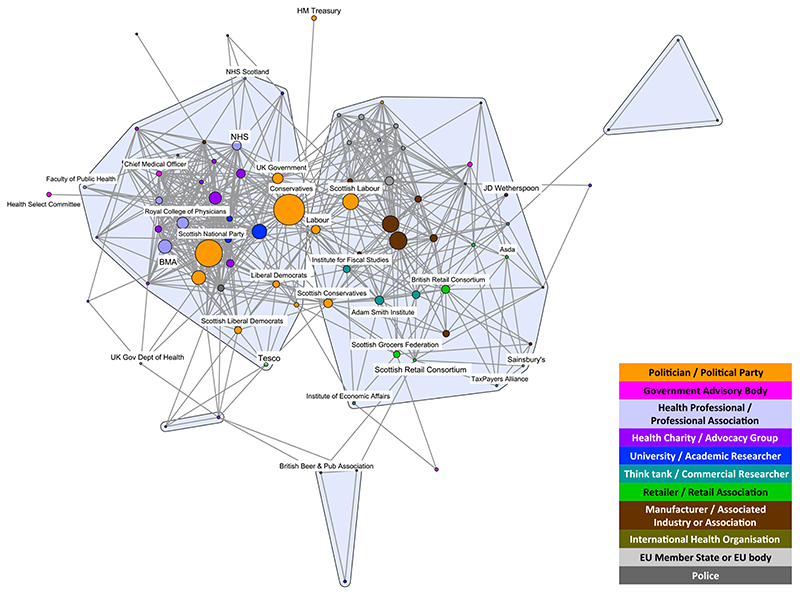
The networks for both pricing debates involve a similar range of stakeholder types and form clusters representing policy discourse coalitions. The SDIL network is larger than the MUP network, particularly the proponents' cluster, with more than three times as many stakeholders. Both networks have tight clusters of manufacturers, think-tanks and commercial analysts in the opponents' coalition. Public health stakeholders appear in both networks, but no health charity or advocacy group is common to both.
A comparison of the discourse in the UK press during the policy development processes for minimum unit pricing for alcohol and the soft drinks industry levy suggests greater cross-sector collaboration among policy opponents than proponents.
公共卫生政策的制定受到一系列利益相关者的影响,他们提出自己的观点,以影响对政策行动最佳选择的看法。本文比较了英国两个定价政策辩论中利益相关者在话语网络中的立场:酒精最低单位定价(MUP)和软饮料行业征税(SDIL)。
话语分析与网络可视化相结合,为两个政策辩论中的利益相关者的立场创建了代表,这些立场代表了 11 家英国全国性报纸中的观点。
英国。
MUP 辩论中,从 348 篇文章中对 87 个组织的 152 人共 1924 个陈述进行了编码。在 SDIL 辩论中,从 511 篇文章中对 175 个组织的 214 人共 3883 个陈述进行了编码。
使用网络分析技术来识别强有力的论证相似性,并最大限度地识别网络结构。网络大小、连通性和内聚性的测量用于比较话语网络。
两个定价辩论的网络都涉及类似的利益相关者类型,并形成了代表政策话语联盟的集群。SDIL 网络比 MUP 网络更大,特别是反对者的集群,利益相关者数量超过三倍。两个网络的反对者联盟中都有制造商、智库和商业分析师的紧密集群。公共卫生利益相关者出现在两个网络中,但没有一个健康慈善机构或倡导团体同时出现在两个网络中。
对英国媒体在酒精最低单位定价和软饮料行业征税的政策制定过程中的话语进行比较,表明政策反对者比支持者之间有更多的跨部门合作。