Médecins Sans Frontières (Operational Centre Geneva), Mbabane, Eswatini.
Eswatini National AIDS Programme (ENAP), Ministry of Health, Mbabane, Eswatini.
Trop Med Int Health. 2020 Jun;25(6):723-731. doi: 10.1111/tmi.13396. Epub 2020 Apr 13.
WHO recommends HIV self-testing (HIVST) as an additional approach to HIV testing services. The study describes the strategies used during phase-in of HIVST under routine conditions in Eswatini (formerly Swaziland).
Between May 2017 and January 2018, assisted and unassisted oral HIVST was offered at HIV testing services (HTS) sites to people aged ≥ 16 years. Additional support tools were available, including a telephone hotline answered 24/7, HIVST demonstration videos and printed educational information about HIV prevention and care services. Demographic characteristics of HIVST users were described and compared with standard blood-based HTS in the community. HIVST results were monitored with follow-up phone calls and the hotline.
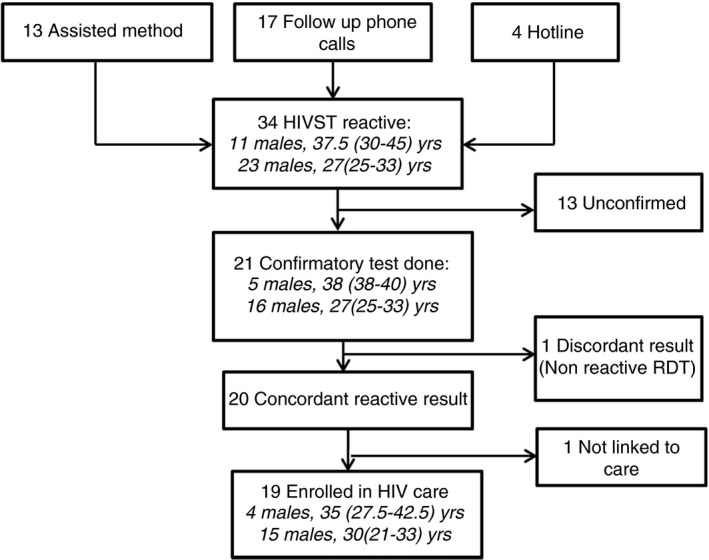
During the 9-month period, 1895 people accessed HIVST and 2415 HIVST kits were distributed. More people accessed HIVST kits in the community (n = 1365, 72.0%) than at health facilities (n = 530, 28.0%). The proportion of males and median age among those accessing HIVST and standard HTS in the community were similar (49.3%, 29 years HIVST vs. 48.7%, 27 years standard HTS). In total, 34 (3.9%) reactive results were reported from 938 people with known HIVST results; 32.4% were males, and median age was 30 years (interquartile range 25-36). Twenty-one (62%) patients were known to have received confirmatory blood-based HTS; of these, 20 (95%) had concordant reactive results and 19 (95%) were linked to HIV care at a clinic.
Integration of HIVST into existing HIV facility- and community-based testing strategies in Eswatini was found to be feasible, and HIVST has been adopted by national testing bodies in Eswatini.
世界卫生组织(WHO)推荐艾滋病毒自我检测(HIVST)作为艾滋病毒检测服务的另一种方法。本研究描述了在斯威士兰(前称斯威士兰)常规条件下 HIVST 逐步引入期间所采用的策略。
2017 年 5 月至 2018 年 1 月,在艾滋病毒检测服务(HTS)点向年龄≥16 岁的人群提供辅助和非辅助口腔 HIVST。还提供了额外的支持工具,包括每天 24 小时接听的电话热线、HIVST 演示视频以及有关艾滋病毒预防和护理服务的印刷教育信息。描述了 HIVST 用户的人口统计学特征,并将其与社区内的标准基于血液的 HTS 进行了比较。通过后续电话和热线监测 HIVST 结果。
在 9 个月期间,有 1895 人接受了 HIVST,共发放了 2415 个 HIVST 试剂盒。在社区中(n=1365,72.0%)获得 HIVST 试剂盒的人数多于在卫生机构中(n=530,28.0%)。在社区中接受 HIVST 和标准 HTS 的男性比例和中位年龄相似(HIVST 为 49.3%,29 岁;标准 HTS 为 48.7%,27 岁)。总共从已知 HIVST 结果的 938 人中报告了 34 例(3.9%)阳性结果;32.4%为男性,中位年龄为 30 岁(四分位间距 25-36)。21 人(62%)已知接受了基于血液的确认性 HTS;其中 20 人(95%)有一致的阳性结果,19 人(95%)在诊所接受了艾滋病毒护理。
在斯威士兰,将 HIVST 纳入现有的艾滋病毒机构和社区为基础的检测策略是可行的,HIVST 已被斯威士兰国家检测机构采用。