Department of Orthopedics, Southwest Hospital, Army Medical University, Gaotanyan Main Street 30#, District Shapingba, Chongqing, China.
Department of Orthopedics, Dujiangyan Medical Center, Dujiangyan, Sichuan, China.
Ann Clin Microbiol Antimicrob. 2020 Mar 26;19(1):10. doi: 10.1186/s12941-020-00352-4.
Staphylococcus aureus is a primary pathogen of orthopedic infections. By mediating antimicrobial resistance, S. aureus biofilm plays an important role in the recalcitrance of orthopedic infections, especially for the intractable osteomyelitis (OM). This study investigated the relationship between biofilm production and various genetic or phenotypic characteristics among orthopedic S. aureus strains.
A total of 137 orthopedic S. aureus isolates were enrolled and divided into OM and non-OM groups. Biofilm production was evaluated using the crystal violet assay. Genetic and phenotypic characteristics including MRSA identification, MLST and spa typing, carriage of virulence genes, drug resistance, and patients' inflammatory responses indicators were characterized. The relationship between biofilm production and above-mentioned features was respectively analyzed among all isolates and compared between OM and non-OM isolates.
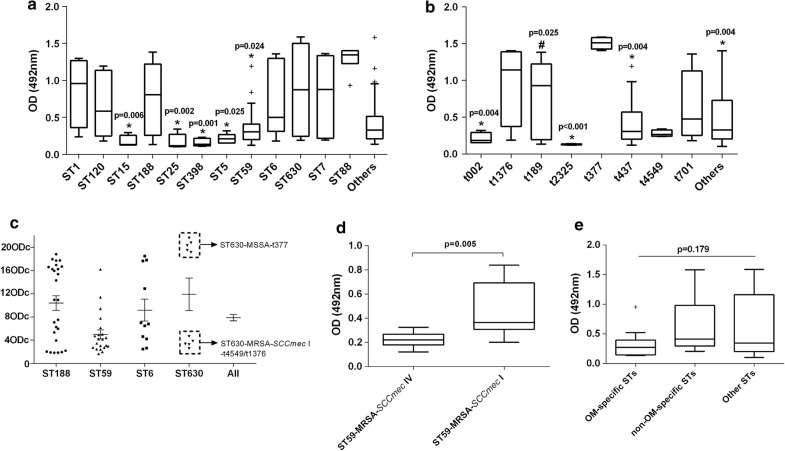
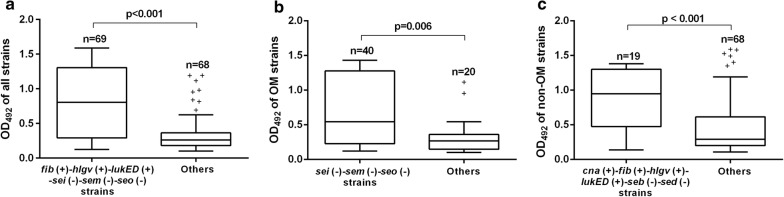
Biofilm production presented no significant difference between OM (including 9 MRSA isolates) and non-OM (including 21 MRSA isolates) strains. We found that ST88, t377 and ST630-MSSA-t377 strains produced very strong biofilms, while MLST types of ST15, ST25, ST398, ST5, ST59 and spa types of t002, t2325, t437 tended to produce weaker biofilms. Strains with the following profiles produced stronger biofilms: fib(+)-hlgv(+)-lukED(+)-sei(-)-sem(-)-seo(-) for all isolates, sei(-)-sem(-)-seo(-) for OM isolates, and cna (+)-fib (+)-hlgv (+)-lukED (+)-seb(-)-sed(-) for non-OM isolates. In addition, not any single drug resistance was found to be related to biofilm production. We also observed that, among OM patients, strains with stronger biofilms caused weaker inflammatory responses.
Some genetic or phenotypic characteristics of orthopedic strains were associated with biofilm production, and this association could be different among OM and non-OM strains. The results are of great significance for better understanding, evaluating and managing different kinds of biofilm-associated orthopedic infections, and provide potential targets for biofilm clearance.
金黄色葡萄球菌是骨科感染的主要病原体。金黄色葡萄球菌生物膜通过介导抗菌药物耐药性,在骨科感染的难治性中发挥重要作用,特别是对难治性骨髓炎(OM)。本研究调查了骨科金黄色葡萄球菌菌株中生物膜产生与各种遗传或表型特征之间的关系。
共纳入 137 株骨科金黄色葡萄球菌分离株,分为 OM 组和非 OM 组。采用结晶紫法评估生物膜生成。对包括 MRSA 鉴定、MLST 和 spa 分型、毒力基因携带、耐药性和患者炎症反应指标在内的遗传和表型特征进行了描述。分别分析了所有分离株中生物膜产生与上述特征之间的关系,并比较了 OM 组和非 OM 组分离株之间的差异。
OM 组(包括 9 株 MRSA 分离株)和非 OM 组(包括 21 株 MRSA 分离株)之间生物膜生成无显著差异。我们发现 ST88、t377 和 ST630-MSSA-t377 菌株产生非常强的生物膜,而 MLST 类型为 ST15、ST25、ST398、ST5、ST59 和 spa 类型为 t002、t2325、t437 的菌株倾向于产生较弱的生物膜。以下表型的菌株产生更强的生物膜:所有分离株的 fib(+)-hlgv(+)-lukED(+)-sei(-)-sem(-)-seo(-)、OM 分离株的 sei(-)-sem(-)-seo(-)和非 OM 分离株的 cna (+)-fib (+)-hlgv (+)-lukED (+)-seb(-)-sed(-)。此外,未发现任何单一耐药性与生物膜生成相关。我们还观察到,在 OM 患者中,具有更强生物膜的菌株引起的炎症反应较弱。
骨科菌株的某些遗传或表型特征与生物膜生成有关,并且这种关联在 OM 和非 OM 菌株之间可能不同。这些结果对于更好地理解、评估和管理不同类型的生物膜相关骨科感染具有重要意义,并为生物膜清除提供了潜在的目标。