Takenaka Shiho, Saeki Ayano, Sukenaga Norihiko, Ueki Ryusuke, Kariya Nobutaka, Tatara Tsuneo, Hirose Munetaka
Department of Anesthesiology and Pain Medicine, Hyogo College of Medicine, Hyogo.
Anesthesia Department, Cancer Pain Clinic, Fukuyama City Hospital, Fukuyama, Japan.
Medicine (Baltimore). 2020 Mar;99(13):e19629. doi: 10.1097/MD.0000000000019629.
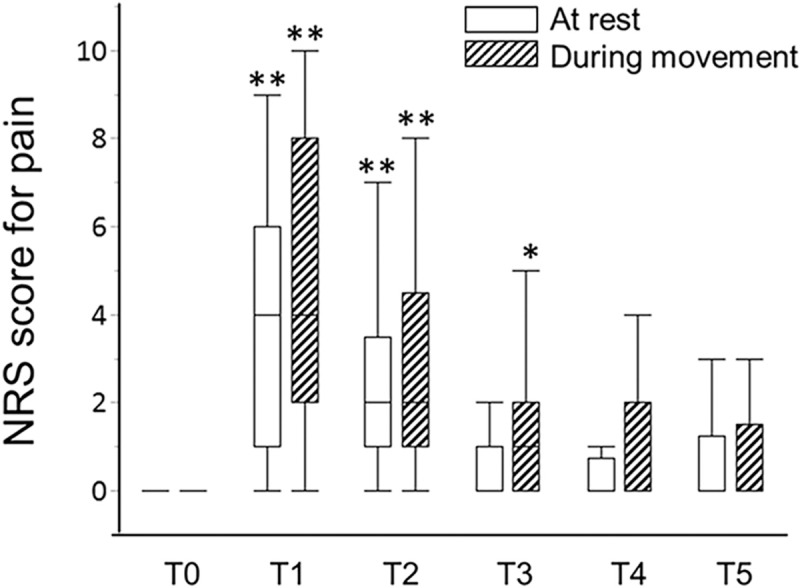
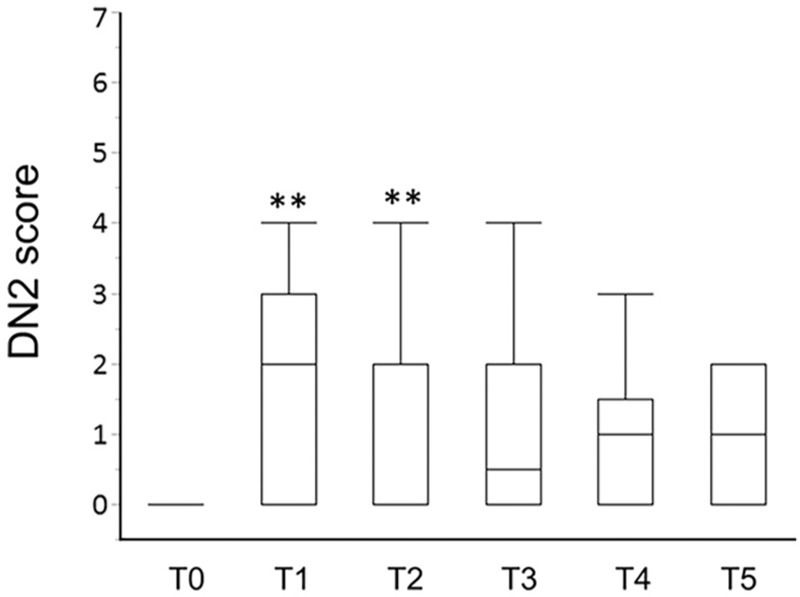
Acute postsurgical pain, probably including acute neuropathic pain (ANeP), starts at the early postoperative period, and chronic postsurgical pain including chronic neuropathic pain (CNeP) persists at least 3 months after surgery. Although it must be important for prevention and treatment of acute and chronic postoperative pain to reveal the time course of postoperative neuropathic characteristics, a neuropathic pain profile after surgery has not been evaluated.Pain status at the surgical site in adult patients who underwent video-assisted thoracic surgery (VATS) for lung cancer was prospectively assessed until 12 months after surgery. Neuropathic characteristics were assessed using the Douleur Neuropathique 4 (DN4) questionnaire until 6 days after surgery and the DN2 questionnaire throughout the study.Twenty-seven patients were enrolled in this study. Pain intensity at surgical sites were significantly higher at 1 and 6 days after surgery during resting state, and were also significantly higher at 3, 6, and 12 months after surgery during movement than those before surgery. The incidence of ANeP was 33.3% at 1 day, and 18.5% at 6 days after surgery. The incidence of CNeP decreased to 12.5% at 3 months, 5.0% at 6 months, and 0.0% at 12 months after surgery. The number of neuropathic characteristics, assessed by DN2 scores, significantly increased at 1 and 6 days after surgery, compared to those before surgery. DN2 scores at 3, 6, and 12 months after surgery, however, showed no significant differences compared to those before surgery.In patients with acute postsurgical pain, 20% to 30% of patients show ANeP characteristics, and the incidence of CNeP gradually decreases after VATS in patients with chronic postsurgical pain.
急性术后疼痛,可能包括急性神经性疼痛(ANeP),始于术后早期,而慢性术后疼痛包括慢性神经性疼痛(CNeP)则在术后至少持续3个月。尽管揭示术后神经病理性特征的时间进程对于急性和慢性术后疼痛的预防和治疗至关重要,但术后神经病理性疼痛的特征尚未得到评估。对接受肺癌电视辅助胸腔手术(VATS)的成年患者手术部位的疼痛状况进行了前瞻性评估,直至术后12个月。在术后6天内使用神经病理性疼痛4(DN4)问卷评估神经病理性特征,在整个研究过程中使用DN2问卷进行评估。本研究共纳入27例患者。手术部位的疼痛强度在术后1天和6天静息状态时显著高于术前,在术后3个月、6个月和12个月活动时也显著高于术前。术后1天ANeP的发生率为33.3%,术后6天为18.5%。术后3个月CNeP的发生率降至12.5%,6个月时为5.0%,12个月时为0.0%。与术前相比,术后1天和6天通过DN2评分评估的神经病理性特征数量显著增加。然而,术后3个月、6个月和12个月的DN2评分与术前相比无显著差异。在急性术后疼痛患者中,20%至30%的患者表现出ANeP特征,慢性术后疼痛患者在VATS后CNeP的发生率逐渐降低。