Department of Epidemiology and Prevention, Center for Clinical Sciences, National Center for Global Health and Medicine, Tokyo 162-8655, Japan.
Department of Health Administration, Furukawa Electric Corporation, Tokyo 100-8322, Japan.
Nutrients. 2020 Mar 26;12(4):902. doi: 10.3390/nu12040902.
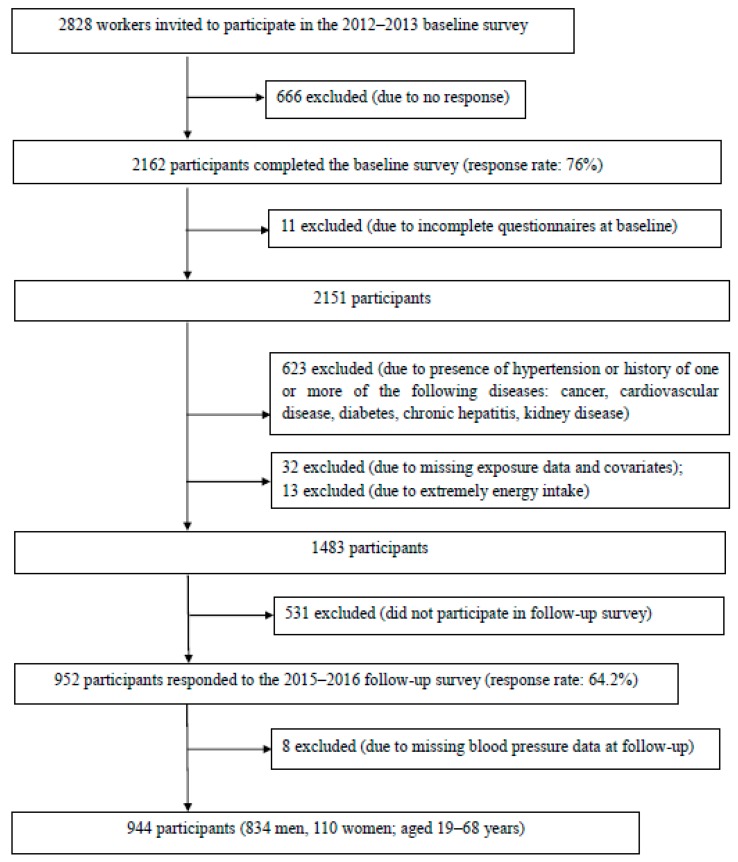
Hypertension has become a major public health issue worldwide. Whole grains contain higher levels and a broader range of nutrients with potential health benefits and may decrease the risk of hypertension. However, no prospective studies have investigated this association in the high-income Asia Pacific region, which has the lowest whole grain intake worldwide. Thus, we examined the prospective association between whole grain consumption and the development of hypertension in Japan. Participants included 944 working Japanese adults aged 19-68 years who had no hypertension at baseline and completed a 3-year follow-up survey. Whole grain consumption was assessed via a self-administered dietary questionnaire. Multivariate logistic regression analysis was carried out to examine the association between whole grain consumption and hypertension, adjusting for potential confounding factors, such as sociodemographic, lifestyle, dietary, and occupational characteristics. After 3 years, 9.4% (86 cases) of the study participants had developed hypertension. More frequent whole grain consumption, classified as an intake frequency of "sometimes or always", was associated with lower odds of hypertension (multivariate-adjusted odds ratio: 0.36; 95% confidence interval: 0.16-0.83; for trend = 0.04) compared with no consumption. Consuming more whole grains may decrease the risk of developing hypertension.
高血压已成为全球主要的公共卫生问题。全谷物含有更高水平和更广泛范围的具有潜在健康益处的营养物质,可能降低高血压的风险。然而,尚无前瞻性研究调查过高收入的亚太地区(全世界全谷物摄入量最低的地区)的这种关联。因此,我们研究了日本全谷物摄入量与高血压发展之间的前瞻性关联。参与者包括 944 名年龄在 19-68 岁之间、基线时无高血压且完成了 3 年随访调查的日本在职成年人。通过自我管理的饮食问卷评估全谷物的摄入量。采用多变量逻辑回归分析,调整了社会人口统计学、生活方式、饮食和职业特征等潜在混杂因素,以检验全谷物摄入量与高血压之间的关联。3 年后,8.6%(86 例)的研究参与者出现了高血压。与不摄入全谷物相比,更频繁地摄入全谷物(摄入量为“有时或总是”)与较低的高血压发病风险相关(多变量调整后的比值比:0.36;95%置信区间:0.16-0.83;趋势检验=0.04)。摄入更多的全谷物可能会降低患高血压的风险。