Department of Nutrition, Harvard TH Chan School of Public Health, 665 Huntington Avenue, Boston, MA 02115, USA.
Department of Epidemiology, Harvard TH Chan School of Public Health, Boston, MA, USA.
BMJ. 2020 Jul 8;370:m2206. doi: 10.1136/bmj.m2206.
To examine the associations between the intake of total and individual whole grain foods and the risk of type 2 diabetes.
Prospective cohort studies.
Nurses' Health Study (1984-2014), Nurses' Health Study II (1991-2017), and Health Professionals Follow-Up Study (1986-2016), United States.
158 259 women and 36 525 men who did not have type 2 diabetes, cardiovascular disease, or cancer at baseline.
Self-reports of incident type 2 diabetes by participants identified through follow-up questionnaires and confirmed by a validated supplementary questionnaire.
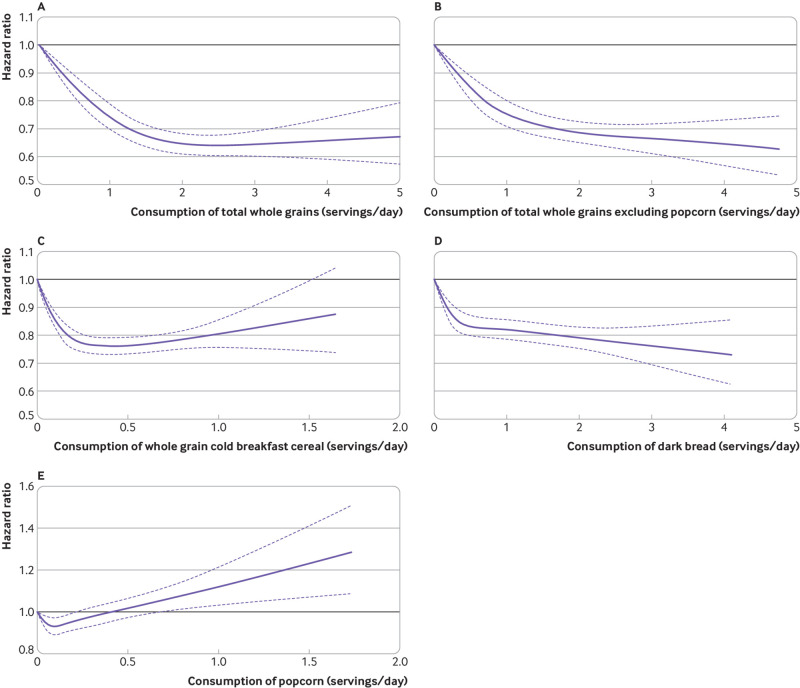
During 4 618 796 person years of follow-up, 18 629 participants with type 2 diabetes were identified. Total whole grain consumption was categorized into five equal groups of servings a day for the three cohorts. After adjusting for lifestyle and dietary risk factors for diabetes, participants in the highest category for total whole grain consumption had a 29% (95% confidence interval 26% to 33%) lower rate of type 2 diabetes compared with those in the lowest category. For individual whole grain foods, pooled hazard ratios (95% confidence intervals) for type 2 diabetes in participants consuming one or more servings a day compared with those consuming less than one serving a month were 0.81 (0.77 to 0.86) for whole grain cold breakfast cereal, 0.79 (0.75 to 0.83) for dark bread, and 1.08 (1.00 to 1.17) for popcorn. For other individual whole grains with lower average intake levels, comparing consumption of two or more servings a week with less than one serving a month, the pooled hazard ratios (95% confidence intervals) were 0.79 (0.75 to 0.83) for oatmeal, 0.88 (0.82 to 0.94) for brown rice, 0.85 (0.80 to 0.90) for added bran, and 0.88 (0.78 to 0.98) for wheat germ. Spline regression showed a non-linear dose-response association between total whole grain intake and the risk of type 2 diabetes where the rate reduction slightly plateaued at more than two servings a day (P<0.001 for curvature). For whole grain cold breakfast cereal and dark bread, the rate reduction plateaued at about 0.5 servings a day. For consumption of popcorn, a J shaped association was found where the rate of type 2 diabetes was not significantly raised until consumption exceeded about one serving a day. The association between higher total whole grain intake and lower risk of type 2 diabetes was stronger in individuals who were lean than in those who were overweight or obese (P=0.003 for interaction), and the associations did not vary significantly across levels of physical activity, family history of diabetes, or smoking status.
Higher consumption of total whole grains and several commonly eaten whole grain foods, including whole grain breakfast cereal, oatmeal, dark bread, brown rice, added bran, and wheat germ, was significantly associated with a lower risk of type 2 diabetes. These findings provide further support for the current recommendations of increasing whole grain consumption as part of a healthy diet for the prevention of type 2 diabetes.
研究全谷物食物和各类全谷物食物的摄入量与 2 型糖尿病风险之间的关系。
前瞻性队列研究。
美国护士健康研究(1984-2014 年)、护士健康研究 II(1991-2017 年)和健康专业人员随访研究(1986-2016 年)。
158259 名女性和 36525 名基线时无 2 型糖尿病、心血管疾病或癌症的男性。
参与者通过随访问卷确定的 2 型糖尿病的发生率,并通过经过验证的补充问卷进行确认。
在 4618796 人年的随访期间,有 18629 名参与者发生了 2 型糖尿病。总全谷物摄入量分为三个队列每天摄入 5 份的 5 个等量组。在调整了糖尿病的生活方式和饮食风险因素后,与最低摄入量组相比,总全谷物摄入量最高组的 2 型糖尿病发生率降低了 29%(95%置信区间 26%至 33%)。对于个体全谷物食物,与每月摄入少于 1 份相比,每天摄入 1 份或更多份的参与者发生 2 型糖尿病的合并危险比(95%置信区间)为:全谷物冷早餐麦片 0.81(0.77 至 0.86),深色面包 0.79(0.75 至 0.83),爆米花 1.08(1.00 至 1.17)。对于其他平均摄入量较低的个体全谷物,与每月摄入少于 1 份相比,每周摄入 2 份或更多份的合并危险比(95%置信区间)为:燕麦片 0.79(0.75 至 0.83),糙米 0.88(0.82 至 0.94),添加麸皮 0.85(0.80 至 0.90),小麦胚芽 0.88(0.78 至 0.98)。样条回归显示,全谷物总摄入量与 2 型糖尿病风险之间存在非线性剂量反应关系,在每天摄入超过 2 份时,这种降低率略有趋于平稳(P<0.001 表示曲线性)。对于全谷物冷早餐麦片和深色面包,降低率在每天约 0.5 份时趋于平稳。对于爆米花的摄入量,发现呈 J 型关联,直到每天摄入超过约 1 份时,2 型糖尿病的发病率才明显升高。在较瘦的个体中,较高的全谷物总摄入量与较低的 2 型糖尿病风险之间的关联更强,而在超重或肥胖的个体中则较弱(交互作用 P=0.003),且这些关联在不同体力活动水平、糖尿病家族史或吸烟状况下无显著差异。
较高的全谷物总摄入量和几种常见的全谷物食物(包括全谷物早餐麦片、燕麦片、深色面包、糙米、添加麸皮和小麦胚芽)的摄入量与 2 型糖尿病风险显著降低有关。这些发现进一步支持了目前增加全谷物摄入量作为预防 2 型糖尿病的健康饮食建议。