Prager K C, Mazet Jonna A K, Munson Linda, Cleaveland Sarah, Donnelly Christl A, Dubovi Edward J, Szykman Gunther Micaela, Lines Robin, Mills Gus, Davies-Mostert Harriet T, Weldon McNutt J, Rasmussen Gregory, Terio Karen, Woodroffe Rosie
Wildlife Health Center, University of California, One Shields Avenue, Davis, CA 95616, USA.
Boyd Orr Centre for Population and Ecosystem Health, University of Glasgow, Glasgow, United Kingdom.
Biol Conserv. 2012 Jun;150(1):15-22. doi: 10.1016/j.biocon.2012.03.005. Epub 2012 Apr 28.
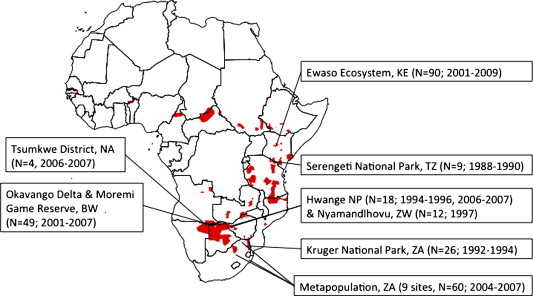
Infectious diseases impact African wild dogs (), but the nature and magnitude of this threat likely varies among populations according to different factors, such as the presence and prevalence of pathogens and land-use characteristics. We systematically evaluated these factors to assist development of locally appropriate strategies to mitigate disease risk. Wild dogs from 16 sites representing five unconnected populations were examined for rabies virus, canine distemper virus (CDV), canine parvovirus, canine coronavirus, and spp. exposure. Analyses revealed widespread exposure to viral pathogens, but was never detected. Exposure to CDV was associated with unprotected and protected-unfenced areas where wild dogs likely have a high probability of domestic dog contact and, in the case of protected-unfenced areas, likely reside amongst high wildlife densities. Our findings also suggest that domestic dog contact may increase rabies and coronavirus exposure risk. Therefore, domestic dogs may be a source of CDV, rabies and coronavirus, while wildlife may also play an important role in CDV transmission dynamics. Relatively high parvovirus seroprevalence across land-use types suggests that it might persist in the absence of spillover from domestic dogs. Should intervention be needed to control pathogens in wild dogs, efforts to prevent rabies and coronavirus exposure might be directed at reducing infection in the presumed domestic dog reservoir through vaccination. If prevention of CDV and parvovirus infections were deemed a management necessity, control of disease in domestic dogs may be insufficient to reduce transmission risks, and vaccination of wild dogs themselves may be the optimal strategy.
传染病影响非洲野犬,但根据病原体的存在和流行情况以及土地利用特征等不同因素,这种威胁的性质和程度在不同种群中可能有所不同。我们系统地评估了这些因素,以协助制定因地制宜的策略来降低疾病风险。对代表五个不相连种群的16个地点的野犬进行了狂犬病病毒、犬瘟热病毒(CDV)、犬细小病毒、犬冠状病毒和 属暴露情况的检测。分析显示广泛暴露于病毒病原体,但从未检测到 。接触CDV与未受保护和有保护但无围栏的区域有关,在这些区域野犬很可能有很高概率与家犬接触,而且在有保护但无围栏的区域,野犬可能生活在野生动物密度高的地方。我们的研究结果还表明,与家犬接触可能会增加感染狂犬病和冠状病毒的风险。因此,家犬可能是CDV、狂犬病和冠状病毒的一个来源,而野生动物在CDV传播动态中也可能发挥重要作用。不同土地利用类型中相对较高的细小病毒血清阳性率表明,在没有家犬溢出感染的情况下它可能会持续存在。如果需要采取干预措施来控制野犬中的病原体,预防狂犬病和冠状病毒暴露的努力可能会针对通过疫苗接种减少假定的家犬宿主中的感染。如果认为预防CDV和细小病毒感染是管理上的必要措施,控制家犬中的疾病可能不足以降低传播风险,对野犬本身进行疫苗接种可能是最佳策略。