Department of Pharmaceutical Sciences, Eugene Applebaum College of Pharmacy and Health Sciences, Wayne State University, 259 Mack Avenue, Detroit, MI 48201, USA.
School of Health Sciences, Wuhan University, 115 Donghu Road, Wuhan 430071, China.
Theranostics. 2020 Mar 4;10(9):4134-4149. doi: 10.7150/thno.42903. eCollection 2020.
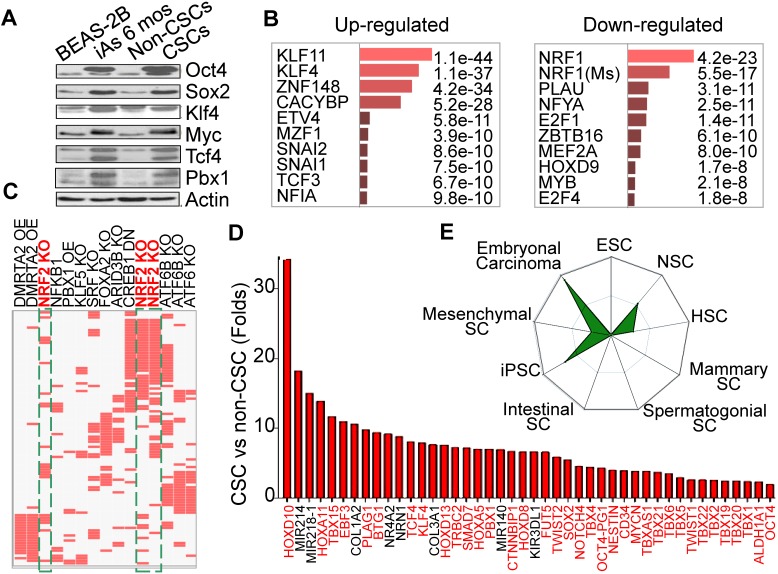
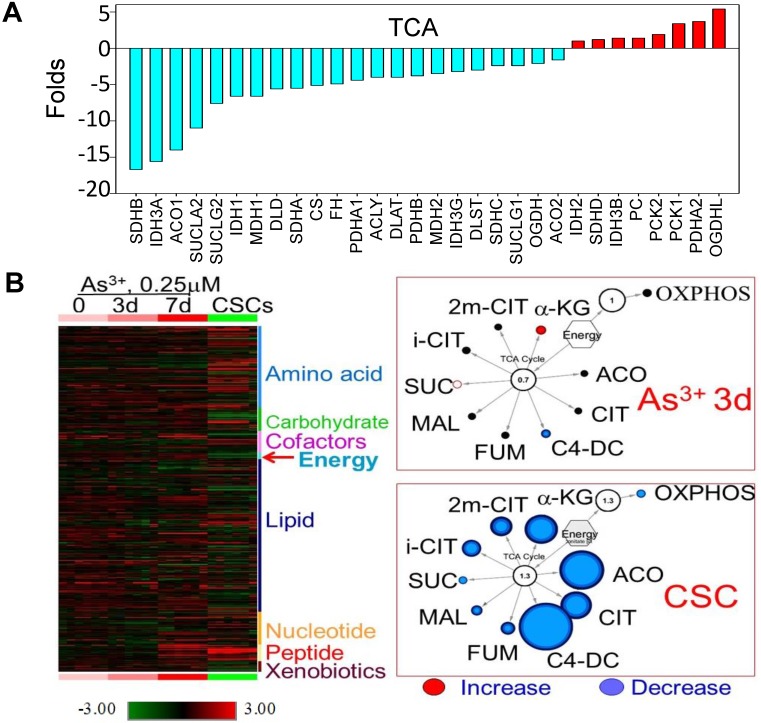
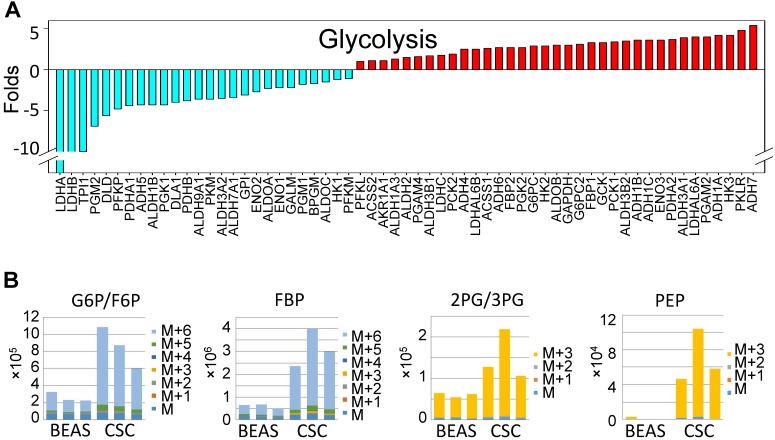
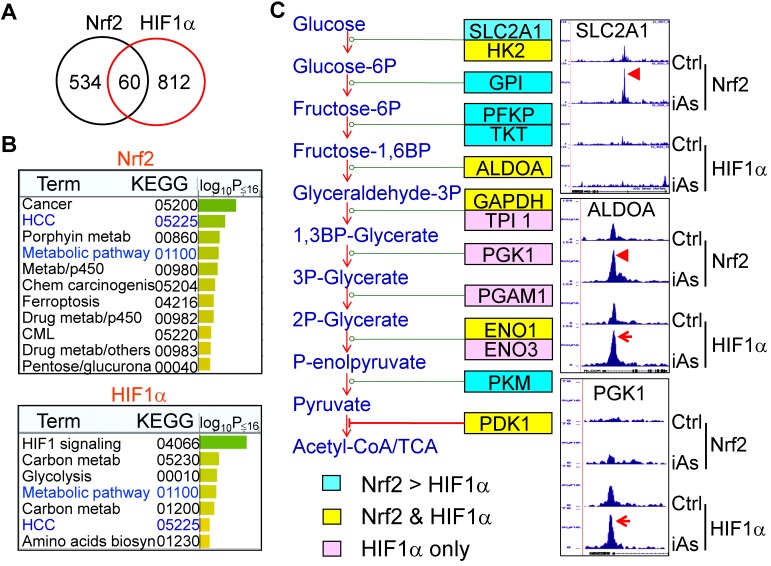
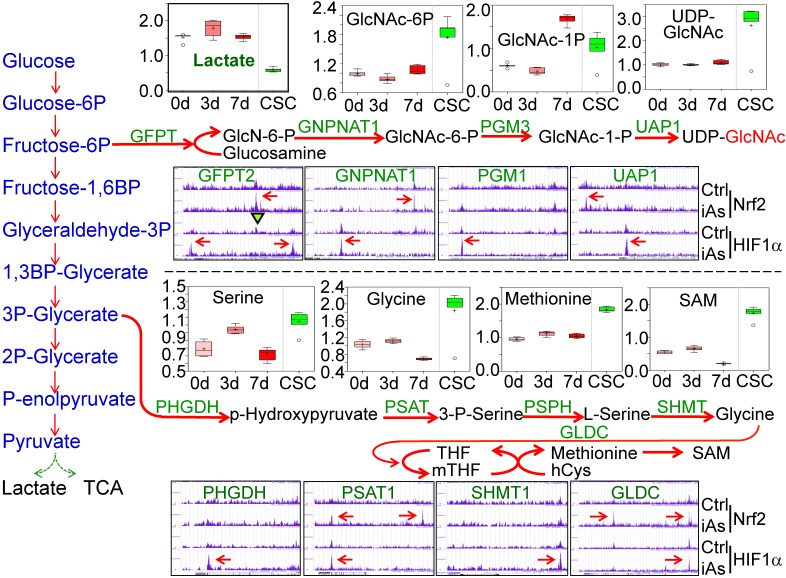
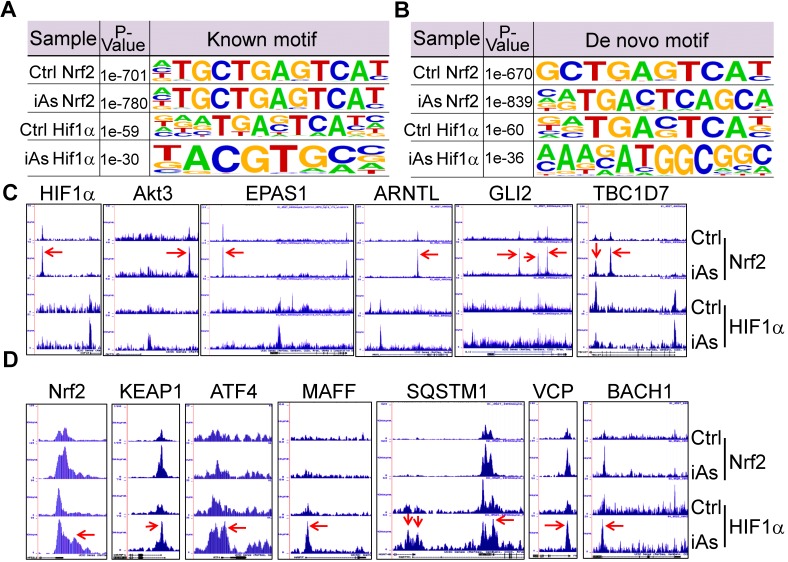
In this report, we demonstrated that inorganic arsenic (iAs) induces generation of the cancer stem-like cells (CSCs) through Nrf2-dependent HIF1α activation, and the subsequent metabolic reprogramming from mitochondrial oxidative phosphorylation to glycolysis in epithelial cells. : Genome-wide ChIP-seq analysis was performed to investigate the global binding of Nrf2 and/or HIF1α on the genome in the cells treated with iAs. Both untargeted metabolomics and UDP-C-glucose flux were applied to determine metabolic reprogramming in the iAs-induced CSCs. The role of Nrf2 on iAs-induced HIF1α and other stemness gene expression was validated by lentiviral transfection of Nrf2 inhibitor Keap1 and CRISPR-Cas9-mediated Nrf2 gene knockout, respectively. : The CSCs induced by iAs exhibit a diminished mitochondrial oxidative phosphorylation and an enhanced glycolysis that is actively shunted to the hexosamine biosynthetic pathway (HBP) and serine/glycine pathway. ChIP-seq data revealed that treatment of the cells with iAs amplified Nrf2 enrichment peaks in intergenic region, promoter and gene body. In contrast, a shift of the HIF1α peaks from distal intergenic region to gene promoter and the first exon was noted. Both Nrf2 and HIF1α are responsible for the iAs-induced expression of the glycolytic genes and the genes important for the stemness of the CSCs. Intriguingly, we also discovered a mutual transcriptional regulation between Nrf2 and HIF1α. Inhibition of Nrf2 by lentiviral infection of Keap1, or knockout of Nrf2 by CRISPR-Cas9 gene editing, not only blocked iAs-induced HIF1α activation, but reduced the expression of the key stemness genes for the formation of CSCs also. : We demonstrated that Nrf2 activation is an initiating signal for iAs-induced HIF1α activation, and Nrf2 and HIF1α played a concerted role on inducing metabolic reprogramming and the CSCs.
在本报告中,我们证明无机砷(iAs)通过 Nrf2 依赖性 HIF1α 激活诱导癌症干细胞样细胞(CSC)的产生,随后上皮细胞中的代谢从线粒体氧化磷酸化重编程为糖酵解。:进行了全基因组 ChIP-seq 分析,以研究用 iAs 处理的细胞中 Nrf2 和/或 HIF1α 在基因组上的全局结合。分别应用非靶向代谢组学和 UDP-C-葡萄糖通量来确定 iAs 诱导的 CSCs 中的代谢重编程。通过慢病毒转染 Nrf2 抑制剂 Keap1 和 CRISPR-Cas9 介导的 Nrf2 基因敲除,分别验证了 Nrf2 在 iAs 诱导的 HIF1α 和其他干性基因表达中的作用。:iAs 诱导的 CSCs 表现出线粒体氧化磷酸化减少和糖酵解增强,糖酵解被积极分流到己糖胺生物合成途径(HBP)和丝氨酸/甘氨酸途径。ChIP-seq 数据显示,用 iAs 处理细胞后,Nrf2 富集峰在基因间区、启动子和基因体中放大。相比之下,注意到 HIF1α 峰从远端基因间区转移到基因启动子和第一外显子。Nrf2 和 HIF1α 都负责 iAs 诱导的糖酵解基因和 CSC 干性的重要基因的表达。有趣的是,我们还发现了 Nrf2 和 HIF1α 之间的相互转录调节。通过慢病毒感染 Keap1 抑制 Nrf2 或通过 CRISPR-Cas9 基因编辑敲除 Nrf2,不仅阻断了 iAs 诱导的 HIF1α 激活,而且还降低了形成 CSC 的关键干性基因的表达。:我们证明 Nrf2 激活是 iAs 诱导的 HIF1α 激活的起始信号,Nrf2 和 HIF1α 协同作用于诱导代谢重编程和 CSC。