Department of Ophthalmology, Mackay Memorial Hospital, Taipei, Taiwan.
Department of Internal Medicine, Cathay General hospital, Taipei, Taiwan.
BMC Infect Dis. 2020 Mar 30;20(1):254. doi: 10.1186/s12879-020-04979-8.
To evaluate nasal carriage, antibiotic susceptibility and molecular characteristics of methicillin-resistant Staphylococcus aureus (MRSA), as well as the risk factors of MRSA colonization, in human immunodeficiency virus (HIV)-infected patients in northern Taiwan.
From September 2014 to November 2015, HIV-infected patients seeking outpatient care at four hospitals were eligible for this study. A nasal specimen was obtained from each subject for the detection of S. aureus and a questionnaire was completed by each subject. MRSA isolates once identified were characterized.
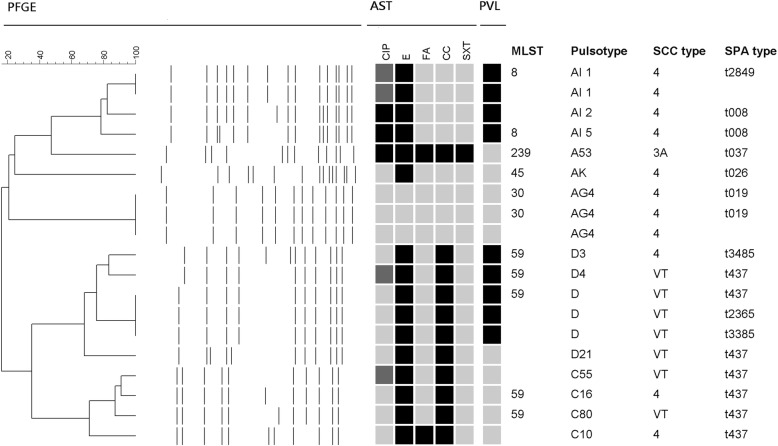
Of 553 patients surveyed, methicillin-susceptible S. aureus (MSSA) was detected in 119 subjects (21.5%) and MRSA in 19 subjects (3.4%). Female gender, injection drug use, smoking, hepatitis C virus carrier, cancer and antibiotic use within 1 year were positively associated with MRSA colonization. By multivariate analysis, only cancer (adjust odds ratio (aOR) 7.78, [95% confidence interval (CI), 1.909-31.731]) and antibiotic use within 1 year (aOR 3.89, [95% CI, 1.219-12.433]) were significantly associated with MRSA colonization. Ten isolates were characterized as sequence type (ST) 59/staphylococcal chromosome cassette (SCC) IV or V, endemic community strains in Taiwan, four isolates as ST 8/SCCmec IV (USA 300) and one isolate as ST 239/SCCmec IIIA, a hospital strain. All the community-associated MRSA isolates were susceptible to trimethoprim-sulfamethoxazole (TMP-SMX).
Nasal MRSA carriage in HIV-infected patients seeking outpatient care was low (3.4%) in northern Taiwan. Most of the colonizing isolates were genetically endemic community strains and exhibited high susceptibility to TMP-SMX and fluoroquinolones. Cancer and antibiotic use within 1 year were associated with MRSA colonization.
评估耐甲氧西林金黄色葡萄球菌(MRSA)在台湾北部地区 HIV 感染者中的鼻腔携带情况、抗生素敏感性和分子特征,以及 MRSA 定植的危险因素。
2014 年 9 月至 2015 年 11 月,在四家医院接受门诊治疗的 HIV 感染者符合本研究条件。从每位研究对象中采集一个鼻腔样本,用于检测金黄色葡萄球菌,并由每位研究对象填写一份问卷。一旦鉴定出 MRSA 分离株,即对其进行特征分析。
在接受调查的 553 名患者中,119 名(21.5%)患者检测出甲氧西林敏感金黄色葡萄球菌(MSSA),19 名(3.4%)患者检测出 MRSA。女性、注射吸毒、吸烟、丙型肝炎病毒携带者、癌症和 1 年内使用抗生素与 MRSA 定植呈正相关。多变量分析显示,仅癌症(调整优势比[aOR]7.78,[95%置信区间(CI),1.909-31.731])和 1 年内使用抗生素(aOR 3.89,[95% CI,1.219-12.433])与 MRSA 定植显著相关。10 株分离株被鉴定为序列类型(ST)59/葡萄球菌染色体盒(SCC)IV 或 V,为台湾地区流行的社区菌株,4 株分离株为 ST8/SCCmecIV(USA300),1 株分离株为 ST239/SCCmecIIIa,为医院菌株。所有社区相关的 MRSA 分离株均对甲氧苄啶-磺胺甲恶唑(TMP-SMX)敏感。
在台湾北部地区,接受门诊治疗的 HIV 感染者中,鼻腔 MRSA 携带率较低(3.4%)。定植分离株大多为遗传上的流行社区菌株,对 TMP-SMX 和氟喹诺酮类药物具有较高的敏感性。癌症和 1 年内使用抗生素与 MRSA 定植相关。