Department of Epidemiology & Biostatistics, Collage of Health and Medical Sciences, Haramaya University, Haramaya, Ethiopia.
Department of Epidemiology and Biostatistics, Institute of Public Health, College of Medicine and Health Sciences, University of Gondar, Gondar, Ethiopia.
Health Qual Life Outcomes. 2020 Mar 30;18(1):83. doi: 10.1186/s12955-020-01337-9.
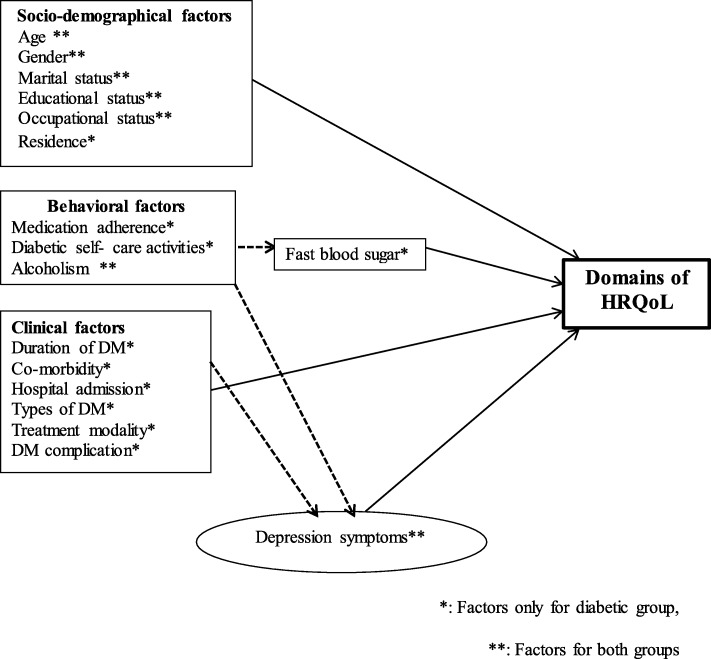
Diabetes mellitus (DM) is a chronic disease, leading to many complications and substantial decrease in patients' Health Related Quality of Life (HRQoL). HRQoL among diabetic patients could affect by concurrent various factors. Therefore, analysis of these concomitant factors using generalized structural equation model (GSEM) that takes account the complex network of relationship could be a more utilitarian approach to better understand factor affecting HRQoL. The present study aimed to assesses the level of HRQoL and its associated factors among adults with and without diabetes.
A comparative cross-sectional study was conducted from March 13 to April 4, 2019 in Adama Hospital and Medical College and Adama city Kebele 2, 4 and 5, East Shewa Ethiopia. Data related to socio-demographics, behavioral, clinical factors and HRQoL were collected from 359 adults with diabetes & 415 adults without diabetes through face to face interviews. Data was entered to Epi-data 3.1 then it was exported to STATA 14 for further analysis. GSEM was employed to verify relationships and association among exogenous, mediating and endogenous variable concurrently.
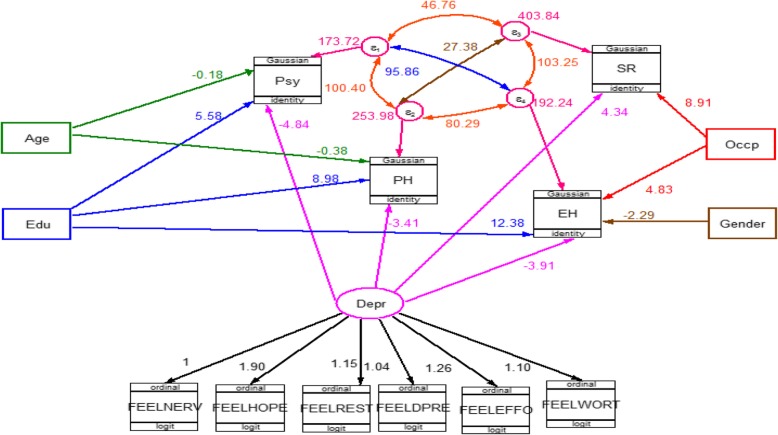
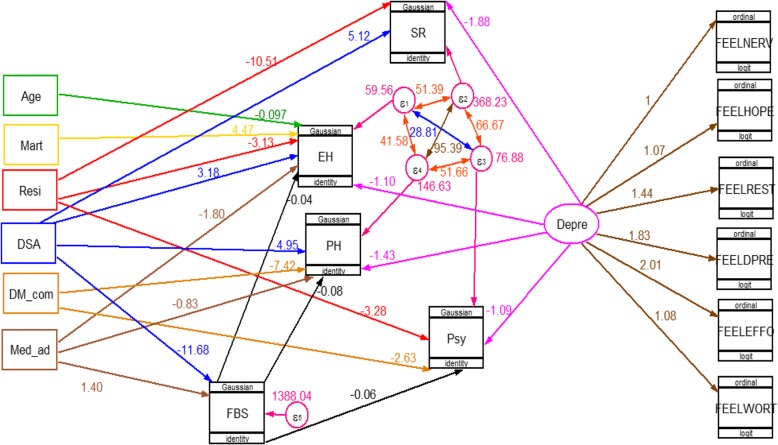
Diabetic groups had a significant lower mean score in all domains of HRQoL than non- diabetic group (p-value< 0.0001). Depression had a direct negative effect on all domains of HRQoL in both groups. Fasting blood sugar also had a direct negative effect on all domains of HRQoL except social relation. Diabetes mellitus complication had a direct negative effect on both physical and psychological health. Low Medication adherence and poor diabetic self-care activity had a negative direct, indirect and total effect on physical and environmental health through fasting blood sugar.
Diabetic patients had lower HRQoL in all the domains of quality of life. Socio-demographic factor (Age, residence and marital status), clinical factor (Depression & Diabetes mellitus complication) and behavioral factor (diabetic self-care activity and medication adherence) mediated by fasting blood sugar were factor associated HRQoL among the diabetic group. Thus, we recommend that integration of screening for depression and give counseling on medication adherences and diabetic self-care activity along with the already existing DM treatment.
糖尿病(DM)是一种慢性病,导致许多并发症,并显著降低患者的健康相关生活质量(HRQoL)。糖尿病患者的 HRQoL 可能受到多种并发因素的影响。因此,使用广义结构方程模型(GSEM)分析这些并发因素,该模型考虑到了复杂的关系网络,可能是一种更实用的方法,可以更好地了解影响 HRQoL 的因素。本研究旨在评估有和没有糖尿病的成年人的 HRQoL 水平及其相关因素。
2019 年 3 月 13 日至 4 月 4 日,在埃塞俄比亚东谢瓦的阿达玛医院和医学院以及阿达玛市第 2、4 和 5 凯贝勒进行了一项比较性横断面研究。通过面对面访谈,从 359 名糖尿病患者和 415 名非糖尿病患者中收集了与社会人口统计学、行为、临床因素和 HRQoL 相关的数据。数据输入 Epi-data 3.1 后,将其导出到 STATA 14 进行进一步分析。GSEM 用于同时验证外生、中介和内生变量之间的关系和关联。
糖尿病组在 HRQoL 的所有领域的平均得分均显著低于非糖尿病组(p 值<0.0001)。抑郁对两组的所有 HRQoL 领域都有直接的负面影响。空腹血糖也对除社会关系外的所有 HRQoL 领域有直接的负面影响。糖尿病并发症对身心健康都有直接的负面影响。低药物依从性和差的糖尿病自我护理活动通过空腹血糖对身体和环境卫生有直接、间接和总影响。
糖尿病患者在所有生活质量领域的 HRQoL 都较低。社会人口统计学因素(年龄、居住地和婚姻状况)、临床因素(抑郁和糖尿病并发症)和行为因素(糖尿病自我护理活动和药物依从性)通过空腹血糖介导与糖尿病组的 HRQoL 相关。因此,我们建议在现有的糖尿病治疗基础上,增加对抑郁的筛查,并提供药物依从性和糖尿病自我护理活动方面的咨询。