The School of Clinical Medicine, University of Cambridge, Cambridge, UK.
School of Public Health, Fudan University, Shanghai, China.
BMC Public Health. 2020 Mar 30;20(1):408. doi: 10.1186/s12889-020-8448-8.
More than 90% of the Chinese population was covered by its three basic social health insurances. However, the Chinese rural-to-urban migrant workers (RUMWs), accounting for about one-fifth of China's total population, seem to be put on a disadvantaged position under the current health insurance schemes. The purpose of this study is to identify the current barriers and to provide policy suggestions to the ineffective health insurance coverage of RUMWs in China.
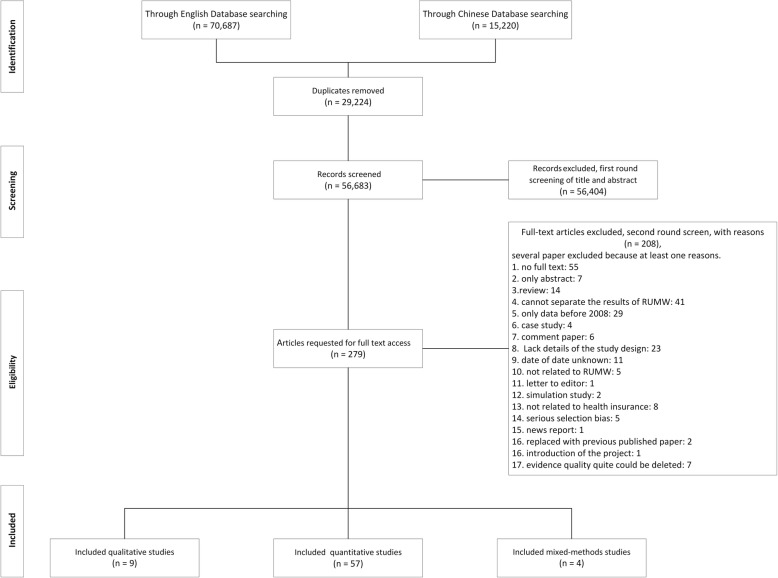
A systematic review guided by the Preferred Reporting Items for Systematic Reviews and Meta-Analysis (PRISMA) guidelines. The searched databases included PubMed, Embase, Medline, Web of Science, PsycINFO, Maternity and Infant Care Database MIDIRS, the Cochrane Library, WHO Library Database (WHOLIS), WHO Global Health Library, World Bank eLibrary, OpenGrey, CNKI, and Wanfang. In total, 70 articles were reviewed.
(1) Chinese RUMWs have high work mobility and low job stability; (2) Barriers faced by RUMWs in obtaining effective health insurance coverage are primarily due to the reluctance of employers to provide insurance for all employees and the disadvantaged position held by RUMWs when negotiating with their employers; (3) Fissures among existing health insurance schemes leaves no room for RUMWs to meet their primary needs; and (4) Recent efforts in improving the portability and transferability of insurance across borders and schemes are not enough to solve the barriers.
It is argued that the Chinese central government must deal with the fragmentation of healthcare system in China and promote effective coverage by: (1) playing a more active role in coordinating different healthcare and social welfare schemes across the country, (2) increasing the health insurance portability, (3) making the healthcare policies more compatible with RUMW's characteristics to meet their primary health needs, (4) strengthening supervision of employers, and (5) providing more vocational training and other support to increase RUMW's job stability.
中国超过 90%的人口都享有三项基本社会医疗保险。然而,中国农村到城市的流动人口(RUMWs),约占中国总人口的五分之一,在中国现行的医疗保险计划下,他们似乎处于不利地位。本研究旨在确定当前的障碍,并为中国流动人口医疗保险覆盖不足的问题提供政策建议。
本研究采用系统综述的方法,由 Preferred Reporting Items for Systematic Reviews and Meta-Analysis(PRISMA)指南指导。检索数据库包括 PubMed、Embase、Medline、Web of Science、PsycINFO、Maternity and Infant Care Database MIDIRS、Cochrane 图书馆、世界卫生组织图书馆数据库(WHOLIS)、世界卫生组织全球卫生图书馆、世界银行电子图书馆、OpenGrey、中国知网(CNKI)和万方。共评价了 70 篇文章。
(1)中国的流动人口工作流动性高,工作稳定性低;(2)流动人口获得有效医疗保险覆盖的障碍主要是雇主不愿意为所有员工提供保险,以及流动人口在与雇主谈判时处于不利地位;(3)现有医疗保险计划之间的裂痕使得流动人口无法满足其基本需求;(4)最近在提高保险跨境和跨计划可转移性方面的努力还不足以解决这些障碍。
有观点认为,中国中央政府必须解决中国医疗体系碎片化的问题,通过以下措施促进有效的覆盖:(1)在协调全国不同的医疗保健和社会福利计划方面发挥更积极的作用;(2)增加医疗保险的可转移性;(3)使医疗政策更符合流动人口的特点,以满足他们的基本健康需求;(4)加强对雇主的监督;(5)提供更多的职业培训和其他支持,以提高流动人口的工作稳定性。