Department of Health Administration, School of Public Health, Sun Yat-sen University, Guangzhou, 510080, China.
Department of Family Medicine and Community Health, Case Western Reserve University, Cleveland, OH, 44106, USA.
Int J Equity Health. 2018 Apr 27;17(1):51. doi: 10.1186/s12939-018-0758-4.
The equity of rural-to-urban migrants' health care utilization is already on China's agenda. The Chinese government has been embarking on efforts to improve the financial and geographical accessibility of health care for migrants by strengthening primary care services and providing universal coverage. Patient experiences are equally vital to migrants' health care utilization. To our knowledge, no studies have focused on equity in the patient experiences between migrants and locals. Based on a patient survey from Guangdong, China, which has a large number of rural-to-urban migrants, our study assessed the equity in the primary care patient experiences between rural-to-urban migrants and urban locals in the same health insurance context, since different forms of insurance can affect the patient experiences of primary care.
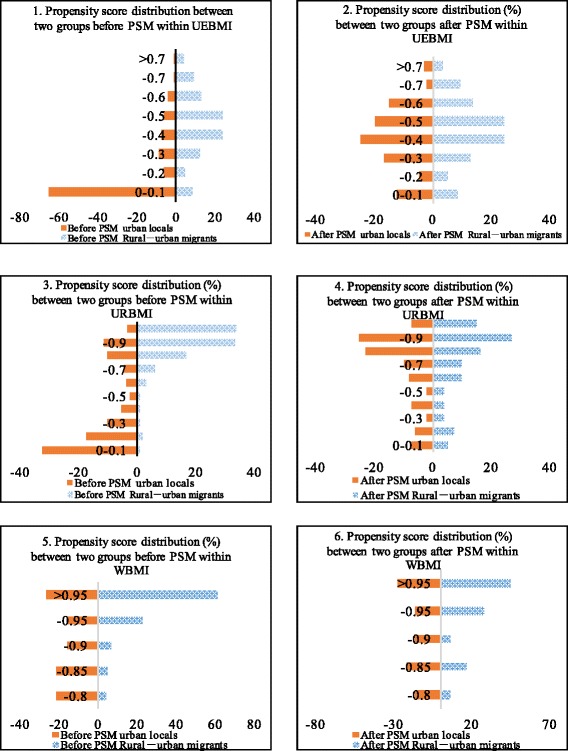
We stratified our samples by different insurance types into three layers. We assessed primary care patient experiences using a validated Chinese version of the Primary Care Assessment Tool (PCAT), including eight primary care attributes. A 'PCAT total score' was calculated. Data were collected through face-to-face and one-on-one surveys in 2014. Propensity score matching (PSM) was used for each layer to generate comparable samples between rural-to-urban migrants and urban locals. Based on the matched dataset, a t-test was employed to compare the primary care patient experiences of the two groups.
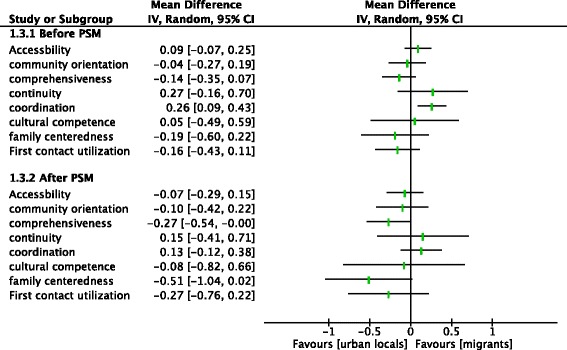
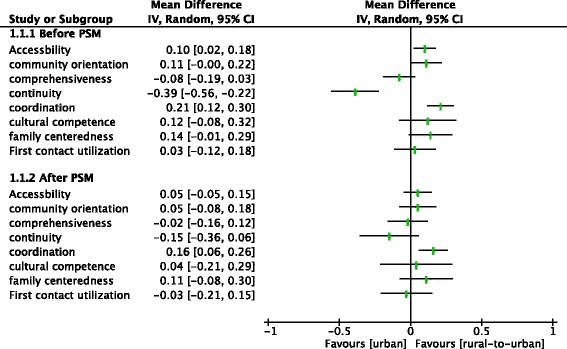
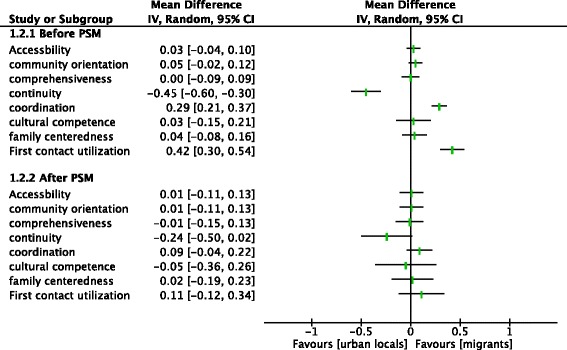
Using PSM, 220 patients in the rural-to-urban migrants group were matched to 220 patients in the urban locals group. After the matching, the observed confounding variables were balanced, and the PCAT scores were almost equal between the two groups. The only slight differences existed in the Urban Employee Basic Medical Insurance layer and in the without basic medical insurance coverage layer.
Equity in the primary care patient experiences between rural-to-urban migrants and urban locals seems to have been achieved to some extent. However, there is room for improvement in the equity of coordination of care and comprehensiveness. Policy makers should consider strengthening these two dimensions by integrating the health care system. More attention should be focused on helping migrants break down language and cultural barriers and improving the patient-physician communication process.
农村到城市移民的医疗保健利用公平性已经提上中国的议程。中国政府一直在努力通过加强基层医疗服务和提供全民覆盖来改善移民的医疗保健的经济和地理可及性。患者体验对于移民的医疗保健利用同样至关重要。据我们所知,没有研究关注移民和本地人之间的患者体验公平性。基于来自中国广东省的一项患者调查,该省有大量农村到城市的移民,我们的研究在相同的医疗保险背景下评估了农村到城市移民和城市本地人的初级保健患者体验的公平性,因为不同形式的保险会影响初级保健的患者体验。
我们根据不同的保险类型将样本分层为三层。我们使用经过验证的中文版初级保健评估工具(PCAT)评估初级保健患者体验,包括八项初级保健属性。计算“PCAT 总分”。数据于 2014 年通过面对面和一对一调查收集。在每个层使用倾向评分匹配(PSM)生成农村到城市移民和城市本地人的可比样本。基于匹配数据集,使用 t 检验比较两组的初级保健患者体验。
使用 PSM,农村到城市移民组中 220 名患者与城市本地组中 220 名患者相匹配。匹配后,观察到的混杂变量得到平衡,两组的 PCAT 评分几乎相等。仅在城镇职工基本医疗保险层和无基本医疗保险覆盖层存在细微差异。
农村到城市移民和城市本地人的初级保健患者体验公平性似乎已经在一定程度上实现。然而,在协调护理和综合性方面的公平性仍有改进的空间。政策制定者应考虑通过整合医疗保健系统来加强这两个方面。应更加关注帮助移民克服语言和文化障碍,并改善医患沟通过程。