Watcharatpong Phurisorn, Kaga Akito, Chen Xin, Somta Prakit
Department of Agronomy, Faculty of Agriculture at Kamphaeng Saen, Kasetsart University, Kamphaeng Saen Campus, Nakhon Pathom 73140, Thailand.
Soybean and Field Crop Applied Genomics Research Unit, Institute of Crop Science, National Agriculture and Food Research Organization, 2-1-2, Kannondai, Tsukuba, Ibaraki 305-8602, Japan.
Genes (Basel). 2020 Mar 27;11(4):363. doi: 10.3390/genes11040363.
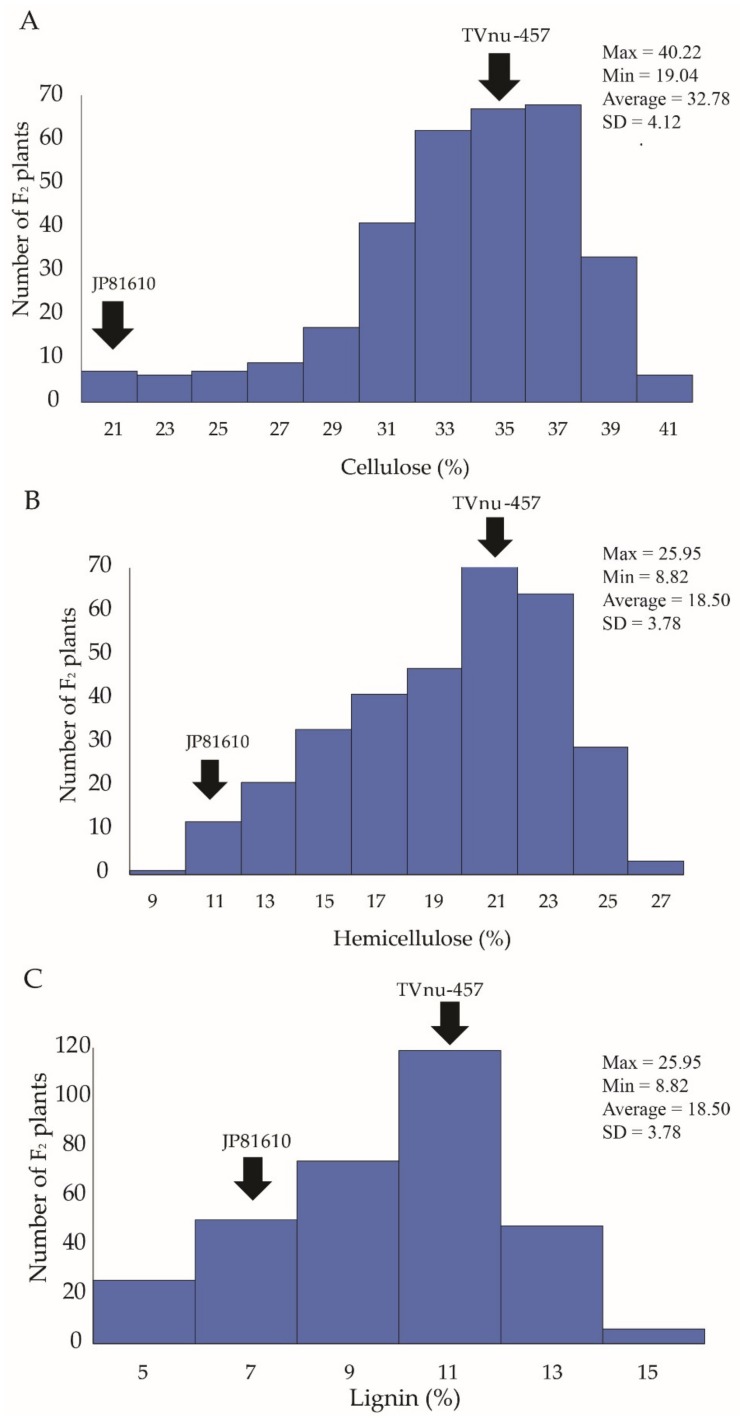
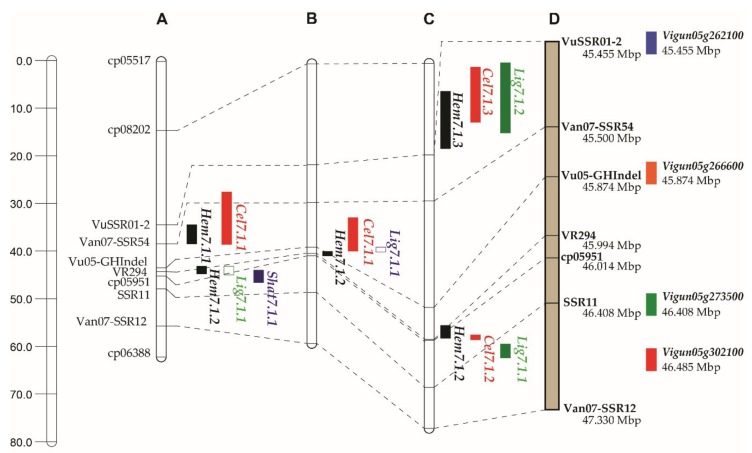
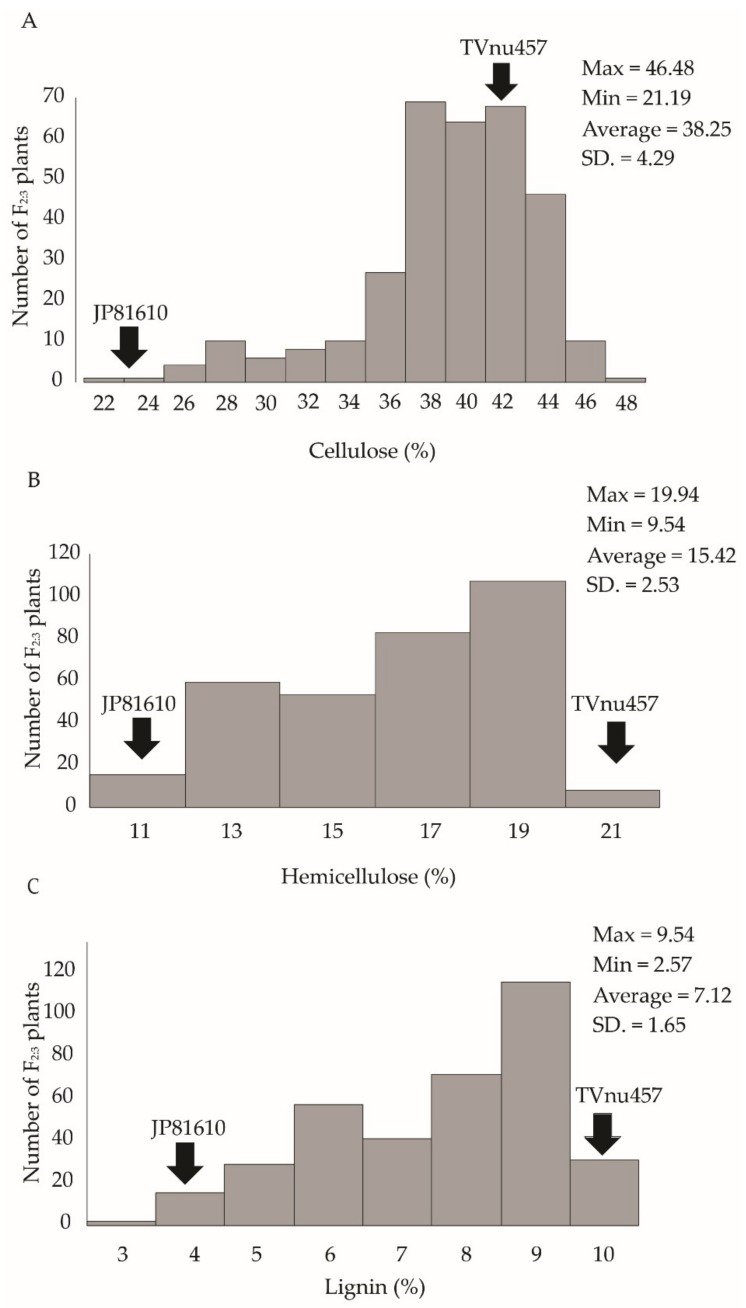
Yardlong bean ( (L.) Walp. ssp. ), a subgroup of cowpea, is an important vegetable legume crop of Asia where its young pods are consumed in both fresh and cooked forms. Pod fiber contents (cellulose, hemicellulose and lignin) correlates with pod tenderness (softness/hardness) and pod shattering. In a previous study using populations derived from crosses between yardlong bean and wild cowpea ( ssp. var. ), three major quantitative trait loci (QTLs), , and , controlling these fibers were identified on linkage group 7 (cowpea chromosome 5) and are co-located with QTLs for pod tenderness and pod shattering. The objective of this study was to identify candidate gene(s) controlling the pod fiber contents. Fine mapping for , and was conducted using F and F populations of 309 and 334 individuals, respectively, from the same cross combination. New DNA markers were developed from cowpea reference genome sequence and used for fine mapping. A QTL analysis showed that in most cases, each pod fiber content was controlled by one major and one minor QTLs on the LG7. The major QTLs for cellulose, hemicellulose and lignin in pod were always mapped to the same regions or close to each other. In addition, a major QTL for pod shattering was also located in the region. Although there were several annotated genes relating to pod fiber contents in the region, two genes including () encoding a beta glucosidase and () encoding a transcription factor MYB26 were identified as candidate genes for the pod fiber contents and pod shattering. Function(s) of these genes in relation to pod wall fiber biosynthesis and pod shattering was discussed.
长豇豆((L.) Walp. ssp.)是豇豆的一个亚组,是亚洲一种重要的蔬菜豆类作物,其嫩荚可鲜食或烹饪后食用。豆荚纤维含量(纤维素、半纤维素和木质素)与豆荚嫩度(软/硬)和豆荚开裂相关。在之前一项使用长豇豆与野生豇豆(ssp. var.)杂交后代群体的研究中,在连锁群7(豇豆第5号染色体)上鉴定出了控制这些纤维的三个主要数量性状位点(QTL),即、和,并且它们与控制豆荚嫩度和豆荚开裂的QTL位于同一位置。本研究的目的是鉴定控制豆荚纤维含量的候选基因。分别使用来自相同杂交组合的309个个体的F和334个个体的F群体对、和进行精细定位。从豇豆参考基因组序列开发了新的DNA标记并用于精细定位。QTL分析表明,在大多数情况下,每个豆荚纤维含量由LG7上的一个主要QTL和一个次要QTL控制。豆荚中纤维素、半纤维素和木质素的主要QTL总是定位在相同区域或彼此靠近。此外,一个控制豆荚开裂的主要QTL也位于该区域。尽管该区域有几个与豆荚纤维含量相关的注释基因,但包括编码β-葡萄糖苷酶的()和编码转录因子MYB26的()这两个基因被鉴定为豆荚纤维含量和豆荚开裂候选基因。讨论了这些基因在豆荚壁纤维生物合成和豆荚开裂方面的功能。