
宏转录组分析揭示了品种对不同饲料效率肉牛瘤胃活性真核生物组成的影响。
Metatranscriptomic Profiling Reveals the Effect of Breed on Active Rumen Eukaryotic Composition in Beef Cattle With Varied Feed Efficiency.
作者信息
Zhang Yawei, Li Fuyong, Chen Yanhong, Wu Hao, Meng Qingxiang, Guan Le Luo
机构信息
State Key Laboratory of Animal Nutrition, College of Animal Science and Technology, China Agricultural University, Beijing, China.
Department of Agricultural, Food and Nutritional Science, University of Alberta, Edmonton, AB, Canada.
出版信息
Front Microbiol. 2020 Mar 13;11:367. doi: 10.3389/fmicb.2020.00367. eCollection 2020.
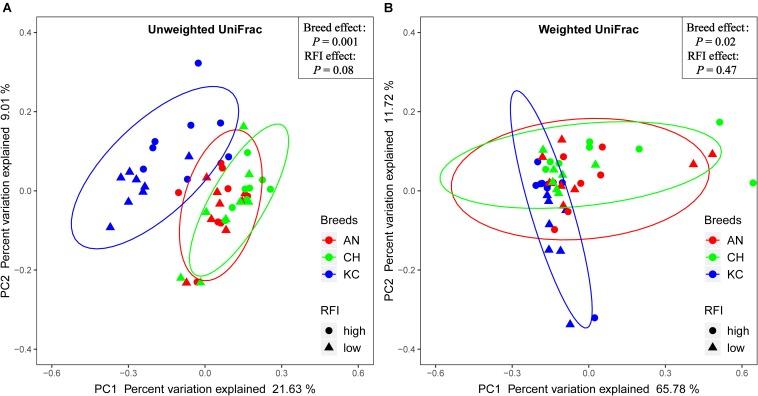
Exploring the compositional characteristics of rumen eukaryotic community can expand our understanding of their role in rumen function and feed efficiency. In this study, we applied metatranscriptomics to characterize the active rumen eukaryotic community (protozoa and fungi) in beef cattle ( = 48) of three breeds [Angus (AN), Charolais (CH), and Kinsella Composite (KC)] and with divergent residual feed intake (RFI). The composition of active rumen eukaryotic microbiota was evaluated based on enriched 18S rRNAs from the metatranscriptomic datasets. At the phylum level, a total of four protozoal taxa (, , unclassified , and unclassified ), six fungal taxa (, , unclassified , , , and ), and one sister group of kingdom (unclassified ) were detected with relative abundances higher than 0.01% and in at least 50% of animals within each breed. Among these, , , unclassified , and were the top four active eukaryotic phyla. At the genus level, a total of 8 ciliated protozoa, 5 flagellated protozoa, 5 anaerobic fungi, and 10 aerobic fungi taxa were detected, with unclassified , , unclassified , and being the most predominant taxa of ciliated protozoa, flagellated protozoa, anaerobic fungi, and aerobic fungi, respectively. Differential abundance analysis revealed that breed had a significant effect on the phylogenetic lineages of rumen eukaryotes, and seven fungal taxa were more abundant (linear discriminant analysis score > 2 with < 0.05) in the rumen of KC steers than in the rumen of AN and CH steers. Although principal coordinate analysis (PCoA) revealed that the ruminal active eukaryotic profiles were not distinguishable between high- and low-RFI groups, the diversity indices, including Faith's phylogenetic diversity (PD), observed operational taxonomic units (OTUs), and Shannon index of rumen eukaryotes were higher in low-RFI steers than those in high-RFI steers. Meanwhile, the abundance of genus and the kingdom was higher in low-RFI steers than that in high-RFI steers. This information on active rumen eukaryotic microbiota and identified differential abundance of taxa between high- and low-RFI animals suggests the possibility of improving feed efficiency through altering rumen eukaryotic microbiota.
探索瘤胃真核生物群落的组成特征可以扩展我们对其在瘤胃功能和饲料效率中作用的理解。在本研究中,我们应用宏转录组学来表征三个品种(安格斯牛(AN)、夏洛莱牛(CH)和金塞拉复合牛(KC))且剩余采食量(RFI)不同的48头肉牛瘤胃中的活性真核生物群落(原生动物和真菌)。基于宏转录组数据集富集的18S rRNA评估活性瘤胃真核微生物群的组成。在门水平上,共检测到四个原生动物类群(、、未分类的和未分类的)、六个真菌类群(、、未分类的、、和)以及一个界的姐妹群(未分类的),其相对丰度高于0.01%且在每个品种至少50%的动物中存在。其中,、、未分类的和是活性真核生物的前四大门类。在属水平上,共检测到8种纤毛虫原生动物、5种鞭毛虫原生动物、5种厌氧真菌和10种需氧真菌类群,未分类的、、未分类的和分别是纤毛虫原生动物、鞭毛虫原生动物、厌氧真菌和需氧真菌中最主要的类群。差异丰度分析表明,品种对瘤胃真核生物的系统发育谱系有显著影响,并且在KC阉牛瘤胃中,有7个真菌类群比在AN和CH阉牛瘤胃中更为丰富(线性判别分析得分>2且<0.05)。尽管主坐标分析(PCoA)显示高RFI组和低RFI组之间瘤胃活性真核生物图谱无法区分,但低RFI阉牛的瘤胃真核生物多样性指数,包括费思系统发育多样性(PD)、观测操作分类单元(OTU)和香农指数,均高于高RFI阉牛。同时,低RFI阉牛中属和界的丰度高于高RFI阉牛。这些关于活性瘤胃真核微生物群的信息以及在高RFI和低RFI动物之间鉴定出的类群差异丰度表明,通过改变瘤胃真核微生物群来提高饲料效率具有可能性。


 Zotero 插件