Aynalem Yared Asmare, Shibabaw Shiferaw Wondimeneh, Woldiye Zeleke
College of Health Science, Debre Berhan University, Debre Berhan, Ethiopia.
Debre Berhan Referral Hospital, Debre Berhan, Ethiopia.
Adv Hematol. 2020 Mar 11;2020:2513578. doi: 10.1155/2020/2513578. eCollection 2020.
. Anemia was defined as a hemoglobin level of less than or equal to 13.9 g/dl for male and less than or equal to 12.2 g/dl for female adults. It is one of the most common hematological abnormalities in people living with human immunodeficiency virus/acquired immunodeficiency syndrome (HIV/AIDS) and is a determining factor for disease progression and death. Among the countries in sub-Saharan Africa, Ethiopia is one of the most affected nations by HIV. Therefore, this study aimed to assess the prevalence of anemia and its associated factors among HIV-positive adults that had received antiretroviral treatment (ART) at Debre Berhan Referral Hospital.
An institution-based, descriptive, cross-sectional study was conducted involving 263 adults with HIV/AIDS that had undergone ART at Debre Berhan Referral Hospital, Ethiopia. Data were collected from patient charts using systematic sampling with a pretested data extraction tool and entered using EpiData 3.1. Variables having a value ≤0.25 in the bivariate were fitted to a multivariable regression model with a 95% confidence interval. value ≤0.25 in the bivariate were fitted to a multivariable regression model with a 95% confidence interval.
Among the 263 HIV-positive patients, 237 (90.11%) were included in the final analysis. The overall prevalence of anemia was 26.2%. Factors that were significantly associated with anemia were past opportunistic infections, patients being in WHO clinical stage III and IV, and a BMI <18.5. Conversely, those patients who took anti-TB medication were less likely to have anemia.
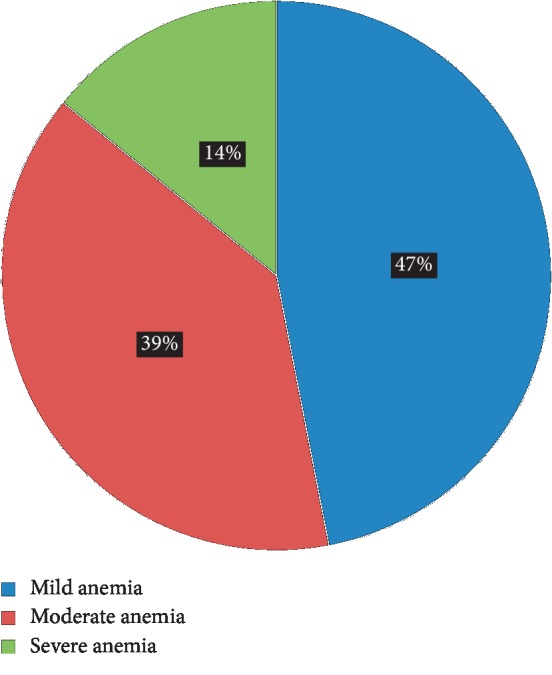
Our study shows that the severity of anemia among HIV/AIDS patients that had undergone ART is lower than most studies conducted in Ethiopia. We also found that opportunistic infection, WHO clinical staging, anti-TB treatment, and low BMI were significantly associated with anemia. Therefore, routine screening of patient nutritional status and opportunistic infections may be useful in predicting and controlling anemia in HIV/AIDS patients.
贫血的定义为成年男性血红蛋白水平小于或等于13.9克/分升,成年女性小于或等于12.2克/分升。它是感染人类免疫缺陷病毒/获得性免疫缺陷综合征(HIV/AIDS)人群中最常见的血液学异常之一,也是疾病进展和死亡的决定因素。在撒哈拉以南非洲国家中,埃塞俄比亚是受HIV影响最严重的国家之一。因此,本研究旨在评估在德布雷伯汉转诊医院接受抗逆转录病毒治疗(ART)的HIV阳性成年人中贫血的患病率及其相关因素。
在埃塞俄比亚德布雷伯汉转诊医院对263例接受ART的HIV/AIDS成年人进行了一项基于机构的描述性横断面研究。使用经过预测试的数据提取工具通过系统抽样从患者病历中收集数据,并使用EpiData 3.1录入。双变量中值≤0.25的变量被纳入95%置信区间的多变量回归模型。双变量中值≤0.25的变量被纳入95%置信区间的多变量回归模型。
在263例HIV阳性患者中,237例(90.11%)纳入最终分析。贫血的总体患病率为26.2%。与贫血显著相关的因素有既往机会性感染、处于世界卫生组织临床III期和IV期以及BMI<18.5。相反,服用抗结核药物的患者贫血可能性较小。
我们的研究表明,接受ART的HIV/AIDS患者贫血的严重程度低于埃塞俄比亚进行的大多数研究。我们还发现机会性感染、世界卫生组织临床分期、抗结核治疗和低BMI与贫血显著相关。因此,常规筛查患者营养状况和机会性感染可能有助于预测和控制HIV/AIDS患者的贫血。