• 文献检索
  • 文档翻译
  • 深度研究
  • 学术资讯
  • Suppr Zotero 插件Zotero 插件
  • 邀请有礼
  • 套餐&价格
  • 历史记录
应用&插件
Suppr Zotero 插件Zotero 插件浏览器插件Mac 客户端Windows 客户端微信小程序
定价
高级版会员购买积分包购买API积分包
服务
文献检索文档翻译深度研究API 文档MCP 服务
关于我们
关于 Suppr公司介绍联系我们用户协议隐私条款
关注我们

Suppr 超能文献

核心技术专利:CN118964589B侵权必究
粤ICP备2023148730 号-1Suppr @ 2026

文献检索

告别复杂PubMed语法,用中文像聊天一样搜索,搜遍4000万医学文献。AI智能推荐,让科研检索更轻松。

立即免费搜索

文件翻译

保留排版,准确专业,支持PDF/Word/PPT等文件格式,支持 12+语言互译。

免费翻译文档

深度研究

AI帮你快速写综述,25分钟生成高质量综述,智能提取关键信息,辅助科研写作。

立即免费体验

基于 2012 年至 2017 年新加坡登革热发病率的登革热早期爆发检测模型。

Early dengue outbreak detection modeling based on dengue incidences in Singapore during 2012 to 2017.

机构信息

Delft Institute of Applied Mathematics, Delft University of Technology, Delft, the Netherlands.

Institute of High Performance Computing, Singapore.

出版信息

Stat Med. 2020 Jul 10;39(15):2101-2114. doi: 10.1002/sim.8535. Epub 2020 Mar 30.

DOI:10.1002/sim.8535
PMID:32232863
原文链接:https://pmc.ncbi.nlm.nih.gov/articles/PMC7318238/
Abstract

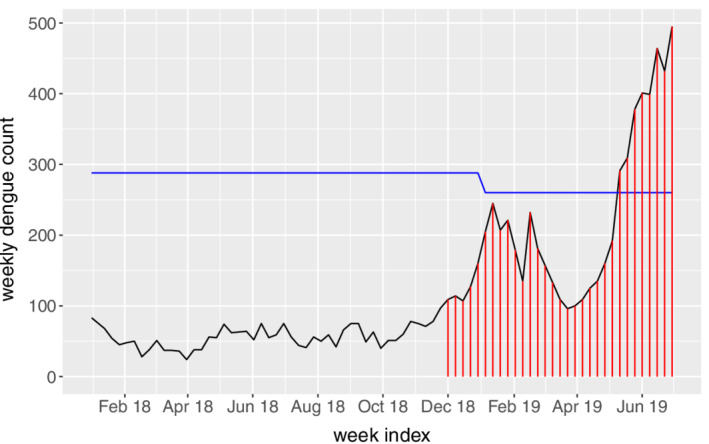
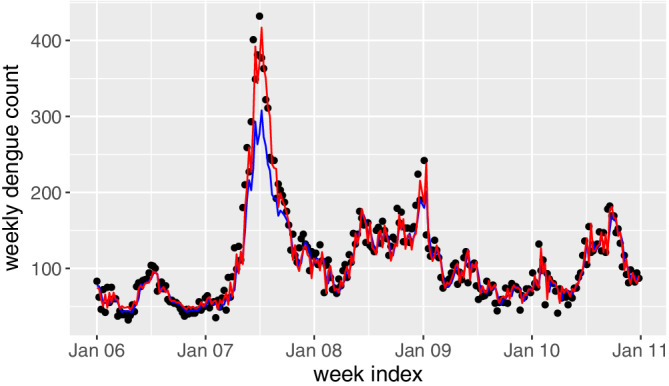
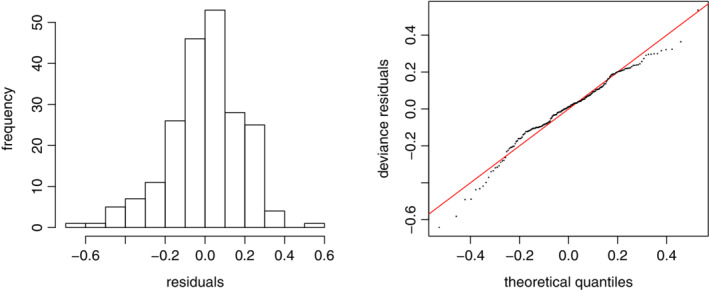
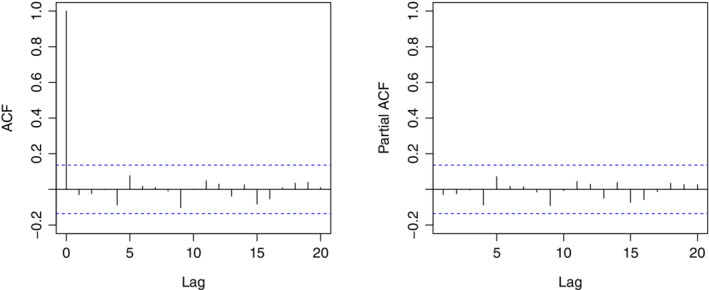
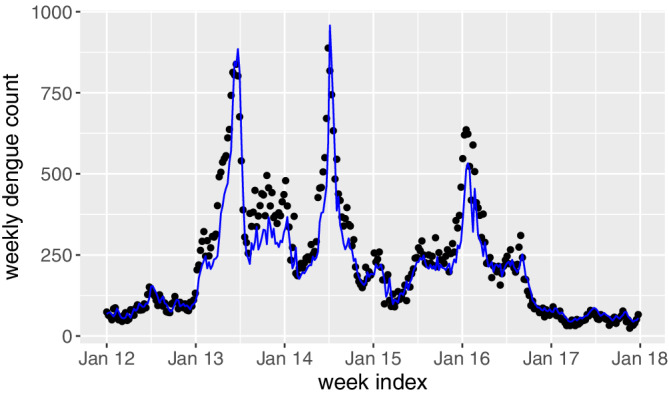
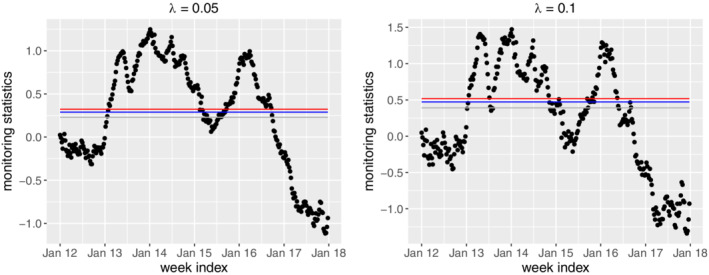
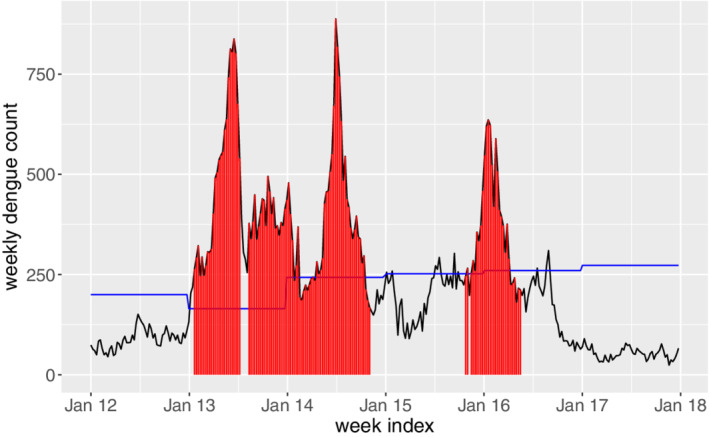
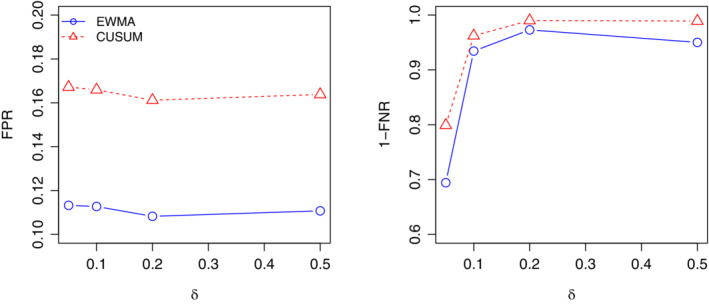
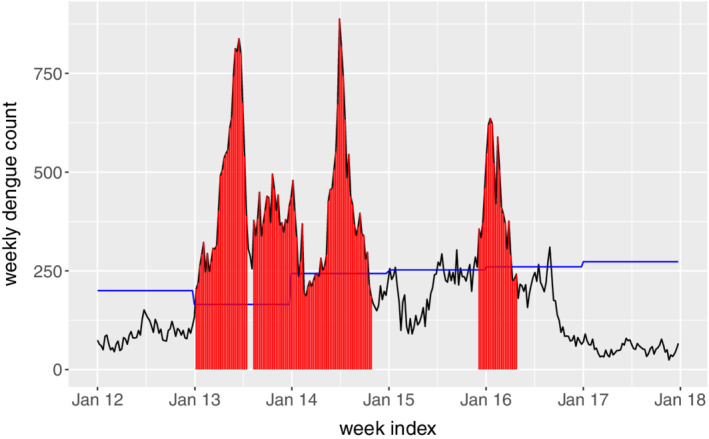
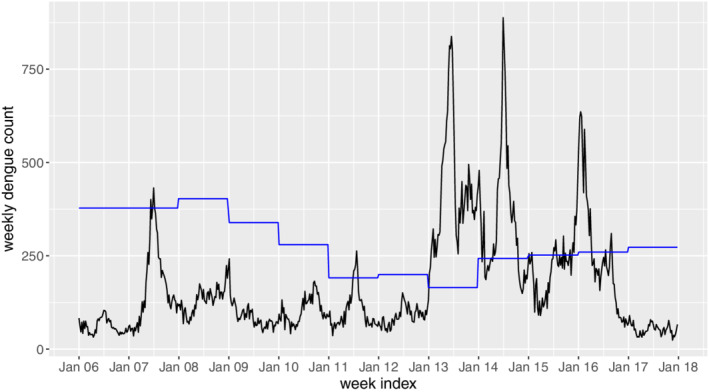
Dengue has been as an endemic with year-round presence in Singapore. In the recent years 2013, 2014, and 2016, there were several severe dengue outbreaks, posing serious threat to the public health. To proactively control and mitigate the disease spread, early warnings of dengue outbreaks, at which there are rapid and large-scale spread of dengue incidences, are extremely helpful. In this study, a two-step framework is proposed to predict dengue outbreaks and it is evaluated based on the dengue incidences in Singapore during 2012 to 2017. First, a generalized additive model (GAM) is trained based on the weekly dengue incidence data during 2006 to 2011. The proposed GAM is a one-week-ahead forecasting model, and it inherently accounts for the possible correlation among the historical incidence data, making the residuals approximately normally distributed. Then, an exponentially weighted moving average (EWMA) control chart is proposed to sequentially monitor the weekly residuals during 2012 to 2017. Our investigation shows that the proposed two-step framework is able to give persistent signals at the early stage of the outbreaks in 2013, 2014, and 2016, which provides early alerts of outbreaks and wins time for the early interventions and the preparation of necessary public health resources. In addition, extensive simulations show that the proposed method is comparable to other potential outbreak detection methods and it is robust to the underlying data-generating mechanisms.

摘要

新加坡登革热常年流行。在 2013 年、2014 年和 2016 年,发生了几起严重的登革热疫情,对公众健康构成严重威胁。为了主动控制和减轻疾病传播,对登革热疫情进行早期预警(即在登革热发病率迅速大规模扩散时发出预警)非常有帮助。本研究提出了一种两步框架来预测登革热疫情,并基于 2012 年至 2017 年新加坡的登革热发病率进行了评估。首先,根据 2006 年至 2011 年的每周登革热发病率数据训练广义加性模型(GAM)。所提出的 GAM 是一个提前一周的预测模型,它固有地考虑了历史发病率数据之间的可能相关性,使残差近似正态分布。然后,提出了一个指数加权移动平均(EWMA)控制图,用于顺序监测 2012 年至 2017 年的每周残差。我们的研究表明,所提出的两步框架能够在 2013 年、2014 年和 2016 年疫情的早期阶段持续发出信号,从而为疫情爆发提供早期警报,并为早期干预和准备必要的公共卫生资源赢得时间。此外,广泛的模拟表明,所提出的方法可与其他潜在的疫情检测方法相媲美,并且对潜在的数据生成机制具有鲁棒性。
https://cdn.ncbi.nlm.nih.gov/pmc/blobs/e7e6/7318238/03876317468e/SIM-39-2101-g011.jpg
https://cdn.ncbi.nlm.nih.gov/pmc/blobs/e7e6/7318238/e44b9e07fd91/SIM-39-2101-g001.jpg
https://cdn.ncbi.nlm.nih.gov/pmc/blobs/e7e6/7318238/49ba89d67c9a/SIM-39-2101-g002.jpg
https://cdn.ncbi.nlm.nih.gov/pmc/blobs/e7e6/7318238/9381d66439ec/SIM-39-2101-g003.jpg
https://cdn.ncbi.nlm.nih.gov/pmc/blobs/e7e6/7318238/f46dfe438ee0/SIM-39-2101-g004.jpg
https://cdn.ncbi.nlm.nih.gov/pmc/blobs/e7e6/7318238/7564b88f9a78/SIM-39-2101-g005.jpg
https://cdn.ncbi.nlm.nih.gov/pmc/blobs/e7e6/7318238/fafd5953d12d/SIM-39-2101-g006.jpg
https://cdn.ncbi.nlm.nih.gov/pmc/blobs/e7e6/7318238/4250b545f56d/SIM-39-2101-g007.jpg
https://cdn.ncbi.nlm.nih.gov/pmc/blobs/e7e6/7318238/3828154b9e8b/SIM-39-2101-g008.jpg
https://cdn.ncbi.nlm.nih.gov/pmc/blobs/e7e6/7318238/a489e49ca390/SIM-39-2101-g009.jpg
https://cdn.ncbi.nlm.nih.gov/pmc/blobs/e7e6/7318238/f1aadbfa8bc5/SIM-39-2101-g010.jpg
https://cdn.ncbi.nlm.nih.gov/pmc/blobs/e7e6/7318238/03876317468e/SIM-39-2101-g011.jpg
https://cdn.ncbi.nlm.nih.gov/pmc/blobs/e7e6/7318238/e44b9e07fd91/SIM-39-2101-g001.jpg
https://cdn.ncbi.nlm.nih.gov/pmc/blobs/e7e6/7318238/49ba89d67c9a/SIM-39-2101-g002.jpg
https://cdn.ncbi.nlm.nih.gov/pmc/blobs/e7e6/7318238/9381d66439ec/SIM-39-2101-g003.jpg
https://cdn.ncbi.nlm.nih.gov/pmc/blobs/e7e6/7318238/f46dfe438ee0/SIM-39-2101-g004.jpg
https://cdn.ncbi.nlm.nih.gov/pmc/blobs/e7e6/7318238/7564b88f9a78/SIM-39-2101-g005.jpg
https://cdn.ncbi.nlm.nih.gov/pmc/blobs/e7e6/7318238/fafd5953d12d/SIM-39-2101-g006.jpg
https://cdn.ncbi.nlm.nih.gov/pmc/blobs/e7e6/7318238/4250b545f56d/SIM-39-2101-g007.jpg
https://cdn.ncbi.nlm.nih.gov/pmc/blobs/e7e6/7318238/3828154b9e8b/SIM-39-2101-g008.jpg
https://cdn.ncbi.nlm.nih.gov/pmc/blobs/e7e6/7318238/a489e49ca390/SIM-39-2101-g009.jpg
https://cdn.ncbi.nlm.nih.gov/pmc/blobs/e7e6/7318238/f1aadbfa8bc5/SIM-39-2101-g010.jpg
https://cdn.ncbi.nlm.nih.gov/pmc/blobs/e7e6/7318238/03876317468e/SIM-39-2101-g011.jpg

相似文献

1
Early dengue outbreak detection modeling based on dengue incidences in Singapore during 2012 to 2017.基于 2012 年至 2017 年新加坡登革热发病率的登革热早期爆发检测模型。
Stat Med. 2020 Jul 10;39(15):2101-2114. doi: 10.1002/sim.8535. Epub 2020 Mar 30.
2
Three-Month Real-Time Dengue Forecast Models: An Early Warning System for Outbreak Alerts and Policy Decision Support in Singapore.三个月实时登革热预测模型:新加坡疫情预警与政策决策支持的早期预警系统
Environ Health Perspect. 2016 Sep;124(9):1369-75. doi: 10.1289/ehp.1509981. Epub 2015 Dec 11.
3
Developing a dengue forecast model using machine learning: A case study in China.利用机器学习开发登革热预测模型:以中国为例的案例研究。
PLoS Negl Trop Dis. 2017 Oct 16;11(10):e0005973. doi: 10.1371/journal.pntd.0005973. eCollection 2017 Oct.
4
Weekly dengue forecasts in Iquitos, Peru; San Juan, Puerto Rico; and Singapore.秘鲁伊基托斯、波多黎各圣胡安和新加坡的每周登革热预测。
PLoS Negl Trop Dis. 2020 Oct 16;14(10):e0008710. doi: 10.1371/journal.pntd.0008710. eCollection 2020 Oct.
5
Dengue disease outbreak detection.登革热疾病爆发检测。
Stud Health Technol Inform. 2014;205:1105-9.
6
A novel entomological index, Aedes aegypti Breeding Percentage, reveals the geographical spread of the dengue vector in Singapore and serves as a spatial risk indicator for dengue.一种新的昆虫学指标,埃及伊蚊繁殖率,揭示了登革热媒介在新加坡的地理分布,并作为登革热的空间风险指标。
Parasit Vectors. 2019 Jan 8;12(1):17. doi: 10.1186/s13071-018-3281-y.
7
Predicting the dengue incidence in Singapore using univariate time series models.使用单变量时间序列模型预测新加坡的登革热发病率。
AMIA Annu Symp Proc. 2013 Nov 16;2013:285-92. eCollection 2013.
8
Prediction of dengue fever outbreaks using climate variability and Markov chain Monte Carlo techniques in a stochastic susceptible-infected-removed model.利用气候变异性和马尔可夫链蒙特卡罗技术在随机易感-感染-移除模型中预测登革热疫情。
Sci Rep. 2022 Mar 31;12(1):5459. doi: 10.1038/s41598-022-09489-y.
9
Optimal lead time for dengue forecast.登革热预测的最佳提前期。
PLoS Negl Trop Dis. 2012;6(10):e1848. doi: 10.1371/journal.pntd.0001848. Epub 2012 Oct 18.
10
Real-time dengue forecast for outbreak alerts in Southern Taiwan.台湾南部登革热疫情爆发实时预警预测。
PLoS Negl Trop Dis. 2020 Jul 27;14(7):e0008434. doi: 10.1371/journal.pntd.0008434. eCollection 2020 Jul.

引用本文的文献

1
Outbreak detection algorithms based on generalized linear model: a review with new practical examples.基于广义线性模型的爆发检测算法:综述及新实例
BMC Med Res Methodol. 2023 Oct 14;23(1):235. doi: 10.1186/s12874-023-02050-z.
2
Dengue Early Warning System as Outbreak Prediction Tool: A Systematic Review.登革热早期预警系统作为疫情预测工具:一项系统综述。
Risk Manag Healthc Policy. 2022 May 3;15:871-886. doi: 10.2147/RMHP.S361106. eCollection 2022.

本文引用的文献

1
Prospective forecasts of annual dengue hemorrhagic fever incidence in Thailand, 2010-2014.泰国 2010-2014 年登革出血热年发病率的前瞻性预测。
Proc Natl Acad Sci U S A. 2018 Mar 6;115(10):E2175-E2182. doi: 10.1073/pnas.1714457115. Epub 2018 Feb 20.
2
Singapore Success: New Model Helps Forecast Dengue Outbreaks.新加坡的成功:新模式助力预测登革热疫情
Environ Health Perspect. 2016 Sep 1;124(9):A167. doi: 10.1289/ehp.124-A167.
3
Three-Month Real-Time Dengue Forecast Models: An Early Warning System for Outbreak Alerts and Policy Decision Support in Singapore.
三个月实时登革热预测模型:新加坡疫情预警与政策决策支持的早期预警系统
Environ Health Perspect. 2016 Sep;124(9):1369-75. doi: 10.1289/ehp.1509981. Epub 2015 Dec 11.
4
Dengue disease outbreak definitions are implicitly variable.登革热疾病暴发的定义存在隐性差异。
Epidemics. 2015 Jun;11:92-102. doi: 10.1016/j.epidem.2015.03.002. Epub 2015 Mar 23.
5
Evaluation of the performance of a dengue outbreak detection tool for China.中国登革热疫情检测工具性能评估
PLoS One. 2014 Aug 29;9(8):e106144. doi: 10.1371/journal.pone.0106144. eCollection 2014.
6
Statistical modeling reveals the effect of absolute humidity on dengue in Singapore.统计建模揭示了绝对湿度对新加坡登革热的影响。
PLoS Negl Trop Dis. 2014 May 1;8(5):e2805. doi: 10.1371/journal.pntd.0002805. eCollection 2014 May.
7
Epidemic features affecting the performance of outbreak detection algorithms.影响疫情爆发检测算法性能的疫情特征。
BMC Public Health. 2012 Jun 8;12:418. doi: 10.1186/1471-2458-12-418.
8
Economic impact of dengue illness and the cost-effectiveness of future vaccination programs in Singapore.新加坡登革热疾病的经济影响和未来疫苗接种计划的成本效益。
PLoS Negl Trop Dis. 2011 Dec;5(12):e1426. doi: 10.1371/journal.pntd.0001426. Epub 2011 Dec 20.
9
Meteorological factors and El Niño Southern Oscillation are independently associated with dengue infections.气象因素和厄尔尼诺南方涛动与登革热感染独立相关。
Epidemiol Infect. 2012 Jul;140(7):1244-51. doi: 10.1017/S095026881100183X. Epub 2011 Sep 12.
10
Time series analysis of dengue incidence in Guadeloupe, French West Indies: forecasting models using climate variables as predictors.法属西印度群岛瓜德罗普登革热发病率的时间序列分析:使用气候变量作为预测因子的预测模型。
BMC Infect Dis. 2011 Jun 9;11:166. doi: 10.1186/1471-2334-11-166.