• 文献检索
  • 文档翻译
  • 深度研究
  • 学术资讯
  • Suppr Zotero 插件Zotero 插件
  • 邀请有礼
  • 套餐&价格
  • 历史记录
应用&插件
Suppr Zotero 插件Zotero 插件浏览器插件Mac 客户端Windows 客户端微信小程序
定价
高级版会员购买积分包购买API积分包
服务
文献检索文档翻译深度研究API 文档MCP 服务
关于我们
关于 Suppr公司介绍联系我们用户协议隐私条款
关注我们

Suppr 超能文献

核心技术专利:CN118964589B侵权必究
粤ICP备2023148730 号-1Suppr @ 2026

文献检索

告别复杂PubMed语法,用中文像聊天一样搜索,搜遍4000万医学文献。AI智能推荐,让科研检索更轻松。

立即免费搜索

文件翻译

保留排版,准确专业,支持PDF/Word/PPT等文件格式,支持 12+语言互译。

免费翻译文档

深度研究

AI帮你快速写综述,25分钟生成高质量综述,智能提取关键信息,辅助科研写作。

立即免费体验

泰国 2010-2014 年登革出血热年发病率的前瞻性预测。

Prospective forecasts of annual dengue hemorrhagic fever incidence in Thailand, 2010-2014.

机构信息

Department of Biostatistics and Epidemiology, School of Public Health and Health Sciences, University of Massachusetts, Amherst, MA 01003;

Department of Biostatistics and Epidemiology, School of Public Health and Health Sciences, University of Massachusetts, Amherst, MA 01003.

出版信息

Proc Natl Acad Sci U S A. 2018 Mar 6;115(10):E2175-E2182. doi: 10.1073/pnas.1714457115. Epub 2018 Feb 20.

DOI:10.1073/pnas.1714457115
PMID:29463757
原文链接:https://pmc.ncbi.nlm.nih.gov/articles/PMC5877997/
Abstract

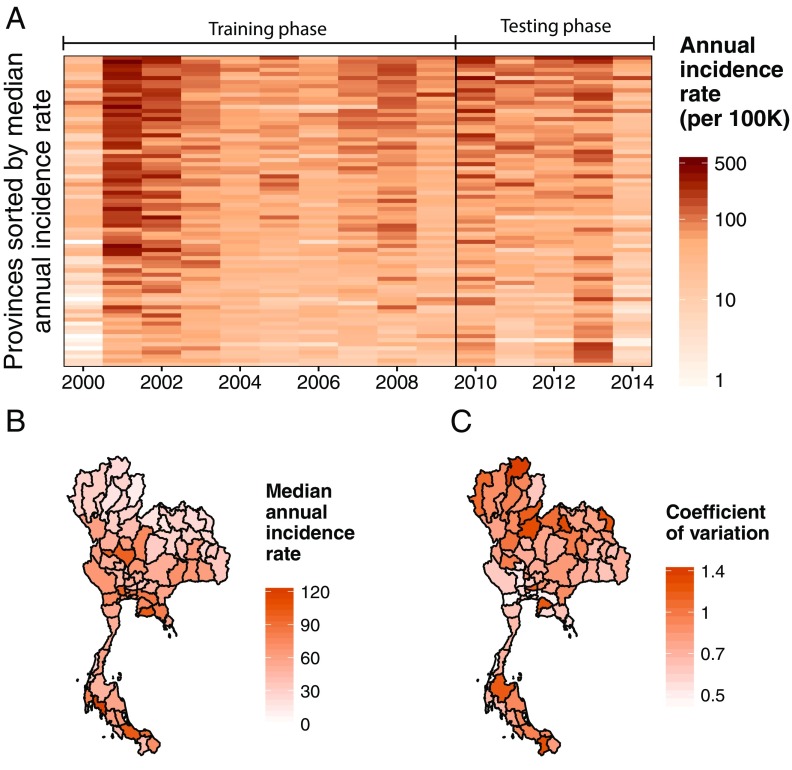
Dengue hemorrhagic fever (DHF), a severe manifestation of dengue viral infection that can cause severe bleeding, organ impairment, and even death, affects between 15,000 and 105,000 people each year in Thailand. While all Thai provinces experience at least one DHF case most years, the distribution of cases shifts regionally from year to year. Accurately forecasting where DHF outbreaks occur before the dengue season could help public health officials prioritize public health activities. We develop statistical models that use biologically plausible covariates, observed by April each year, to forecast the cumulative DHF incidence for the remainder of the year. We perform cross-validation during the training phase (2000-2009) to select the covariates for these models. A parsimonious model based on preseason incidence outperforms the 10-y median for 65% of province-level annual forecasts, reduces the mean absolute error by 19%, and successfully forecasts outbreaks (area under the receiver operating characteristic curve = 0.84) over the testing period (2010-2014). We find that functions of past incidence contribute most strongly to model performance, whereas the importance of environmental covariates varies regionally. This work illustrates that accurate forecasts of dengue risk are possible in a policy-relevant timeframe.

摘要

登革出血热(DHF)是一种严重的登革病毒感染表现,可导致严重出血、器官损伤,甚至死亡,每年在泰国影响 15000 至 105000 人。虽然所有泰国省份每年至少都会出现一例 DHF 病例,但病例的分布会从一年到另一年在地区间转移。在登革热季节前准确预测 DHF 爆发的地点,可以帮助公共卫生官员优先开展公共卫生活动。我们开发了统计模型,这些模型使用每年 4 月之前观察到的生物学合理的协变量来预测当年剩余时间的累积 DHF 发病率。我们在训练阶段(2000-2009 年)进行交叉验证,以选择这些模型的协变量。基于 preseason 发病率的简约模型在 65%的省级年度预测中表现优于 10 年中位数,平均绝对误差降低了 19%,并在测试期(2010-2014 年)成功预测了疫情(接收者操作特征曲线下的面积=0.84)。我们发现,过去发病率的函数对模型性能的贡献最大,而环境协变量的重要性在地区间有所不同。这项工作表明,在相关政策时间范围内,登革热风险的准确预测是可能的。
https://cdn.ncbi.nlm.nih.gov/pmc/blobs/9546/5877997/473509961f7e/pnas.1714457115fig05.jpg
https://cdn.ncbi.nlm.nih.gov/pmc/blobs/9546/5877997/4eeaa5a95e8f/pnas.1714457115fig01.jpg
https://cdn.ncbi.nlm.nih.gov/pmc/blobs/9546/5877997/e66a22d5f580/pnas.1714457115fig02.jpg
https://cdn.ncbi.nlm.nih.gov/pmc/blobs/9546/5877997/e67b28140f3b/pnas.1714457115fig03.jpg
https://cdn.ncbi.nlm.nih.gov/pmc/blobs/9546/5877997/a6159d1f67c9/pnas.1714457115fig04.jpg
https://cdn.ncbi.nlm.nih.gov/pmc/blobs/9546/5877997/473509961f7e/pnas.1714457115fig05.jpg
https://cdn.ncbi.nlm.nih.gov/pmc/blobs/9546/5877997/4eeaa5a95e8f/pnas.1714457115fig01.jpg
https://cdn.ncbi.nlm.nih.gov/pmc/blobs/9546/5877997/e66a22d5f580/pnas.1714457115fig02.jpg
https://cdn.ncbi.nlm.nih.gov/pmc/blobs/9546/5877997/e67b28140f3b/pnas.1714457115fig03.jpg
https://cdn.ncbi.nlm.nih.gov/pmc/blobs/9546/5877997/a6159d1f67c9/pnas.1714457115fig04.jpg
https://cdn.ncbi.nlm.nih.gov/pmc/blobs/9546/5877997/473509961f7e/pnas.1714457115fig05.jpg

相似文献

1
Prospective forecasts of annual dengue hemorrhagic fever incidence in Thailand, 2010-2014.泰国 2010-2014 年登革出血热年发病率的前瞻性预测。
Proc Natl Acad Sci U S A. 2018 Mar 6;115(10):E2175-E2182. doi: 10.1073/pnas.1714457115. Epub 2018 Feb 20.
2
Dengue hemorrhagic fever epidemiology in Thailand: description and forecasting of epidemics.泰国登革出血热流行病学:疫情描述与预测
Microbes Infect. 2002 Jun;4(7):699-705. doi: 10.1016/s1286-4579(02)01589-7.
3
Challenges in Real-Time Prediction of Infectious Disease: A Case Study of Dengue in Thailand.传染病实时预测面临的挑战:以泰国登革热为例的研究
PLoS Negl Trop Dis. 2016 Jun 15;10(6):e0004761. doi: 10.1371/journal.pntd.0004761. eCollection 2016 Jun.
4
Morbidity Rate Prediction of Dengue Hemorrhagic Fever (DHF) Using the Support Vector Machine and the Aedes aegypti Infection Rate in Similar Climates and Geographical Areas.利用支持向量机及相似气候和地理区域的埃及伊蚊感染率预测登革出血热发病率
PLoS One. 2015 May 11;10(5):e0125049. doi: 10.1371/journal.pone.0125049. eCollection 2015.
5
Incorporating human mobility data improves forecasts of Dengue fever in Thailand.将人类流动数据纳入其中可提高泰国登革热预测的准确性。
Sci Rep. 2021 Jan 13;11(1):923. doi: 10.1038/s41598-020-79438-0.
6
Dengue hemorrhagic fever in infants: research opportunities ignored.婴儿登革出血热:被忽视的研究机会。
Emerg Infect Dis. 2002 Dec;8(12):1474-9. doi: 10.3201/eid0812.020170.
7
Relationship between transmission intensity and incidence of dengue hemorrhagic fever in Thailand.泰国登革出血热发病率与传播强度的关系。
PLoS Negl Trop Dis. 2008 Jul 16;2(7):e263. doi: 10.1371/journal.pntd.0000263.
8
Probabilistic seasonal dengue forecasting in Vietnam: A modelling study using superensembles.越南基于超级集成的概率季节性登革热预测:建模研究。
PLoS Med. 2021 Mar 4;18(3):e1003542. doi: 10.1371/journal.pmed.1003542. eCollection 2021 Mar.
9
Serological and virological features of dengue fever and dengue haemorrhagic fever in Thailand from 1999 to 2002.1999年至2002年泰国登革热和登革出血热的血清学及病毒学特征
Epidemiol Infect. 2005 Jun;133(3):503-7. doi: 10.1017/s0950268804003541.
10
Analysis of significant factors for dengue fever incidence prediction.登革热发病率预测的重要因素分析。
BMC Bioinformatics. 2016 Apr 16;17:166. doi: 10.1186/s12859-016-1034-5.

引用本文的文献

1
Synthetic method of analogues for emerging infectious disease forecasting.新发传染病预测类似物的合成方法。
PLoS Comput Biol. 2025 Jun 23;21(6):e1013203. doi: 10.1371/journal.pcbi.1013203. eCollection 2025 Jun.
2
Why the growth of arboviral diseases necessitates a new generation of global risk maps and future projections.为何虫媒病毒疾病的增长需要新一代全球风险地图及未来预测。
PLoS Comput Biol. 2025 Apr 4;21(4):e1012771. doi: 10.1371/journal.pcbi.1012771. eCollection 2025 Apr.
3
Forecasting dengue in Bangladesh using meteorological variables with a novel feature selection approach.

本文引用的文献

1
The Global Precipitation Climatology Project (GPCP) Monthly Analysis (New Version 2.3) and a Review of 2017 Global Precipitation.全球降水气候学计划(GPCP)月度分析(第2.3版)及2017年全球降水综述
Atmosphere (Basel). 2018;9(4). doi: 10.3390/atmos9040138. Epub 2018 Apr 7.
2
Infectious disease prediction with kernel conditional density estimation.基于核条件密度估计的传染病预测
Stat Med. 2017 Dec 30;36(30):4908-4929. doi: 10.1002/sim.7488. Epub 2017 Sep 14.
3
Case study in evaluating time series prediction models using the relative mean absolute error.
利用气象变量和一种新颖的特征选择方法预测孟加拉国的登革热疫情。
Sci Rep. 2024 Dec 30;14(1):32073. doi: 10.1038/s41598-024-83770-0.
4
Perspectives and challenges in developing and implementing integrated dengue surveillance tools and technology in Thailand: a qualitative study.泰国开发和实施综合登革热监测工具和技术的观点和挑战:一项定性研究。
PLoS Negl Trop Dis. 2024 Aug 14;18(8):e0012387. doi: 10.1371/journal.pntd.0012387. eCollection 2024 Aug.
5
A systematic review of the data, methods and environmental covariates used to map Aedes-borne arbovirus transmission risk.一项系统回顾数据、方法和环境协变量用于绘制伊蚊传播虫媒病毒风险的地图。
BMC Infect Dis. 2023 Oct 20;23(1):708. doi: 10.1186/s12879-023-08717-8.
6
Excess Death Rates for Republican and Democratic Registered Voters in Florida and Ohio During the COVID-19 Pandemic.共和党和民主党在佛罗里达州和俄亥俄州的选民在 COVID-19 大流行期间的超额死亡率。
JAMA Intern Med. 2023 Sep 1;183(9):916-923. doi: 10.1001/jamainternmed.2023.1154.
7
Dengue transmission dynamics prediction by combining metapopulation networks and Kalman filter algorithm.基于复种群网络和卡尔曼滤波算法的登革热传播动力学预测。
PLoS Negl Trop Dis. 2023 Jun 7;17(6):e0011418. doi: 10.1371/journal.pntd.0011418. eCollection 2023 Jun.
8
A systematic review of dengue outbreak prediction models: Current scenario and future directions.登革热疫情预测模型的系统评价:现状与未来方向。
PLoS Negl Trop Dis. 2023 Feb 13;17(2):e0010631. doi: 10.1371/journal.pntd.0010631. eCollection 2023 Feb.
9
Impact of COVID-19 on access to cancer care in Rwanda: a retrospective time-series study using electronic medical records data.COVID-19 对卢旺达癌症护理获取的影响:使用电子病历数据的回顾性时间序列研究。
BMJ Open. 2022 Dec 19;12(12):e065398. doi: 10.1136/bmjopen-2022-065398.
10
Trends in non-COVID-19 hospitalizations prior to and during the COVID-19 pandemic period, United States, 2017-2021.2017-2021 年美国 COVID-19 大流行前后非 COVID-19 住院治疗趋势。
Nat Commun. 2022 Oct 8;13(1):5930. doi: 10.1038/s41467-022-33686-y.
使用相对平均绝对误差评估时间序列预测模型的案例研究。
Am Stat. 2016;70(3):285-292. doi: 10.1080/00031305.2016.1148631. Epub 2016 Aug 10.
4
Superensemble forecasts of dengue outbreaks.登革热疫情的超级集合预报。
J R Soc Interface. 2016 Oct;13(123). doi: 10.1098/rsif.2016.0410.
5
Benefits and risks of the Sanofi-Pasteur dengue vaccine: Modeling optimal deployment.赛诺菲巴斯德登革热疫苗的益处与风险:模拟优化部署
Science. 2016 Sep 2;353(6303):1033-1036. doi: 10.1126/science.aaf9590.
6
Evaluating the performance of infectious disease forecasts: A comparison of climate-driven and seasonal dengue forecasts for Mexico.评估传染病预测的性能:墨西哥气候驱动型和季节性登革热预测的比较。
Sci Rep. 2016 Sep 26;6:33707. doi: 10.1038/srep33707.
7
Challenges in Real-Time Prediction of Infectious Disease: A Case Study of Dengue in Thailand.传染病实时预测面临的挑战:以泰国登革热为例的研究
PLoS Negl Trop Dis. 2016 Jun 15;10(6):e0004761. doi: 10.1371/journal.pntd.0004761. eCollection 2016 Jun.
8
Homotypic Dengue Virus Reinfections in Nicaraguan Children.尼加拉瓜儿童的同型登革病毒再感染
J Infect Dis. 2016 Oct 1;214(7):986-93. doi: 10.1093/infdis/jiw099. Epub 2016 Mar 16.
9
Evaluating probabilistic dengue risk forecasts from a prototype early warning system for Brazil.评估巴西一个早期预警系统原型的登革热概率风险预测。
Elife. 2016 Feb 24;5:e11285. doi: 10.7554/eLife.11285.
10
The global burden of dengue: an analysis from the Global Burden of Disease Study 2013.登革热的全球负担:来自《2013年全球疾病负担研究》的分析
Lancet Infect Dis. 2016 Jun;16(6):712-723. doi: 10.1016/S1473-3099(16)00026-8. Epub 2016 Feb 10.