Kalantarian Haik, Jedoui Khaled, Dunlap Kaitlyn, Schwartz Jessey, Washington Peter, Husic Arman, Tariq Qandeel, Ning Michael, Kline Aaron, Wall Dennis Paul
Department of Pediatrics, Stanford University, Stanford, CA, United States.
Department of Biomedical Data Science, Stanford University, Stanford, CA, United States.
JMIR Ment Health. 2020 Apr 1;7(4):e13174. doi: 10.2196/13174.
Autism spectrum disorder (ASD) is a developmental disorder characterized by deficits in social communication and interaction, and restricted and repetitive behaviors and interests. The incidence of ASD has increased in recent years; it is now estimated that approximately 1 in 40 children in the United States are affected. Due in part to increasing prevalence, access to treatment has become constrained. Hope lies in mobile solutions that provide therapy through artificial intelligence (AI) approaches, including facial and emotion detection AI models developed by mainstream cloud providers, available directly to consumers. However, these solutions may not be sufficiently trained for use in pediatric populations.
Emotion classifiers available off-the-shelf to the general public through Microsoft, Amazon, Google, and Sighthound are well-suited to the pediatric population, and could be used for developing mobile therapies targeting aspects of social communication and interaction, perhaps accelerating innovation in this space. This study aimed to test these classifiers directly with image data from children with parent-reported ASD recruited through crowdsourcing.
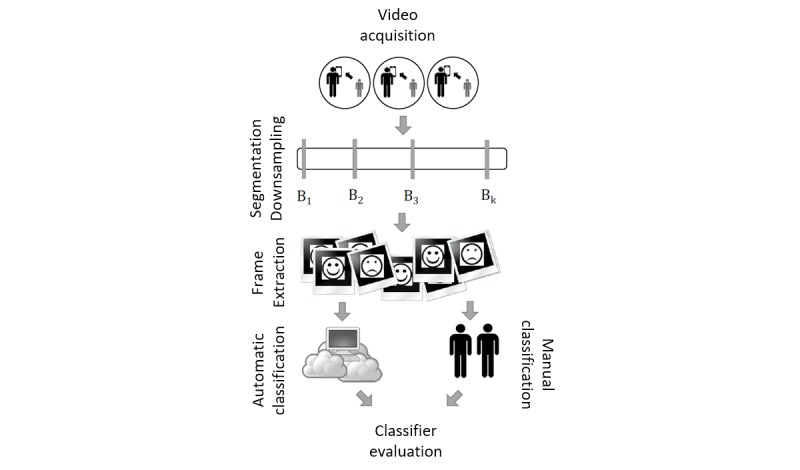
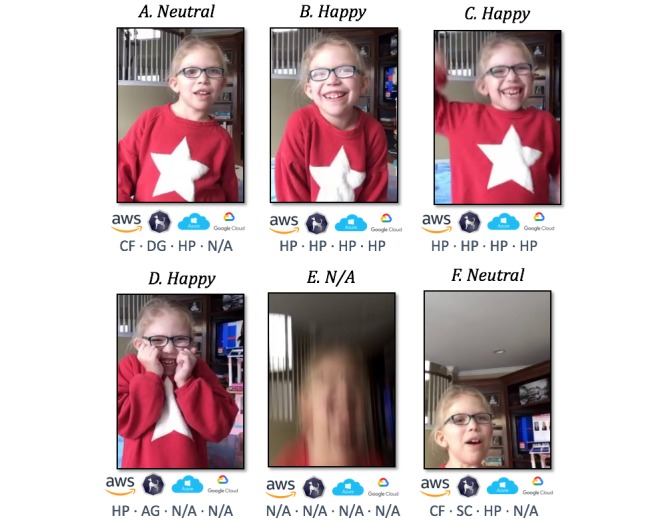
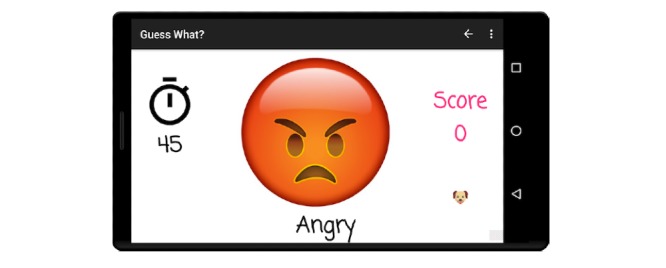
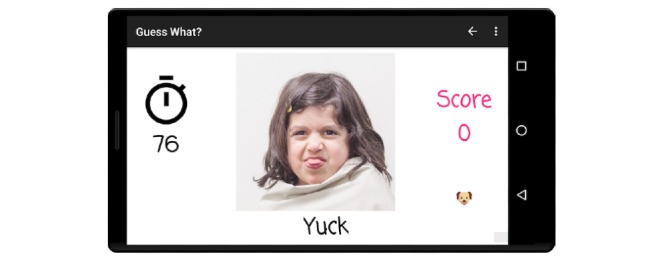
We used a mobile game called Guess What? that challenges a child to act out a series of prompts displayed on the screen of the smartphone held on the forehead of his or her care provider. The game is intended to be a fun and engaging way for the child and parent to interact socially, for example, the parent attempting to guess what emotion the child is acting out (eg, surprised, scared, or disgusted). During a 90-second game session, as many as 50 prompts are shown while the child acts, and the video records the actions and expressions of the child. Due in part to the fun nature of the game, it is a viable way to remotely engage pediatric populations, including the autism population through crowdsourcing. We recruited 21 children with ASD to play the game and gathered 2602 emotive frames following their game sessions. These data were used to evaluate the accuracy and performance of four state-of-the-art facial emotion classifiers to develop an understanding of the feasibility of these platforms for pediatric research.
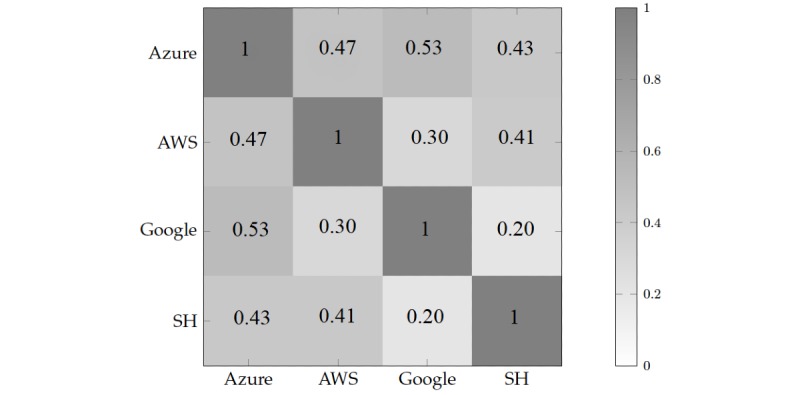
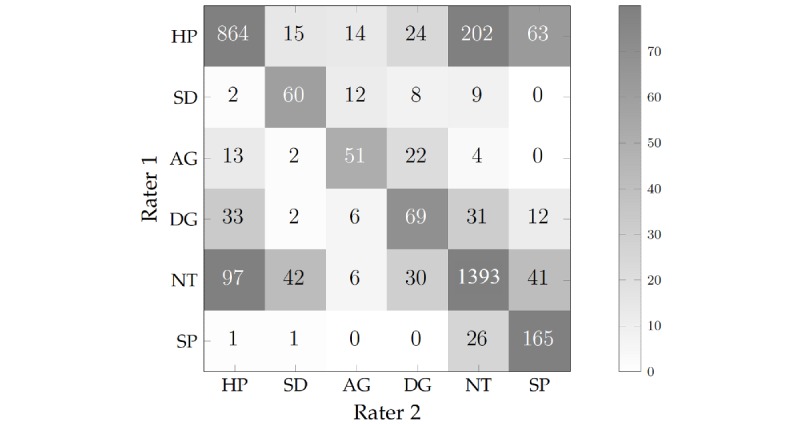
All classifiers performed poorly for every evaluated emotion except happy. None of the classifiers correctly labeled over 60.18% (1566/2602) of the evaluated frames. Moreover, none of the classifiers correctly identified more than 11% (6/51) of the angry frames and 14% (10/69) of the disgust frames.
The findings suggest that commercial emotion classifiers may be insufficiently trained for use in digital approaches to autism treatment and treatment tracking. Secure, privacy-preserving methods to increase labeled training data are needed to boost the models' performance before they can be used in AI-enabled approaches to social therapy of the kind that is common in autism treatments.
自闭症谱系障碍(ASD)是一种发育障碍,其特征是社交沟通和互动存在缺陷,以及行为和兴趣受限且重复。近年来,ASD的发病率有所上升;据估计,现在美国每40名儿童中约有1人受到影响。部分由于患病率上升,治疗的可及性受到了限制。希望在于通过人工智能(AI)方法提供治疗的移动解决方案,包括主流云提供商开发的面部和情感检测AI模型,可直接供消费者使用。然而,这些解决方案可能没有经过充分训练以用于儿科人群。
通过微软、亚马逊、谷歌和Sighthound向公众提供的现成情感分类器非常适合儿科人群,可用于开发针对社交沟通和互动方面的移动疗法,可能会加速这一领域的创新。本研究旨在通过众包招募的家长报告患有ASD的儿童的图像数据直接测试这些分类器。
我们使用了一款名为《猜猜看?》的手机游戏,该游戏要求孩子根据显示在其护理人员额头所持智能手机屏幕上的一系列提示进行表演。该游戏旨在为孩子和家长提供一种有趣且引人入胜的社交互动方式,例如,家长试图猜出孩子正在表演的情绪(如惊讶、害怕或厌恶)。在90秒的游戏过程中,孩子表演时会显示多达50个提示,视频会记录孩子的动作和表情。部分由于游戏的趣味性,它是通过众包远程吸引儿科人群(包括自闭症人群)的一种可行方式。我们招募了21名患有ASD的儿童来玩这个游戏,并在他们的游戏环节后收集了2602个情感帧。这些数据用于评估四种最先进的面部情感分类器的准确性和性能,以了解这些平台用于儿科研究的可行性。
除了“开心”之外,所有分类器对每种评估情绪的表现都很差。没有一个分类器能正确标记超过60.18%(1566/2602)的评估帧。此外,没有一个分类器能正确识别超过11%(6/51)的愤怒帧和14%(10/69)的厌恶帧。
研究结果表明,商业情感分类器可能没有经过充分训练,无法用于自闭症治疗和治疗跟踪的数字方法。在这些模型可用于自闭症治疗中常见的那种人工智能支持的社交治疗方法之前,需要安全、保护隐私的方法来增加标记的训练数据,以提高模型的性能。