Levich Institute, City College of New York, New York, NY 10031.
Physics Department, City College of New York, New York, NY 10031.
Proc Natl Acad Sci U S A. 2020 Apr 14;117(15):8306-8314. doi: 10.1073/pnas.1914628117. Epub 2020 Mar 31.
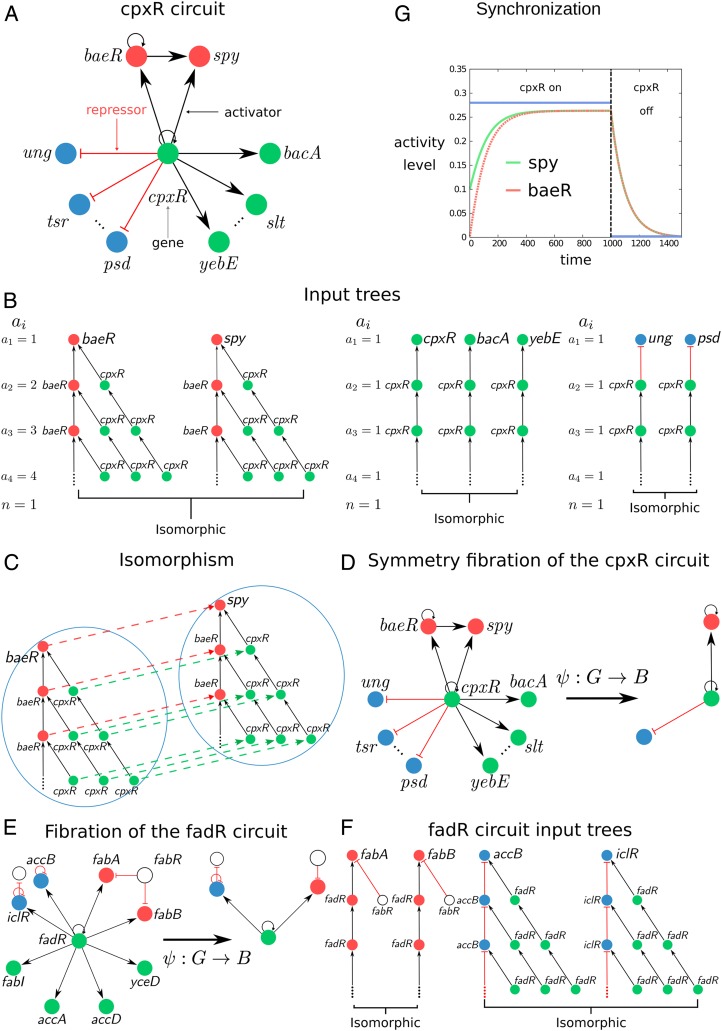
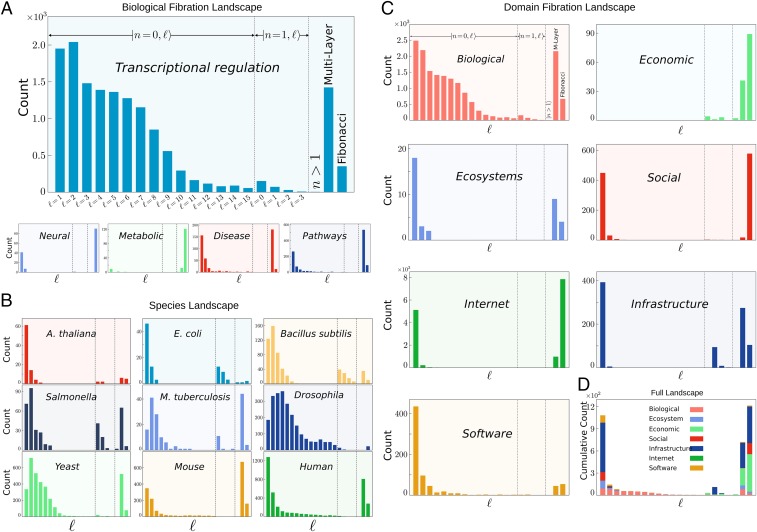
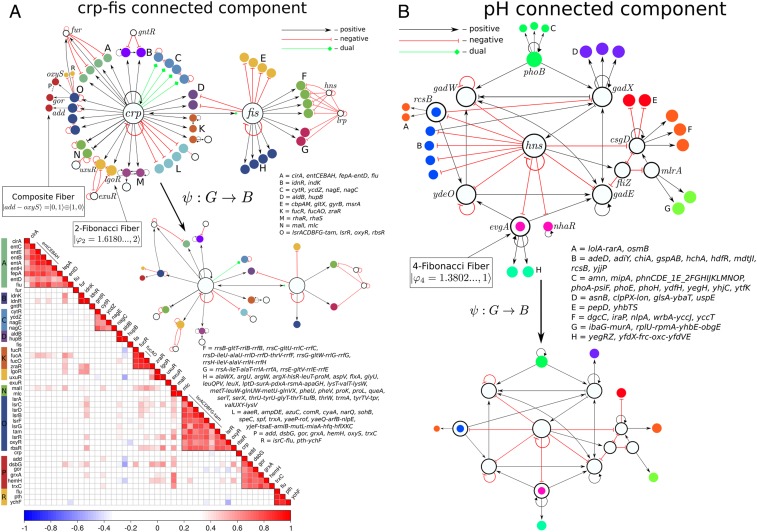
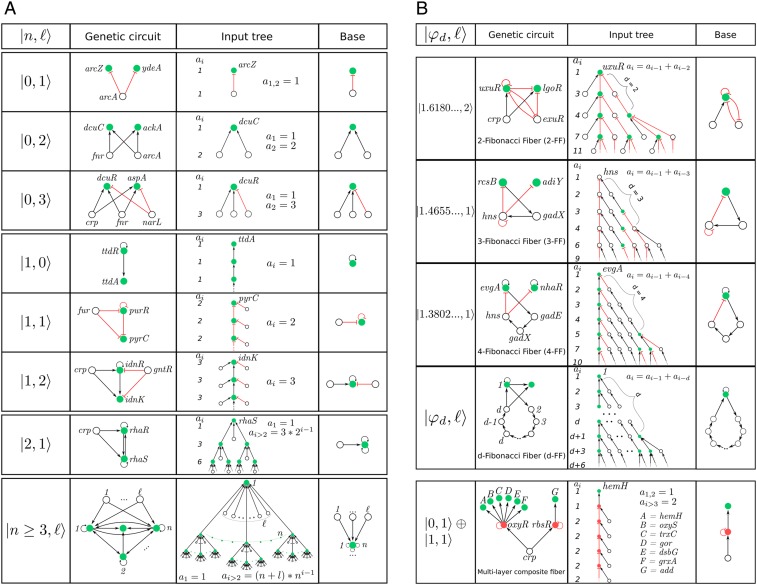
A major ambition of systems science is to uncover the building blocks of any biological network to decipher how cellular function emerges from their interactions. Here, we introduce a graph representation of the information flow in these networks as a set of input trees, one for each node, which contains all pathways along which information can be transmitted in the network. In this representation, we find remarkable symmetries in the input trees that deconstruct the network into functional building blocks called fibers. Nodes in a fiber have isomorphic input trees and thus process equivalent dynamics and synchronize their activity. Each fiber can then be collapsed into a single representative base node through an information-preserving transformation called "symmetry fibration," introduced by Grothendieck in the context of algebraic geometry. We exemplify the symmetry fibrations in gene regulatory networks and then show that they universally apply across species and domains from biology to social and infrastructure networks. The building blocks are classified into topological classes of input trees characterized by integer branching ratios and fractal golden ratios of Fibonacci sequences representing cycles of information. Thus, symmetry fibrations describe how complex networks are built from the bottom up to process information through the synchronization of their constitutive building blocks.
系统科学的主要目标之一是揭示任何生物网络的构建块,以破译细胞功能如何从它们的相互作用中产生。在这里,我们引入了一种信息流的图形表示,作为一组输入树,每个节点一个,其中包含信息可以在网络中传输的所有路径。在这种表示中,我们发现输入树中的对称性非常显著,这些对称性将网络分解为称为纤维的功能构建块。纤维中的节点具有同构的输入树,因此它们处理等效的动力学并同步其活动。然后,通过称为“对称纤维化”的信息保持变换,可以将每个纤维简化为单个代表基节点,该变换由 Grothendieck 在代数几何的上下文中引入。我们在基因调控网络中举例说明了对称纤维化,然后表明它们普遍适用于从生物学到社会和基础设施网络的跨物种和领域。构建块被分类为输入树的拓扑类,其特征是整数分支比和代表信息循环的斐波那契数列的分形黄金比。因此,对称纤维化描述了复杂网络如何通过其组成构建块的同步来构建以处理信息。