Zoological Institute and Museum, Applied Zoology and Nature Conservation, Greifswald University, Loitzerstraße 26, 17489, Greifswald, Germany.
Department of Ecological Science/Animal Ecology, Faculty of Earth and Life Sciences, Vrije Universiteit Amsterdam, Amsterdam, The Netherlands.
Oecologia. 2020 Apr;192(4):979-988. doi: 10.1007/s00442-020-04634-8. Epub 2020 Mar 31.
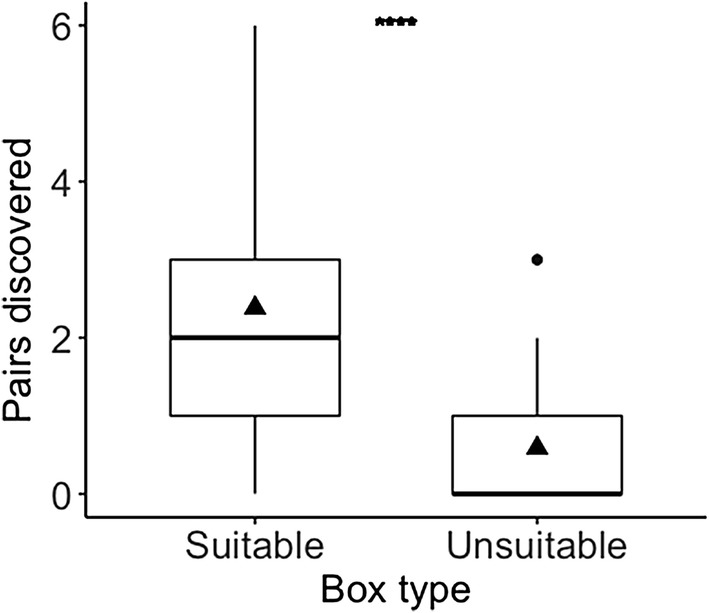
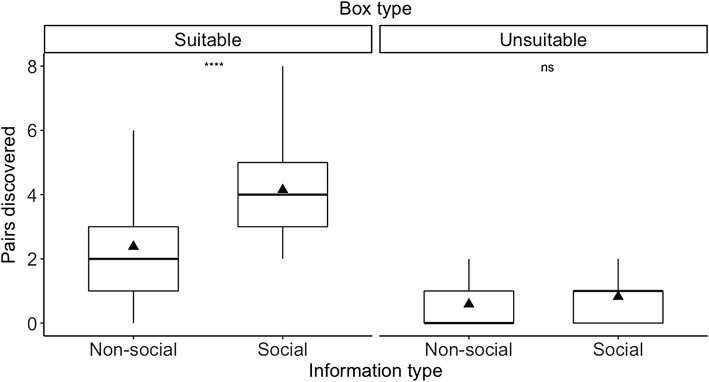
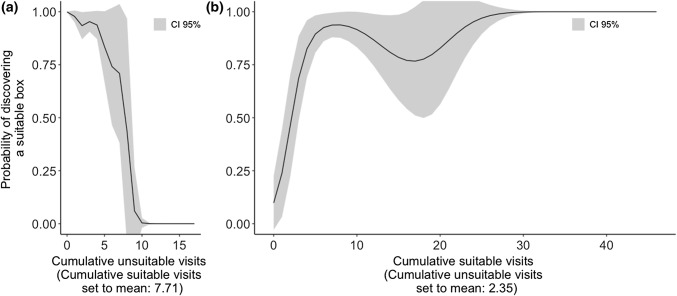
Animals have evolved different cognitive processes to localize crucial resources that are difficult to find. Relevant cognitive processes such as associative learning and spatial memory have commonly been studied in a foraging related context under controlled laboratory conditions. However, in natural environments, animals can use multiple cognitive processes to localize resources. In this field study, we used a pairwise choice experiment and automatic roost monitoring to assess how individually marked, free-ranging Bechstein's bats belonging to two different colonies use associative learning, spatial memory and social information when localizing suitable day roosts. To our knowledge, this study tests for the first time how associative learning, spatial memory and social information are used in the process of roost localization in bats under the natural conditions. We show that, when searching for new roosts, bats used associative learning to discriminate between suitable and unsuitable roosts. For re-localizing previously occupied roosts, bats used spatial memory rather than associative learning. Moreover, bats significantly improved the localization of suitable unfamiliar roosts and tended to increase their accuracy to re-localize previously occupied day roosts using social information. Our field experiments suggest that Bechstein's bats make hierarchical use of different cognitive processes when localizing day roosts. More generally, our study underlines that evaluating different cues under natural conditions is fundamental to understanding how natural selection has shaped the cognitive processes used for localizing resources.
动物进化出了不同的认知过程来定位难以找到的关键资源。在相关的认知过程中,如联想学习和空间记忆,通常在受控的实验室条件下,在与觅食相关的背景下进行研究。然而,在自然环境中,动物可以使用多种认知过程来定位资源。在这项实地研究中,我们使用了成对选择实验和自动栖息地监测,以评估属于两个不同群体的个体标记的自由飞行的巴氏蝙蝠如何在定位合适的日间栖息地时使用联想学习、空间记忆和社会信息。据我们所知,这项研究首次测试了在自然条件下,蝙蝠在栖息地定位过程中如何使用联想学习、空间记忆和社会信息。我们表明,在寻找新的栖息地时,蝙蝠利用联想学习来区分合适和不合适的栖息地。为了重新定位之前占据的栖息地,蝙蝠使用空间记忆而不是联想学习。此外,蝙蝠在使用社会信息来定位合适的陌生栖息地方面显著提高了定位能力,并倾向于提高重新定位之前占据的日间栖息地的准确性。我们的实地实验表明,巴氏蝙蝠在定位日间栖息地时,会分层地使用不同的认知过程。更一般地说,我们的研究强调了在自然条件下评估不同线索的重要性,这对于理解自然选择如何塑造用于定位资源的认知过程至关重要。