Sheffield Alcohol Research Group, School of Health and Related Research, University of Sheffield, Sheffield, UK.
NIHR School for Public Health Research.
Addiction. 2020 Dec;115(12):2268-2279. doi: 10.1111/add.15037. Epub 2020 Mar 31.
When measuring inequalities in health, public health and addiction research has tended to focus on differences in average life-span between socio-economic groups. This does not account for the extent to which age of death varies between individuals within socio-economic groups or whether this variation differs between groups. This study assesses (1) socio-economic inequalities in both average life-span and variation in age at death, (2) the extent to which these inequalities can be attributed to alcohol-specific causes (i.e. those attributable only to alcohol) and (3) how this contribution has changed over time.
Cause-deleted life table analysis of national mortality records.
England and Wales, 2001-16.
All-cause and alcohol-specific deaths for all adults aged 18+, stratified by sex, age and quintiles of the index of multiple deprivation (IMD).
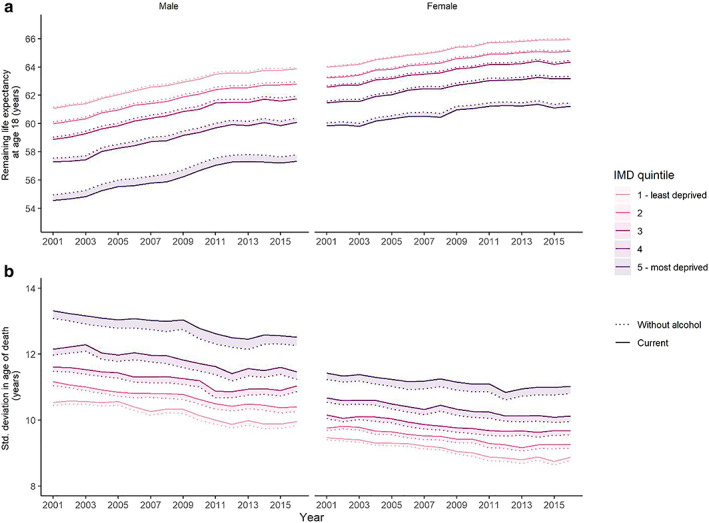
Life expectancy at age 18 yearss and standard deviation in age at death within IMD quintiles and the contribution of alcohol to overall differences in both measures between the highest and lowest IMD quintiles by comparing observed and cause-deleted inequality 'gaps'.
In 2016, alcohol-specific causes reduced life expectancy for men and women by 0.26 and 0.14 years, respectively, and increased the standard deviation in age at death. These causes also increased the inequality gap in life expectancy by 0.33 years for men and 0.17 years for women, and variation in age at death by 0.14 years and 0.13 years, respectively. For both measures, the contribution of alcohol to mortality inequalities rose after 2001 and subsequently fell back. For women, alcohol accounted for 3.6% of inequality in age at death and 6.0% of life-span uncertainty, suggesting that using only the former may underestimate alcohol-induced inequalities. There was no comparable difference for men.
Deaths from alcohol-specific causes increase inequalities in both life expectancy and variation in age of death between socio-economic groups. Using both measures can provide a fuller picture of overall inequalities in health.
在衡量健康方面的不平等时,公共卫生和成瘾研究倾向于关注社会经济群体之间平均寿命的差异。这并没有说明社会经济群体内部个体死亡年龄的差异程度,也没有说明这种差异在群体之间是否存在差异。本研究评估了(1)平均寿命和死亡年龄变化方面的社会经济不平等,(2)这些不平等在多大程度上可以归因于特定于酒精的原因(即仅归因于酒精的原因),以及(3)这种贡献随时间的变化。
全国死亡率记录的死因删除生命表分析。
英格兰和威尔士,2001-2016 年。
所有年龄在 18 岁以上的成年人的全因和酒精特异性死亡,按性别、年龄和多因素剥夺指数(IMD)五分位数分层。
18 岁时的预期寿命和 IMD 五分位数内死亡年龄的标准差,以及通过比较观察到的和死因删除的不平等“差距”,比较最高和最低 IMD 五分位数之间这两个措施的总体差异中酒精的贡献。
2016 年,酒精特异性原因分别使男性和女性的预期寿命缩短了 0.26 年和 0.14 年,并增加了死亡年龄的标准差。这些原因还使男性的预期寿命不平等差距增加了 0.33 年,女性增加了 0.17 年,死亡年龄的变异分别增加了 0.14 年和 0.13 年。对于这两个措施,酒精对死亡率不平等的贡献在 2001 年后上升,随后又下降。对于女性,酒精占死亡年龄不平等的 3.6%和寿命不确定性的 6.0%,这表明仅使用前者可能会低估酒精引起的不平等。男性没有可比的差异。
特定于酒精的死亡原因会增加社会经济群体之间预期寿命和死亡年龄变化方面的不平等。使用这两个措施可以更全面地了解健康方面的总体不平等。